
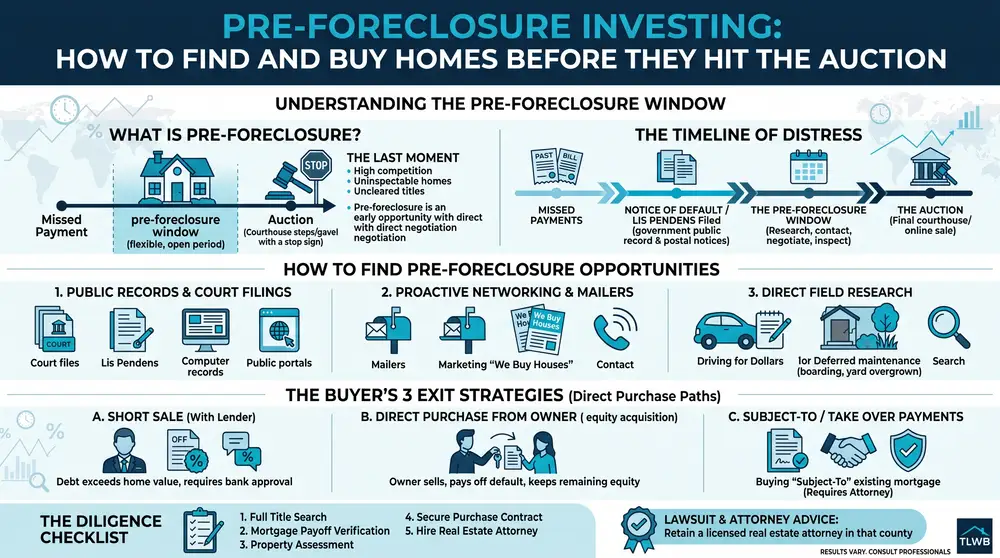
Most investors who chase distressed property start at the wrong end. They compete against cash bidders at the auction and buy a house they could not inspect, with a title they could not fully clear. By then, the most flexible moment to buy has passed. That moment is pre foreclosure: the window between a missed mortgage payment and the foreclosure sale.
Pre-foreclosure is where you negotiate with an owner, see the inside of the house, and order a full title search before you commit a dollar. It is also where the law watches investors most closely, and some of those rules carry criminal penalties.
This guide covers what pre-foreclosure means, how long it lasts in judicial and non-judicial states, where pre-foreclosure lists come from, how property tax delinquency shows up beside mortgage default, the rules that govern contacting owners, and when a short sale makes more sense than a direct purchase. It is the stage that comes before the auctions covered in our post on sheriff sales versus tax sales. It does not cover bidding at those auctions.
Nothing here is legal advice. Retain a licensed real estate attorney in the county where the property sits.
What Pre-Foreclosure Actually Means
Pre-foreclosure is the period after a homeowner defaults on a mortgage and before the property is sold at a foreclosure auction. During this window the owner still holds title and can sell, refinance, reinstate the loan, or negotiate with the lender, which is why investors can buy directly from the owner.
The formal start of pre-foreclosure is usually a public filing: a notice of default recorded with the county in states that foreclose outside court, or a foreclosure complaint and a lis pendens in states that foreclose through the courts. Before that filing, the owner is simply behind on payments, and nothing appears in public records. After the sale, the stage is over and the property belongs to the auction buyer or the lender.
The Pre-Foreclosure Meaning in Plain Terms
Think of it as a countdown with a public start date. The lender has announced, in a document anyone can read, that it intends to sell the house. The owner has shrinking time to fix the problem or get out with whatever equity remains.
Investors care because it is the last point where the owner, not a court or trustee, controls the sale. Once the gavel falls, most of the owner's equity can disappear in an afternoon.
What Pre-Foreclosure Is Not
Most new investors assume a house "in pre-foreclosure" is a discounted listing waiting to be picked up. It isn't. It is a privately owned home with a debt problem. The owner has no obligation to talk to you, many owners cure the default and keep the house, and the lender's balance does not shrink because you showed up.
Pre-foreclosure is also not a tax deed sale or a tax lien auction. Those are government processes triggered by unpaid property taxes, on separate statutes and timelines. They can overlap on the same house, but they are different legal events.
A notice of default is a warning, not a discount.
How Long Pre-Foreclosure Lasts
Pre-foreclosure usually lasts from a few months to more than a year, depending on whether the state forecloses through the courts and how quickly the lender moves. Non-judicial states tend to run on shorter, statute-driven clocks. Judicial states run on court calendars, which are slower and less predictable.
The Federal 120-Day Floor
For most residential mortgages, federal servicing rules set the earliest possible start. Under the Consumer Financial Protection Bureau's Regulation X, a servicer may not make the first notice or filing required for a judicial or non-judicial foreclosure unless the borrower's loan is more than 120 days delinquent, with narrow exceptions such as a due-on-sale violation or joining another lienholder's foreclosure (12 CFR 1024.41(f)).
The same rule adds more delay if the borrower applies for loss mitigation. A complete application during that period generally blocks the first filing until the servicer has decided it, and a complete application received more than 37 days before a scheduled sale generally blocks the sale itself until the review ends. In practice, that means most homeowners are at least four months behind before anything shows up in public records, and many are further behind than that.
Non-Judicial States: Notice of Default to Trustee Sale
In non-judicial states, the loan is usually secured by a deed of trust with a power of sale, and a trustee sells the property without a lawsuit. California and Texas are the textbook examples, and their statutes show how different two non-judicial clocks can be.
California. The trustee must first record a notice of default with the county recorder, and not less than three months must pass before the notice of sale can go out (Civil Code 2924). The notice of sale must then be posted at least 20 days before the sale and published once a week for three consecutive calendar weeks under Civil Code 2924f. The owner can generally reinstate the loan by curing the monetary default up to five business days before the scheduled sale under Civil Code 2924c, and postponements can revive that right.
Texas. For a residence, the servicer must send a notice of default giving the borrower at least 20 days to cure before a notice of sale can be given. The notice of sale must be given at least 21 days before the sale, and sales are held on the first Tuesday of the month between 10 a.m. and 4 p.m. (Texas Property Code 51.002). That is a much shorter statutory runway than California's.
Judicial States: Lis Pendens to Sheriff Sale
In judicial states, the lender files a lawsuit, the court enters a judgment, and an officer of the court, often the sheriff, conducts the sale. Florida's statute is blunt about it: "All mortgages shall be foreclosed in equity" (Florida Statutes 702.01). New York and Illinois also foreclose residential mortgages through the courts.
Some judicial states add their own pre-filing notice. New York, for example, requires a lender or servicer to give the borrower on a home loan at least 90 days' notice before starting a foreclosure action (RPAPL 1304). Illinois gives residential owners a statutory redemption periodThe legally defined timeframe during which a property owner can reclaim their property by paying the delinquent taxes plus interest and penalties. that ends on the later of seven months from service of the complaint or three months from the foreclosure judgment (735 ILCS 5/15-1603). Court backlogs, contested motions, mediation programs and bankruptcy filings can stretch a judicial pre-foreclosure well past a year.
Statutes set minimums, not schedules. Treat the statutory timeline as the fastest a case could move, and confirm the actual status in the county record or court docket every time you act.
Pre-Foreclosure vs. Foreclosure Auction vs. Tax Sale
Pre-foreclosure is a negotiated purchase from the owner, while a foreclosure auction and a tax sale are public sales run by a trustee, court officer or county. That changes who you deal with, what you can inspect, and which debts follow the property.
Factor | Pre-foreclosure | Foreclosure auction (trustee or sheriff sale) | Tax sale (lien or deed) |
|---|---|---|---|
Who sells | The owner, sometimes with lender approval | A trustee or court officer for the mortgage lender | The county or its tax collector |
Triggered by | Mortgage default and a notice of default or lis pendens | Completion of the foreclosure process | Unpaid property taxes |
Price set by | Negotiation, plus lender payoff or short sale approval | Competitive bidding, often with a lender credit bid | Competitive bidding on price, premium or interest rate |
Interior inspection | Usually possible with the owner's consent | Rarely possible | Rarely possible |
Title review | Full title commitment before closing | Your own pre-sale research only | Your own pre-sale research only |
Existing mortgage | Paid off at closing or by short sale | The foreclosed lien is extinguished; senior liens generally survive | Property tax liens generally have priority; effect on mortgages varies by state |
Payment terms | Normal closing, financing possible | Cash or certified funds on short deadlines | Cash or certified funds on short deadlines |
Main legal risk | Equity-purchaser and foreclosure-consultant laws | Surviving liens and occupants | Redemption rights, notice defects, title marketability |
Competition | Other investors mailing the same owner | Live or online bidders | Live or online bidders |
These are not three separate markets. A single house can fall behind on the mortgage, stop paying taxes, and land on both the default records and the delinquent tax list in the same year. The structural difference between tax liens and tax deeds is covered in our tax lien vs. tax deed comparison, and the state-by-state split is in tax lien states vs. tax deed states.
How Tax Delinquency Shows Up Alongside Mortgage Default
Tax delinquency often appears alongside mortgage default because the same financial strain that stops mortgage payments also stops tax payments, and on many loans the two are paid together through escrow. Reading both records together tells you more about the owner's position than either record alone.
Escrowed Loans: The Servicer Pays, Up to a Point
When a federally related mortgage requires an escrow account, the servicer must pay taxes and insurance on time and advance funds if the account is short, as long as the borrower's payment is not more than 30 days overdue (12 CFR 1024.17(k)). Past that point the federal requirement falls away, although many servicers keep paying the taxes anyway to protect their collateral, because delinquent taxes usually become a lien with priority over the mortgage.
The result: on an escrowed loan, you often see the mortgage default first, and the tax record looks clean because the servicer is quietly advancing the money and adding it to the payoff.
Non-Escrowed Loans and Free-and-Clear Homes
Owners who pay their own taxes show a different pattern: the tax delinquency can appear at any point, and sometimes it is the only problem. A home with no mortgage at all never enters mortgage pre-foreclosure, but it can still head toward a tax sale. That path is covered in how to buy property with delinquent taxes, and the lists that track it are in our guide to delinquent property tax lists.
What a Double Default Tells You
When a notice of default and a tax delinquency sit on the same parcel, the owner's distress runs deeper than one missed payment, the payoff keeps climbing with advances, interest and fees, and a second clock may be running, since an unredeemed tax lien certificate or a pending tax deed application can threaten the property on a separate schedule from the mortgage foreclosure.
Redemption amounts. If a third party already holds a tax lien, the redemption amount includes the investor's interest or penalty and changes over the redemption period. Get the current figure from the county.
Subsequent taxesAdditional property taxes that become due after the initial tax lien certificate is purchased. Lien holders may need to pay these to protect their investment.. A lien holder may also pay later years' taxes, called subsequent taxes, which raises what must be paid at closing.
Two defaults are not twice the opportunity.
See How the Tax Side of a Distressed Property Works Mortgage default and tax delinquency run on different legal tracks. Knowing the tax track makes a pre-foreclosure file easier to read. |
How to Find Pre-Foreclosure Lists
Pre-foreclosure lists come from three public sources: notices of default recorded with the county recorder, lis pendens and foreclosure complaints filed with the court clerk, and notices of sale published in newspapers or posted at the courthouse. Paid data services repackage those same records, so learning the free sources first makes you a better buyer of paid data.
Notices of Default at the County Recorder
In non-judicial states, start with the recorder's index. Search by document type, using the label your county uses: "Notice of Default," "Notice of Default and Election to Sell," or a similar title. Many recorders let you search by date range, which is how you build a weekly list of new filings. California recorders, for example, receive the notice of default that Civil Code 2924 requires before any trustee sale.
Lis Pendens Filings in the Court Docket
In judicial states, the foreclosure starts with a complaint, and the lender records a notice of lis pendens to warn buyers that the property is in litigation. Florida's statute, for example, provides that a lawsuit operates as a lis pendens on real property only if a notice is recorded in the county's official records (Florida Statutes 48.23). Search the official records for "lis pendens" and cross-check the case number in the court's online docket to see whether a judgment or sale date has been set.
Notices of Sale and Legal-Notice Publications
Notices of trustee or sheriff sale appear later, in the newspaper of record, on courthouse boards and on many county websites. In Texas, notices of sale are filed with the county clerk under Property Code 51.002. They give you the sale date, but your window may be only weeks long.
Tax Delinquency Lists as an Overlay
Pull the county's delinquent tax roll and match it to your pre-foreclosure list by parcel number. Overlap tells you which owners are in the deepest trouble and which properties may face a tax sale on a separate clock. Our delinquent tax list sourcing guide covers where those rolls live and what each source costs.
Paid Pre-Foreclosure Lists: What You Are Buying
Commercial data services sell pre-foreclosure lists by county or ZIP code. You are paying for aggregation and formatting, not secret information. Check how often the vendor refreshes, whether it removes cured or dismissed cases, and whether it shows document type and recording date so you can verify each lead.
Whatever your source, capture the same fields for every lead:
Parcel number. The APN is the only reliable identifier. Addresses get misspelled and owners' names change.
Document type and recording date. A notice of default, a lis pendens and a notice of sale each mark a different point on the clock.
Lender, trustee or plaintiff. Who controls the payoff and who handles a short sale.
Amount in default. Usually the arrears, not the full balance. Treat it as a floor.
Sale date, if set. A sale date a few weeks out may leave time only for a cash close.
Tax status. Current, delinquent, or already sold as a lien, per the county treasurer.
A list is not a pipeline. A list you have verified at the source is.
How to Vet a Pre-Foreclosure Before You Contact Anyone
Vet a pre-foreclosure by confirming its status in the public record, estimating the payoff, pricing the house, and identifying every lien before you send a single letter. Contacting an owner about a house you cannot actually buy wastes their time and yours.
Status check. Confirm the case is still active: no recorded rescission, dismissal or completed sale.
Lien stack. Run a preliminary title searchAn examination of public records to verify a property's legal ownership and identify any liens, encumbrances, or other claims that may affect the title. for the first mortgage, any second mortgage or home equity line, judgments, HOA liens, municipal code liens, IRS liens and tax liens. Every junior lien must be paid, negotiated or released before you can close with clean title. Our guide on how to find a lien on a property covers where each type is recorded, and the differences between federal tax liens and property tax liens matter here because they behave differently at closing.
Value. Estimate fair market value from recent comparable sales, not from the assessed value on the tax bill, which may lag the market or follow a different formula entirely.
Equity estimate. Subtract the estimated payoff, all junior liens, closing costs, repairs and your required margin from the value. If the number is negative, a direct purchase does not work, and you are looking at a short sale or no deal.
Occupancy. Owner occupancy often triggers equity-purchaser laws, discussed next. A vacant house raises the issues covered in how to buy an abandoned house.
Title complications. A deceased owner or multiple heirs creates the problems described in our post on heirs property.
A hypothetical shows how fast the margin disappears. A house worth $300,000 carries a $210,000 first mortgage, $15,000 in arrears and foreclosure costs, and a $20,000 home equity line. Add $25,000 in repairs and closing costs, and the equity an investor can capture is thin. Use local figures, not these.
The checklist in our tax lien due diligence guide carries over almost entirely; the same due diligence discipline applies whether you buy a lien, a deed or a house from its owner.
The Legal and Ethical Rules for Approaching Distressed Owners
Several states regulate anyone who buys a home from an owner in foreclosure or offers to help that owner avoid it, and violations can void the deal, create civil liability or lead to criminal charges. Before you contact a single owner, know which law applies in your state and have an attorney review your letters and contracts.
These laws exist because of foreclosure rescue fraud, where a "buyer" takes the deed with a promise of a rent-back and later strips the equity. The Federal Trade Commission lists rent-to-buy and equity-skimming schemes among the common mortgage relief scams. Legislatures responded by putting rules on the buyer, not the owner.
Equity-Purchaser Laws
California. The Home Equity Sales Contracts chapter (Civil Code 1695 to 1695.17) applies to a one- to four-unit home that the owner occupies as a principal residence and that has an outstanding recorded notice of default. An "equity purchaser" is anyone who acquires title to that home, with exceptions that include buying it to live in yourself and buying at the foreclosure sale. The contract must follow a prescribed form with specific notices. The owner can cancel until midnight of the fifth business day after signing or 8 a.m. on the day of the trustee sale, whichever comes first. Until it ends, the purchaser cannot take a deed, record documents signed by the owner, encumber the property, or pay the owner. Violations can bring actual damages, attorney fees and, for some violations, at least triple damages, and a criminal conviction can carry a fine of up to $25,000, up to a year in county jail, or both, for each violation. The chapter also makes it unlawful to take "unconscionable advantage" of an owner in foreclosure.
New York. The Home Equity Theft Prevention Act, Real Property Law 265-a, covers sales of owner-occupied one- to four-family homes that are in foreclosure or in default, which the statute defines as two months or more behind on mortgage payments. The New York Department of Financial Services explains that the law gives homeowners disclosures and remedies, including the ability in some cases to cancel or void the sale (DFS home equity theft guidance).
Minnesota. Chapter 325N regulates both foreclosure consultants and "foreclosure purchasers." Contracts with an equity purchaser must be in writing in at least 12-point bold type, and the owner can cancel until midnight of the fifth business day after signing or 8 a.m. on the last day of the redemption period, whichever comes first (Minnesota Statutes chapter 325N).
Illinois. The Mortgage Rescue Fraud Act (765 ILCS 940) is notable for tax lien investors because its definition of "distressed property" reaches one- to six-unit residential property that is in foreclosure, at risk of loss due to nonpayment of taxes, or whose owner is more than 30 days delinquent on a loan secured by the property (765 ILCS 940/5). In Illinois, the tax-delinquent owner is protected too.
Other states have similar statutes under different names. Do not assume your state has none because you have not heard of one.
Foreclosure-Consultant Laws
A separate set of rules covers anyone who offers to help an owner avoid foreclosure. California's definition of a "foreclosure consultant" includes anyone who, for compensation, represents that they will stop or postpone the sale, obtain forbearance, help the owner reinstate, help the owner obtain a loan, or save the residence from foreclosure, among other services (Civil Code 2945.1). At the federal level, the FTC's Mortgage Assistance Relief Services rule bars companies from collecting fees for mortgage relief before delivering results.
The practical point: if your letter says "we can stop your foreclosure" or "we will save your home," you may have stopped being a buyer and started being a regulated consultant. Investors offer to buy. They do not promise rescue.
What Ethical Outreach Looks Like
Say who you are. State that you are a private investor interested in buying the property. Never imply you represent the lender, the court, the county or a government program.
Point to free help. Include a line telling the owner that free, HUD-approved housing counseling is available through HUD's housing counseling page. An owner who can keep the house by reinstating or modifying the loan should know that.
No invented urgency. The real deadline is the sale date. Do not manufacture pressure beyond it.
Encourage independent advice. Tell the owner in writing to talk to their own attorney before signing, and use any notice language your state requires word for word.
Respect "no." Honor do-not-contact requests and the telemarketing and texting rules that apply to your channel.
The best pre-foreclosure investors are the ones an owner's attorney is comfortable dealing with.
Learn the Rules Before You Work the List Distressed-property investing rewards investors who know the statutes before they make contact. Our course covers the legal framework behind tax liens, tax deeds and the sales that sit around them. |
How to Buy a Pre-Foreclosure Home: Step by Step
To buy a pre-foreclosure home, you confirm the stage and sale date, clear the lien picture, reach the owner in writing, verify the payoff with the owner's authorization, choose between a direct purchase and a short sale, sign a contract that complies with state law, and close through a title company before the sale date. Each step below assumes you have an attorney reviewing the documents.
Step 1: Confirm the Stage and the Sale Date
Pull the recorded notice or court docket yourself. Identify whether you are looking at a notice of default, a lis pendens, a judgment or a notice of sale, and note any scheduled sale date. That date controls everything that follows.
Step 2: Run the Title and Lien Review
Order a preliminary title report or run your own search of the recorder and court records. List every encumbrance and lien, the creditor, and an estimated amount. Check the tax collector's records for unpaid taxes or a sold tax lien.
Step 3: Make Contact in Writing
Send a short, plain letter: who you are, that you want to buy, how to reach you, and a reminder that free housing counseling exists. A letter creates a record of exactly what you said.
Step 4: Get the Reinstatement and Payoff Figures
Ask the owner to sign a third-party authorization so the servicer can release loan information to you, or have the owner request the figures directly. You need two numbers: the reinstatement amount (what cures the default) and the payoff amount (what retires the loan). Request payoffs for any second mortgage too.
Step 5: Choose the Deal Structure
If the payoff plus all liens is comfortably below what you can pay, a direct purchase works. If it is above, you either negotiate a short sale with the lender or walk away. The next section compares the two.
Step 6: Sign a Compliant Contract
Have your attorney draft or review the purchase agreement. In states with equity-purchaser laws, the contract may need specific notice language, type size and a cancellation form, and the deal may not close until the cancellation period ends. Build that time into your schedule.
Step 7: Close Through Title or Escrow and Record the Deed
Use a title company or closing attorney who pays the lenders directly and obtains releases. Never hand cash to the owner to "pay the bank." Get owner's title insurance, record the deed, and confirm the sale is cancelled.
The paperwork is the deal.
Short Sale vs. Direct Purchase
A direct purchase pays the owner's lenders in full and works when the owner has equity, while a short sale asks the lender to accept less than the balance and works only when the owner is underwater and the lender agrees. The choice depends almost entirely on the equity estimate from your vetting.
Direct Purchase
In a direct purchase, the closing pays off the mortgage, arrears and other liens, and the owner receives what remains. It is a normal closing with a hard deadline, and it is the structure equity-purchaser laws most often regulate.
Advantages. Faster than a short sale, no lender approval of the price, and a clean payoff of each lien.
Disadvantages. You need enough cash or financing to cover the full payoff, and any mistake in the lien review comes out of your pocket.
Short Sale
A short sale is a sale for less than the amount owed, which the lender approves in exchange for releasing its lien. The owner, usually through a listing agent, submits a hardship package and the offer. The lender orders its own valuation, reviews the file, and approves, counters or rejects. A second lienholder must also agree, and it often asks for a payment to release its lien.
Advantages. It can make a deal possible on a house with no equity, and it can be a better outcome for the owner than a foreclosure.
Disadvantages. Slow and uncertain. The lender may keep the foreclosure moving during review and may or may not waive the owner's remaining balance. Deficiency and tax questions belong to the owner's attorney and tax adviser, not to you.
Our older post on short selling tips and strategies touches on short sales as an investor play. The rule here is simpler: never promise an owner a short sale will stop the foreclosure, and never charge the owner to negotiate one.
Structures That Concentrate Legal Risk
"Subject-to" deals, where you take title while the existing loan stays in place, plus lease-backs and repurchase options, are where foreclosure rescue disputes concentrate. The loan may have a due-on-sale clause, which the 120-day rule itself lists as a separate foreclosure trigger, the owner stays liable on a loan they no longer control, and equity-purchaser statutes target these structures. Have a local attorney structure one before you raise it with an owner.
Cost and Timeline: What to Plan For
A pre-foreclosure purchase costs the payoff of every lien plus normal closing costs, and it takes as long as the slower of the lender's process and your state's cancellation and closing requirements. Costs and timelines vary widely by county, so treat the ranges below as planning assumptions to verify locally.
Acquisition price. The first mortgage payoff, arrears, the lender's foreclosure fees and costs, junior liens, unpaid taxes and HOA dues, plus whatever you pay the owner for their equity.
Closing and legal costs. Title insurance, escrow or attorney fees, recording fees, transfer taxes, and a local attorney's review of the contract. In regulated states, that review is not optional.
Timeline. A direct purchase with clean title can close within weeks of signing, subject to any statutory cancellation period. Short sales commonly take months, and some never close. If the sale date cannot be moved, you may lose the deal regardless of the work you put in.
Talk Through a Deal Before You Commit If a file involves both a mortgage default and a tax delinquency, the order of operations matters. Our team can help you understand how the tax side works before you make an offer. |
What Can Go Wrong in Pre-Foreclosure Deals
Pre-foreclosure deals usually fail because the sale happens first, a lien was missed, the owner cancels, or a legal rule was ignored. Most of these failures are preventable with early title work and a lawyer's review.
The sale goes ahead. Trustees and courts do not wait for investors.
A missed lien. HOA balances, code liens, judgments or federal tax liens can surface late. A full title commitment and title insurance are your protection.
The owner reinstates. A good outcome for the owner, and one you should expect some of the time.
The owner cancels. Statutory cancellation rights mean a signed contract is not a done deal until the period expires.
Bankruptcy. A bankruptcy filing triggers an automatic stay that halts the foreclosure and most collection activity. It can also put the sale of the house under the bankruptcy court's control, which changes who can approve your purchase.
Occupancy and condition surprises. Tenants may have lease rights, and stressed owners often defer repairs. Inspect before you commit.
Regulatory exposure. A non-compliant contract can be challenged years later. California's private action provision allows four years.
For the parallel risks at the auction stage, see the risks of buying tax deed properties.
When Pre-Foreclosure Is the Wrong Strategy
Pre-foreclosure is the wrong strategy when you cannot close quickly, cannot afford legal review in a regulated state, or prefer passive investing to direct negotiation with homeowners. It is a hands-on, relationship-driven business, and many serious investors choose a different stage of the distressed-property cycle instead.
Foreclosure auctions. If you would rather bid than negotiate, our sheriff sale vs. tax sale guide covers deposits, surviving liens and redemption.
Tax lien certificates. For a more passive, interest-driven investment, tax lien certificates let you invest at the county level without negotiating with owners. Start with how to invest in tax liens and the walkthrough of a tax lien certificate auction.
Tax deeds. The complete tax deed investing guide covers buying the property through a government sale, and the quiet title action guide covers what comes after the deed.
Over-the-counterTax liens or tax deeds that were not sold at public auction and are available for purchase directly from the county or taxing authority. and land bank purchases. Some counties sell over-the-counter tax liens after the auction, and unsold tax-foreclosed homes may go to a public land bank, covered in our land bank property guide.
The right stage fits your capital, your schedule and your tolerance for sitting across from a homeowner in trouble. The pros and cons of tax lien investing are a useful comparison point.
Frequently Asked Questions
What is pre-foreclosure?
Pre-foreclosure is the period after a homeowner defaults on a mortgage and before the property is sold at a foreclosure auction. It usually begins publicly with a recorded notice of default or a lis pendens. During this time the owner still holds title and can sell, refinance or reinstate the loan.
How long does pre-foreclosure last?
It typically lasts from a few months to more than a year. Federal rules generally bar the first foreclosure filing until the loan is more than 120 days delinquent, and state law then sets the minimum steps. Non-judicial states such as Texas and California tend to move faster than judicial states such as Florida, New York and Illinois.
How do I find pre-foreclosure lists for free?
Search the county recorder's index for notices of default and lis pendens filings, and search the court docket for foreclosure cases. Notices of sale also appear in the newspaper of record and on many county or sheriff websites. Paid lists use the same public records, so verify each lead at the source.
What is the difference between pre-foreclosure and foreclosure?
Pre-foreclosure is the stage before the sale, when the owner still controls the property and can negotiate. Foreclosure is the completed legal process, ending with a trustee or sheriff sale that transfers the property to the winning bidder or the lender. Once the sale happens, the pre-foreclosure window is closed.
Can you buy a house directly from an owner in pre-foreclosure?
Yes, in most states, as long as the price covers the lender's payoff or the lender approves a short sale. Some states, including California, New York, Minnesota and Illinois, regulate these purchases with specific contract terms, notices and cancellation rights. Have a local attorney review the deal before the owner signs.
Is it legal to contact homeowners in pre-foreclosure?
Generally yes, but what you say is regulated in many places. Promising to stop the foreclosure can make you a regulated foreclosure consultant, and misstating value or terms can violate equity-purchaser laws.
What is a notice of default?
A notice of default is a recorded document stating that the borrower has breached the deed of trust or mortgage and the lender intends to sell. In California, at least three months must pass after recording before a notice of sale. It is the usual starting point of a pre-foreclosure list in non-judicial states.
Is a short sale better than a direct purchase?
Neither is better in general; the equity decides. A direct purchase works when the owner owes less than the house is worth and closes faster. A short sale is for underwater properties and requires lender approval, which is slow and uncertain.
Can a homeowner stop a pre-foreclosure?
Yes, in several ways. The owner can reinstate the loan by paying the arrears and costs, qualify for loss mitigation such as a modification, sell the house, or in some cases file bankruptcy, which triggers an automatic stay. Free HUD-approved housing counselors can explain the options.
Do unpaid property taxes affect a pre-foreclosure purchase?
Yes. Unpaid taxes generally become a lien with priority over the mortgage, so they must be paid at closing, and the redemption amount rises if a third party already holds a tax lien certificateA legal document issued by a government authority when a property owner fails to pay property taxes, granting the certificate holder a lien on the property.. The servicer may also have advanced taxes and added them to the payoff.
Do I need a real estate license to buy pre-foreclosures?
Generally no, not to buy for your own account. Licensing rules can apply if you act for others, such as assigning contracts for a fee or negotiating short sales for an owner. Check your state's rules with a local attorney.
The Window Before the Gavel
Pre-foreclosure and the foreclosure auction can involve the same house, but they are different purchases. At auction you buy from a process. In pre-foreclosure you buy from a person, with an inspection, a title commitment and a negotiated price, under laws written specifically to protect that person from you. Respect that difference and you close deals. Ignore it and you meet the statute's damages provisions.
Next steps:
Pull one month of notices of default or lis pendens filings from one county and verify each against the recorder or court docket.
Overlay the county's delinquent tax roll by parcel number to see which owners face both a mortgage and a tax clock.
Read your state's equity-purchaser and foreclosure-consultant statutes, then have a local attorney review your letter and contract templates.
Build a payoff and lien worksheet so every file goes through the same vetting before you contact anyone.
Decide which stage fits you: pre-foreclosure, foreclosure auction, tax lien or tax deed.
New to distressed property? Start with tax lien investing for beginners and the best states for tax lien investing. To source, use the guide to finding tax lien properties, and weigh the realistic upside in how to make money with tax liens. For Florida property, read how Florida tax deed sales work. Our FAQ page answers common questions, and our success stories show what other investors have done; results vary.
Learn the Distressed-Property Cycle With Other Investors Pre-foreclosure, sheriff sales and tax sales are stages of one cycle. Our live events show how to evaluate properties before you bid or buy. |
EARNINGS DISCLAIMER. Results vary. Tax lien and tax deed investing involves risk, including the potential loss of principal. Past performance is not indicative of future results. Nothing in this article constitutes financial, legal, or investment advice. See our full earnings disclaimer before making any investment decisions. |
Related reading: What Is a Sheriff Sale? Sheriff Sale vs. Tax Sale Explained · Land Bank Properties: What a Land Bank Is and How to Buy Tax-Foreclosed Homes · How to Buy Property with Delinquent Taxes