
Most new investors assume every courthouse auction is the same auction. They see "sheriff sale" on a county website, assume it is the tax sale they read about, and register to bid. They're wrong, and the mistake can leave them owning a house with a surviving mortgage attached.
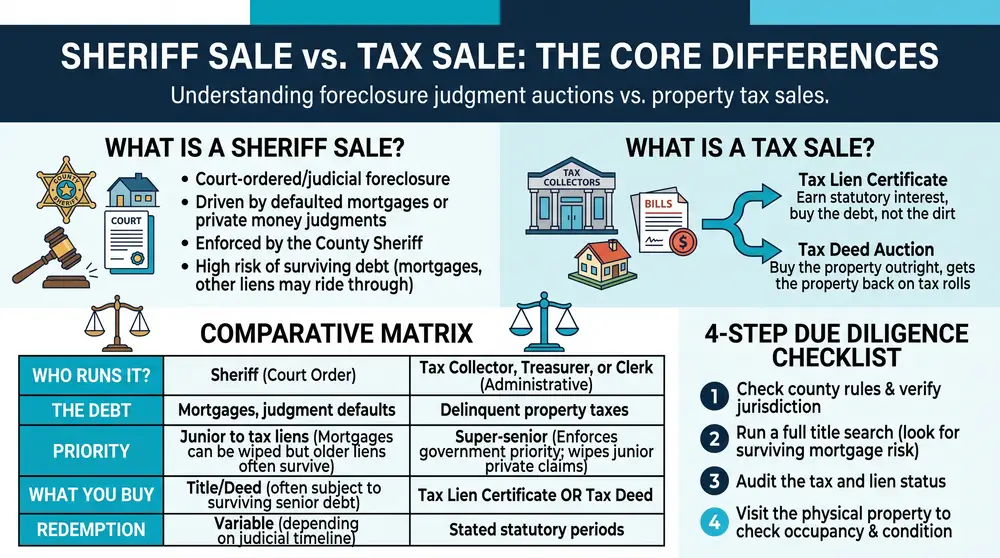
So what is a sheriff sale? It is a court-ordered auction, usually the last step of a mortgage or judgment foreclosure, carried out by the county sheriff. A tax sale enforces unpaid property taxes, and depending on the state it sells either a tax lien certificate or the property itself. Different debt, different priority, different rules about what you actually get for your money.
This post covers who runs each sale, which liens survive, deposits and payment terms, redemption rights, the states where the sheriff also runs the tax sale, and which sale suits which investor. It does not cover bidding strategy. Nothing here is legal advice. Retain a licensed real estate attorney in the county where the property sits.
What Is a Sheriff Sale?
A sheriff sale is a public auction of real property, conducted by the county sheriff under a court order, to satisfy a debt the court has confirmed in a judgment. The most common debt is a defaulted mortgage, but a sheriff sale can also follow a money judgment or, in some states, a tax foreclosureThe legal process by which a lienholder forces the sale of a property to recover the debt owed when the property owner fails to pay. case.
The sheriff is not the creditor, just the officer who carries out the court's order. The plaintiff sets the amount owed, the sheriff runs the auction, the high bidder pays, and the buyer receives a sheriff's deed. Allegheny County, Pennsylvania, explains that the attorney for the lender, taxing body, or judgment holder determines the amount sought, and a third-party bidder may have to open at the judgment plus costs and taxes.
Sheriff sales belong mostly to judicial foreclosure, where a lender must sue and win first. In states that allow nonjudicial foreclosure, a trustee often runs the auction under a power of sale, with no court case. That is why "how do foreclosure auctions work" has no single answer. Verify locally which system your state uses.
What a Tax Sale Is, and Why It Is Different
A tax sale is an auction the government holds to collect delinquent taxes. The creditor is the county or municipality, and the debt usually sits at the top of the priority ladder, ahead of mortgages.
In a lien state, you buy the debt at a tax lien auction, earn statutory interest while the owner has time to pay, and pursue the property only if the owner never redeems. In a deed state, a tax deed sale transfers the property itself. If that's still fuzzy, start with the structural difference between liens and deeds and check which instrument your target state sells.
The office running the tax sale varies: treasurer, tax collector, tax claim bureau, clerk of court, or sheriff. Florida splits the work between the tax collector, who sells certificates, and the clerk, who runs Florida tax deed sales. The office matters less than the statute behind it.
Where the Lines Blur: When the Sheriff Runs the Tax Sale
In some states, a tax foreclosure auction is a sheriff sale. The same office runs mortgage and tax auctions on the same platform, and the listing title alone won't tell you which is which. Pennsylvania and Ohio are the clearest examples.
Pennsylvania
Most Pennsylvania counties sell tax-delinquent property through a county tax claim bureau, not the sheriff, holding an upset sale first and a judicial sale later. Lycoming County's tax sale rules say upset sale properties are sold subject to existing liens, while judicial sales are free and clear of tax and municipal liens, mortgages, and other filed liens.
Philadelphia and Allegheny County work differently. The Philadelphia Sheriff's Office runs two types of sheriff sales: mortgage foreclosure sales and tax sales covering city and school district taxes and water and sewer bills. Allegheny's sheriff also sells property for unpaid county, municipal, and school district taxes alongside its mortgage docket. Same sheriff, very different post-sale rights.
Ohio
Ohio forecloses on tax-delinquent land in court, and the resulting sale is typically a sheriff sale. Summit County holds mortgage sales and delinquent tax sales on separate days through the same office. Cuyahoga County's court FAQ says the minimum bid in a real estate tax case equals the taxes owed plus court costs.
New Jersey: The Contrast
In New Jersey, county sheriffs run mortgage foreclosure sales, but each municipality's tax collector runs the tax sale. According to the state's Division of Local Government Services, certificates can earn up to 18% interest and bidders compete by bidding down the interest rate. Same parcel, two possible auctions, two different offices.
Not sure which sale you're looking at? Reading the statute behind an auction is a skill, not a guess. Our process shows how we confirm the sale type and rules before any capital moves. |
How Sheriff Sales Work, Step by Step
A sheriff sale follows the court case, not the tax calendar. This sequence is typical of judicial foreclosure. Timelines vary by state and county.
Step 1: File the Lawsuit
The borrower defaults, the lender files a foreclosure complaint, and a lis pendens is usually recorded against the title.
Step 2: Obtain Judgment and an Order of Sale
The court enters judgment and orders the sale. Cuyahoga's sheriff assigns a sale date roughly six weeks after receiving the order.
Step 3: Advertise and Auction
The sale is advertised in a legal newspaper and online. Philadelphia, Cuyahoga, and many other counties now auction on third-party platforms. The plaintiff often bids its own judgment, which is why many properties revert to the lender.
Step 4: Pay, Confirm, and Take the Deed
The winner posts a deposit and pays the balance by a deadline. In confirmation states like Ohio, the court then approves the sale. The deed transfers title but not possession. Philadelphia warns that occupied property requires a separate ejectment action.
Sheriff Sale vs. Tax Sale: Side-by-Side Comparison
Every row below has state exceptions. Use it as a map, not a rulebook.
Feature | Sheriff sale (mortgage or judgment) | Tax lien sale | |
|---|---|---|---|
Debt enforced | Mortgage or court judgment | Unpaid property taxes | Unpaid property taxes |
Who runs it | Sheriff under court order (trustee in nonjudicial states) | Treasurer, tax collector, or municipality | Treasurer, clerk, tax claim bureau, or sheriff |
What you buy | The property, via sheriff's deed | A lien certificate earning interest | The property, via tax deedA legal document that transfers property ownership to the government or an investor after the owner fails to pay property taxes for an extended period. |
Opening bid | Judgment plus costs | Taxes, interest, and fees owed | Taxes and costs owed |
Senior liens | Survive | Not applicable | Most private liens wiped; some survive |
Deposit | Fixed amount or percentage of bid | Varies by county | Deposit plus short balance deadline |
Redemption after sale | None to several months, by state | Built in; owner pays you interest | None in most deed states |
Best fit | Experienced cash buyers | Yield-focused, patient investors | Buyers who can clear title |
Which Liens Survive Each Sale
A foreclosure sale wipes out the foreclosed debt and the liens below it. It does not touch the liens above it.
If a second mortgage holder forecloses, the first mortgage survives and you inherit it. Philadelphia's sheriff says it directly: a property sold subject to a mortgage does not come with clean title. Property taxes vary. Bergen County, New Jersey, sells property subject to unpaid taxes, assessments, and recorded encumbrances, while Philadelphia's mortgage sales pay delinquencies through the sheriff's office.
Tax sales start from the opposite end. Because the property tax lien generally outranks mortgages, a completed tax deed usually extinguishes mortgages and junior liens whose holders got proper notice. "Usually" is doing real work there. Pennsylvania upset sales leave mortgages in place, and some easements and municipal charges survive. Many buyers clear title with a quiet title action after a tax deed.
Federal tax liens need their own warning. When a junior federal tax lien is wiped out, the United States generally keeps 120 days to redeem, or the state period if longer, under 26 U.S.C. § 7425(d) and 28 U.S.C. § 2410(c). Run a title search and learn how to find a lien on a property before either auction.
Surviving liens are where buyers lose money. Our training covers reading a title report, spotting senior liens, and pricing them into a bid before auction day. |
Deposits and Payment Terms
Sheriff sales usually demand more cash, faster, than tax lien sales. Rules come from statute, court rule, or county policy, and they change. Examples:
Ohio. For residential property, R.C. 2329.211 sets the deposit by appraised value: $2,000, $5,000, or $10,000. The balance is due within 30 days of the court's confirmation. Summit County lists a $1,000 deposit per delinquent tax case.
New Jersey. Bergen County requires 20% of the bid at the sale, with the balance due within 30 days.
Allegheny County. 10% of the bid is due the day after the sale and the balance by the following Monday.
Philadelphia. Bidders post a deposit before the online auction, fund 10% after winning, and pay the rest within 15 days. Tax sale buyers must also be tax-compliant with the city.
Windows that short rule out most financing. Plan on cash. Default is costly: Philadelphia forfeits the deposit and can bar the buyer from future sales.
Redemption Rights After the Sale
Whether the owner can take the property back depends on the sale type and the state. Never assume.
Mortgage sheriff sales. Many states end the right of redemption at or near the sale. Ohio allows redemption until the court confirms the sale under R.C. 2329.33. New Jersey counties such as Bergen and Mercer allow ten days. Michigan generally gives a residential borrower six months.
Tax sales run by the sheriff. Ohio's R.C. 5721.25 allows redemption until the confirmation entry is filed. Philadelphia is the trap. Under 53 P.S. § 7293, the owner can petition to redeem within nine months of the deed's acknowledgment. The sheriff says this applies when the home was owner-occupied 90 days before the sale, and improvement money spent in that window can be lost. The same office's mortgage sales carry no such right.
Tax lien sales. Here the redemption period is the investment. The owner pays, you collect statutory interest.
The listing says "sheriff sale." The statute decides whether you own it.
Which Sale Suits Which Investor
The right auction depends on your capital, timeline, and tolerance for title risk.
Tax lien certificates suit investors who want yield, smaller entry points, and a passive hold. Most liens redeem, so you are lending, not buying. Start with what a tax lien is and how a tax lien certificate auction runs.
Tax deed sales suit investors who want property, have cash, and can handle title work and occupants. The complete guide to tax deed investing covers the cycle, and the risks of buying tax deed properties covers what goes wrong.
Mortgage sheriff sales suit experienced buyers with larger reserves who can read a title report. Opening bids reflect a loan balance, not a tax bill, so the discount is often thinner than expected, and you usually buy as is with no interior access.
For most people starting out, the tax side is the cleaner entry: smaller debt, stronger priority, published rules. Tax lien investing for beginners lays out the first steps.
Compare the auctions in a live room. At our events we walk through real county listings and separate tax sales from foreclosure sales. |
Frequently Asked Questions
What is a sheriff sale in simple terms?
A sheriff sale is a court-ordered public auction of a property, run by the county sheriff, to pay a debt such as a defaulted mortgage or a judgment. The high bidder receives a sheriff's deed.
Is a sheriff sale the same as a tax sale?
No. A sheriff sale enforces a court judgment, usually a mortgage, while a tax sale enforces unpaid property taxes. The overlap is that in Ohio and parts of Pennsylvania, the sheriff conducts tax foreclosure sales too.
Do mortgages survive a sheriff sale?
Mortgages senior to the one being foreclosed generally survive. The foreclosed mortgage and properly notified junior liens are typically wiped out.
How much deposit do you need for a sheriff sale?
It depends on the state and county. Ohio uses $2,000, $5,000, or $10,000 for residential property based on appraised value, while Bergen County, New Jersey, requires 20% of the bid.
Can the owner get the property back after a sheriff sale?
Sometimes. Ohio allows redemption until confirmation, New Jersey counties allow ten days, and Philadelphia tax sales allow nine months for qualifying owner-occupied homes.
How do foreclosure auctions work online?
You register, post a deposit before the sale, bid during a set window, and pay the balance by the county's deadline. The legal rules match an in-person sale.
Is a tax foreclosure auction riskier than a tax lien sale?
Generally yes. At a tax foreclosure auction you buy the property with its condition, occupants, and surviving liens. A tax lien certificateA legal document issued by a government authority when a property owner fails to pay property taxes, granting the certificate holder a lien on the property. gives you a secured claim most owners redeem with interest.
The Bottom Line: Know Who Holds the Gavel
A sheriff sale enforces a court judgment. A tax sale enforces the tax bill. Sometimes the same sheriff runs both, and the post-sale rules still differ. Before you bid:
Identify the debt being enforced from the court case or tax claim.
Read the county's current conditions of sale.
Order a title searchAn examination of public records to verify a property's legal ownership and identify any liens, encumbrances, or other claims that may affect the title. and list every lien above the foreclosing debt.
Confirm the redemption rules for that sale type.
Have cash positioned before registration closes.
From here, learn how to invest in tax liens, compare the best states for tax lien investing, and build a parcel list from free and paid delinquent tax list sources. For another perspective on online auctions, see United Tax Liens. Questions about a specific county? Contact our team.
Want help choosing the right auction? We help investors pick target counties, decode sale rules, and choose between liens, deeds, and foreclosure sales. |
EARNINGS DISCLAIMER. Results vary. Tax lien and tax deed investing involves risk, including the potential loss of principal. Past performance is not indicative of future results. Nothing in this article constitutes financial, legal, or investment advice. See our full earnings disclaimer before making any investment decisions. |
Related reading: Tax Lien vs. Tax Deed · Risks of Buying Tax Deed Properties · Quiet Title Action After a Tax Deed