
Most people think tax deed investing means buying a house for a few hundred dollars at the courthouse steps and flipping it for six figures. They are half right and completely unprepared. The auctions are real. The discounts are real. But the investor who walks in without a process usually walks out with a landlocked strip of dirt, a demolition bill, or a title so clouded no bank will touch it.
Tax deed investing is one of the oldest ways to buy real estate in America, and it works the same way in most counties: when an owner stops paying property taxes, the county eventually sells the property itself — not a loan against it — to recover what it is owed. The winning bidder gets the deed. Done correctly, you acquire real property at a fraction of market value. Done carelessly, you inherit every problem the previous owner walked away from.
This guide is the version we wish every new investor read first. It covers what a tax deed saleA public auction where the actual ownership of tax-delinquent properties is sold to the highest bidder, transferring the deed to the winning investor. actually is, the three types of deed states, how investors make money, the full process from county list to clear title, and the risks that separate profitable investors from the people who fund their mistakes. If you have not yet nailed down the difference between a tax lien and a tax deed, start there — then come back, because this guide assumes you know which one you are buying.
See tax deed investing done live Reading about auctions is one thing. Watching an experienced investor pull a county list, vet a property, and set a max bid in real time is another. Our live sessions walk through the entire process start to finish. |
What Is Tax Deed Investing?
Tax deed investing is the practice of buying real estate at a government auction after the owner has failed to pay property taxes. The county is not selling you a debt. It is selling you the property. When you win, you receive a tax deed — the legal instrument that transfers ownership from the delinquent owner to you. That single fact is what separates deed investing from lien investing, and it changes everything about your risk, your return, and your timeline.
Property taxes fund schools, roads, fire departments, and county services. When an owner stops paying, the county cannot simply absorb the loss. In deed states, the county forecloses on the delinquency and sells the property at a public auction to convert that unpaid tax bill back into cash. The opening bid is typically the total of the back taxes, penalties, interest, and the cost of running the sale — which is why a property worth $120,000 can open at $9,000.
How a Tax Deed Sale Actually Works
The mechanics are consistent across most deed states. The county compiles a list of properties with delinquent taxesProperty taxes that remain unpaid past the due date, which may result in penalties, interest, and eventually a tax lien being placed on the property. that have aged past the statutory cutoff. It publishes that list — usually in a local newspaper and on the county or a third-party auction site — several weeks before the sale. Investors research the list, register to bid, and post a deposit. On sale day, properties are called one by one and sold to the highest bidder. You pay, you receive the deed, and the former owner's ownership is extinguished. For a deeper look at the same event from the lien side, see how a tax lien certificate auction runs.
The discount is not a gimmick. It exists because the county's only goal is to recover its taxes, not to sell at market value. But the discount also carries the reason it exists: nobody paid the taxes, which often means nobody was maintaining the property, checking the title, or protecting it from other claims. The price reflects that risk, and your job as an investor is to price the risk more accurately than the person bidding next to you.
Tax Deed vs. Tax Lien — Know Which One You're Buying
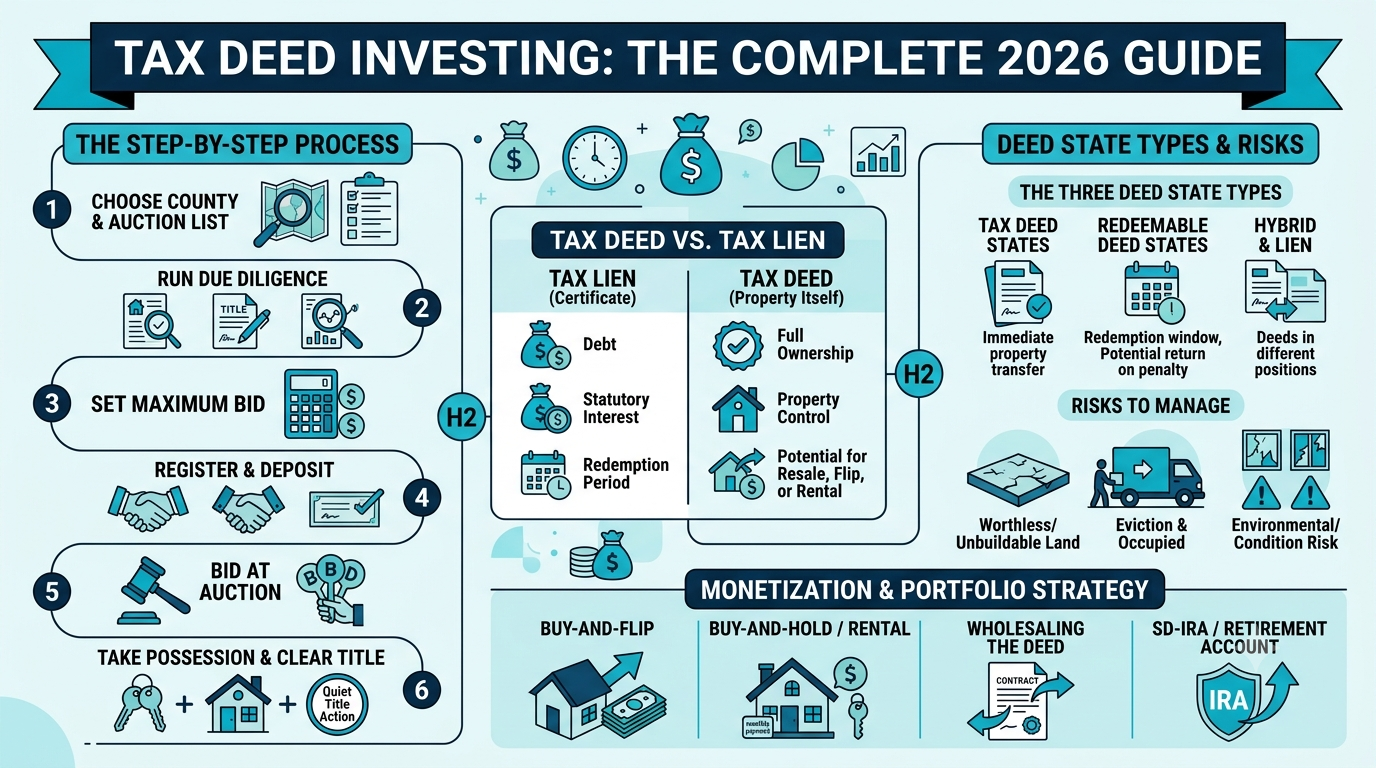
A tax lien is a claim against the property for the unpaid taxes. When you buy a lien, you are not buying the house; you are buying the right to collect the debt plus interest, and if the owner never redeems, the right to eventually foreclose. A tax deed is the property itself. Lien investors are lenders earning a statutory interest rate; deed investors are buyers acquiring real estate. If you want the mechanics of the lien side, our guide to how to invest in tax liens breaks it down, and what a tax lien actually is covers the fundamentals for anyone new to the term.
The distinction matters because it dictates your entire strategy. Lien investing is a yield play — you want your money back with interest. Deed investing is an acquisition play — you want the property, and you need an exit for it. Confusing the two is the single most common beginner mistake, and it is why buying property with delinquent taxes requires a clear answer to one question before you bid: am I here for the interest or the asset?
Why Counties Hold Tax Deed Sales
Counties do not run auctions to help investors. They run them because a property that generates no tax revenue is a liability. Unpaid taxes create a budget hole, and an abandoned or delinquent property drags down the surrounding block. The tax deed sale is the county's mechanism to clear the delinquency, return the property to a paying owner, and put it back on the tax roll. Understanding this motivation is useful, because it tells you exactly how the county behaves: it wants a clean, fast sale that recovers its money, and it structures the auction to make that happen.
This is also why deed sales favor prepared investors. The county publishes the list, sets the rules, and sells as-is with no warranty. It is not going to walk you through the condition of the roof or whether the parcel has legal access to a road. Every protection you get, you build yourself through research. That is the trade for the discount, and it is a fair one — if you do the work.
The Three Types of Deed States
Not every state sells deeds the same way, and the category a state falls into determines your timeline, your return, and your risk. There are three broad models, and knowing which one you are working in is non-negotiable. A quick reference to the best states for tax lien investing will help you see how the map splits between lien and deed jurisdictions.
Tax Deed States
In a pure tax deed state, the winning bidder receives ownership of the property outright at the sale, with no right of the former owner to buy it back afterward. Once the deed is recorded and any short administrative window closes, the property is yours to renovate, rent, sell, or hold. Pure deed states offer the cleanest acquisition path and the fastest timeline, but they also attract the most competition, because everyone understands they are buying real estate at a discount.
Redeemable Deed States
Redeemable deedA tax deed sale where the original property owner retains the right to buy back the property within a specified redemption period. states are a hybrid. You win the property at auction, but the former owner retains a redemption period during which they can reclaim it by repaying what you paid plus a hefty penalty. If they redeem, you do not keep the property — but you collect that penalty, which in some states runs 20 to 25 percent. If they do not redeem, the property is yours. Redeemable deeds behave like a lien and a deed at the same time: you either earn an outsized return or you end up owning the asset, and both outcomes can be profitable.
Hybrid and Lien States (and Where Deeds Fit)
Some states run primarily on liens but convert to a deed process once a lien goes unredeemed and the certificate holder forecloses. In these jurisdictions, the deed is the back end of a lien investment rather than the front-door product. Others operate mixed systems where different counties follow different rules. The practical takeaway is simple: never assume. Read the specific statute for the county you are bidding in, because the label on the state is not always the whole story — and the same investor who profits from making money with tax liens in one state may be buying deeds outright in the next.
Learn the rules state by state Deed states, redeemable states, and lien states each demand a different playbook. Our structured training covers the statutes, timelines, and bidding dynamics for the states investors actually use. |
How Investors Actually Make Money with Tax Deeds
There is no single tax deed strategy. There are several, and the right one depends on your capital, your timeline, and your appetite for hands-on work. The investors who last understand all of them and choose deliberately rather than defaulting to whatever the last podcast told them. For a broader view of how these returns stack up, our breakdown of how tax lien investing yields high profits applies to the deed side as well.
Buy-and-Flip
The classic play. You buy a property well below market at the deed sale, rehab it if needed, and resell it at or near retail. The margin comes from the auction discount minus your repair, holding, and transaction costs. Flipping deeds is the most capital-intensive and hands-on strategy, but it produces the largest single-deal profits when the numbers are right. The discipline is in the underwriting: your profit is made at the purchase, not the sale.
Buy-and-Hold and Rentals
Instead of reselling, you keep the property and rent it. Because your acquisition cost was a fraction of market value, your rental yield on invested capital can be dramatically higher than a conventionally purchased property. This strategy suits investors who want cash flow and long-term appreciation rather than a quick payday, and it pairs naturally with acquiring properties through a retirement account, which we cover below.
Wholesaling the Deed
If you do not want to rehab or hold, you can assign or quickly resell the property to another investor for a smaller but faster profit. Wholesaling deeds requires less capital and less time, but thinner margins and a reliable buyer network. It is a volume game, and it rewards investors who are excellent at sourcing and pricing but would rather not swing a hammer.
Collecting the Redemption Penalty
In redeemable deed states, one of your most reliable outcomes is not owning the property at all. When the former owner redeems, you collect the penalty — a fixed percentage return on the money you laid out, often in a matter of months. Many seasoned investors in redeemable states target this outcome intentionally, treating the penalty as the base case and the property as the upside. It is the closest thing deed investing has to a fixed-income return.
The Tax Deed Investing Process, Step by Step
Every profitable deed purchase follows the same sequence. Skip a step and you are gambling. Here is the process the way disciplined investors run it, and if you want the condensed version, our step-by-step tax lien how-to mirrors much of this workflow on the lien side.
Step 1 — Choose a County and Pull the Auction List
Start by selecting a county whose rules you understand and whose auction calendar fits your schedule. Pull the delinquent property list from the county treasurer, tax collector, or the third-party platform that runs the sale. The list is your universe of opportunities — every decision after this narrows it down. A good list gives you parcel numbers, addresses, assessed values, and the minimum bid.
Step 2 — Run Title and Property Due Diligence
This is where money is made or lost. For every property you might bid on, verify the parcel's location, confirm it has legal road access, check the assessed and market value, review the condition from photos or a drive-by, and research what liens or encumbrances might survive the sale. An IRS lien, a municipal assessment, or an HOA claim can outlive the tax deed and become your problem. Due diligenceThe research and investigation process an investor conducts before purchasing a tax lien or tax deed to evaluate the property and assess risk. is not optional and it is not fast — budget real time for it, because the list is full of traps priced to look like bargains.
Step 3 — Set Your Maximum Bid
Before the auction, decide the absolute most you will pay for each target property and write it down. Your max bid is market value minus repairs, holding costs, closing costs, a title-clearing budget, and your required profit margin. The number you calculate at your desk is the number you obey in the room. Auctions are engineered to make you emotional; your pre-set maximum is the only thing that keeps you disciplined when someone bids against you.
Step 4 — Register and Fund Your Deposit
Counties require you to register before the sale and, in most cases, post a deposit or show proof of funds. Registration deadlines are firm and vary by county. Handle this early — investors miss auctions every year because they underestimated the paperwork or the funding window. Confirm the accepted payment methods and the deadline to pay in full after you win, which is often same-day or within 24 to 48 hours.
Step 5 — Bid at the Auction
On sale day, properties are called and sold to the highest bidder. Stick to your list and your maximums. Do not chase a property past your number because you have fallen in love with it, and do not let a fast-talking auctioneer or an aggressive competitor pull you into an overpay. The best investors lose most of the auctions they attend — they only win the ones that hit their numbers, and they are perfectly comfortable walking away with nothing.
Step 6 — Take Possession and Clear Title
After you win and pay, the county issues the deed. In pure deed states, ownership transfers quickly; in redeemable states, you wait out the redemption window. To sell or finance the property with confidence, you will usually need to clear title — often through a quiet title actionA lawsuit filed to establish clear ownership of a property and resolve any disputes or claims against the title. that removes the cloud left by the tax sale. Only then can you get title insurance and a clean resale. This step is routine but essential, and skipping it is how investors end up owning property they cannot sell.
Understanding Liens, Redemption, and Clear Title
The deed you receive at a tax sale is real, but it is not automatically a marketable title. Understanding what carries over and what gets wiped out is the difference between a clean asset and a legal headache.
What Survives a Tax Deed Sale
A tax deed generally extinguishes the mortgage and most junior liens against the property, which is a large part of why the discount is possible. But not everything disappears. Certain government claims — most notably federal tax liens within their redemption window, some municipal assessments, and specific code-enforcement liens — can survive. Easements and legitimate deed restrictions also remain. Knowing your state's rules on survival is core due diligence, and it is exactly the kind of detail our page on how the process works is built to demystify.
Quiet Title Actions
A quiet title action is a court proceeding that confirms your ownership and clears competing claims, producing a title a buyer's lender and title insurer will accept. In many states it is the standard final step after a tax deed purchase. It costs money and takes time — commonly a few months and a modest legal bill — but it converts a discounted, uninsurable parcel into a fully marketable property. Budget for it in every deal where you intend to resell or refinance.
Risks Every Tax Deed Investor Must Manage
Tax deed investing is not passive and it is not risk-free. The discount exists because the risk is real. The good news: nearly every major risk is knowable in advance and manageable with disciplined due diligence. Here are the ones that catch new investors.
Worthless or Unbuildable Land
The most common trap is a parcel that looks cheap because it is nearly useless — a sliver of land with no road access, a lot in a floodway, wetlands that cannot be developed, or a parcel too small to build on. These show up on every list at tempting prices. Verify zoning, access, and buildability before you bid. A $2,000 lot you can never sell is not a bargain; it is a $2,000 loss plus years of tax bills.
Occupied Properties and Eviction
A property can be occupied by the former owner or a tenant when you take title. Removing occupants is a legal process that varies by state and can take time and money. Factor potential eviction costs and timelines into your underwriting, and never assume a property is vacant just because the taxes went unpaid.
Environmental and Condition Risk
You are buying as-is, sight-unseen-inside in most cases. A property can have a failed foundation, fire damage, mold, or environmental contamination that dwarfs its value. Drive the property when you can, study every available photo, and price conservatively for condition. When you cannot inspect the interior, assume the worst reasonable case and bid accordingly.
Don't underwrite a deal alone Vetting a property before you bid is a skill, not a checklist you can wing. Our team helps investors build a repeatable due-diligence process so the parcels that look like bargains actually are. |
Where Tax Deed Auctions Happen and How to Find Them
You cannot bid on what you cannot find, and sourcing is a skill in its own right. Tax deed auctions are run at the county level, which means there is no single national calendar or marketplace — you assemble your own pipeline county by county. The investors who consistently find good deals are simply better organized about where they look and when.
County Sources and Third-Party Platforms
Every deed sale traces back to the county treasurer, tax collector, or clerk. Many counties still publish the delinquent list in a local newspaper of record and on their official website weeks before the sale. Increasingly, though, counties outsource the auction itself to third-party online platforms that host the bidding, collect deposits, and process payment. Learn which platform your target counties use, create your accounts early, and read the platform-specific rules — deposit deadlines, bid increments, and payment windows differ from one system to the next. If you are still building the underlying knowledge, the beginner's roadmap is a good place to anchor before you start pulling lists.
Timing Your Research Around the Auction Calendar
Deed sales run on a schedule, often annually or a few times a year per county, and the list drops on a predictable cadence. The window between publication and sale is your research runway — sometimes several weeks, sometimes only a few. Build a calendar of the counties you follow and their typical sale dates so you are never scrambling. The best parcels get the most attention, so the discipline is to research broadly, shortlist quickly, and be fully prepared before registration closes. Pairing deed research with steadier lien income keeps your capital productive between sales, which is part of why so many investors run both strategies side by side and lean on resources like which states favor deed buyers to decide where to focus.
A Closer Look at the Redemption Penalty
In redeemable deed states, the penalty is the mechanism that makes the strategy work, and it deserves more attention than most new investors give it. Unlike simple interest that accrues day by day, a redemption penalty is typically a flat percentage applied the moment the deed is issued. If a state carries a 20 percent penalty and the owner redeems one month later, you still collect the full 20 percent — an annualized return that would be extraordinary in any other fixed-income context. That asymmetry is why experienced investors in these states often prefer redemption to ownership.
The trade-off is that you do not control the outcome. The former owner decides whether to redeem, and you must be equally comfortable with both results: collecting the penalty or keeping the property. That is why underwriting a redeemable deed means underwriting the property itself, not just the penalty math — because if the owner walks away, that parcel becomes your asset, and every due-diligence rule above still applies. Think of the penalty as the floor and the property as the ceiling, and only bid when both outcomes work in your favor.
How Much Money Do You Need to Start?
Less than most people assume, and more than the get-rich-crowd admits. Tax deed prices range from a few hundred dollars for raw land to tens of thousands for a house in a competitive market. Beyond the winning bid, budget for due diligence, the title-clearing process, any repairs, holding costs, and a cash reserve for surprises. A realistic first-deal budget in many markets sits in the low five figures once you account for everything, though rural land can be entered for far less. The math only works one way: know your all-in cost before you bid, not after. If you are still weighing whether this fits your situation, our resource for investors who are just starting out lays out realistic entry points.
Building a Repeatable Tax Deed Strategy
A single good deal is luck. A repeatable process is a business. The investors who build real portfolios treat deed investing as a system: they specialize in a handful of counties, learn those rules cold, run the same due-diligence process on every parcel, and stick to strict bidding discipline. They track every deal, learn from every miss, and reinvest profits into the next cycle. They also diversify — pairing occasional deed acquisitions with steadier lien income so their capital is never idle.
Specialization beats spreading yourself thin. Knowing three counties deeply will out-earn dabbling in twenty. Over time, you develop an edge: you recognize which neighborhoods hold value, which parcels hide problems, and where competition is thin. That edge is the whole game, and it compounds. The real student success stories that come out of this approach share the same trait — a process, run consistently, not a lucky swing.
Discipline also means tracking outcomes honestly. Log every property you research, every bid you place, and every deal you win or walk away from. Note why you passed and whether that judgment held up. Over a few auction cycles this record becomes your most valuable asset — a private database of what works in your markets that no course can hand you. The investors who plateau are usually the ones who never review their own decisions; the ones who scale treat each cycle as data. Reinvest your first profits into better research tools and a small reserve, and let the results compound rather than cashing out early.
Tax Deed Investing in a Self-Directed Retirement Account
One of the most powerful and least-used moves in deed investing is buying through a self-directed retirement account. When you acquire property inside a self-directed IRA, the rental income and resale profits can grow tax-deferred or tax-free depending on the account type. The rules are strict — the property must be a genuine investment, you cannot use it personally, and all expenses and income must flow through the account — but for long-term investors the tax treatment is a serious edge.
This strategy suits buy-and-hold investors especially well, since the tax advantages compound over years of rental income. It is not for everyone, and it demands a qualified custodian and careful compliance, but it belongs on the radar of any serious deed investor. Investors who also hold tax-free bonds and other tax-advantaged assets often find deed investing inside an IRA slots neatly into a broader tax-efficient plan.
Frequently Asked Questions
Is tax deed investing profitable?
It can be, but the profit is not automatic. Investors make money through the gap between the discounted auction price and the property's real value, whether they flip, rent, wholesale, or collect a redemption penalty. Profitability depends entirely on due diligence and bidding discipline. Overpay or skip your research, and the discount evaporates. For context on realistic returns, see our guide on what real tax lien returns look like.
Do I actually own the property after a tax deed sale?
In a pure deed state, yes — you own it once the deed is recorded and any administrative window closes. In a redeemable deed state, you own it subject to the former owner's right to redeem during the statutory period; if they redeem, you collect a penalty instead of keeping the property. Always confirm which type of state you are bidding in.
What happens to the mortgage on a tax deed property?
A tax deed generally extinguishes the mortgage and most junior liens, which is why the properties sell at a discount. However, certain government liens can survive, so verify what carries over in your specific state before you bid.
How is a tax deed different from a tax lien?
A tax lien is a claim you buy for the right to collect the unpaid taxes plus interest; a tax deed is the property itself. Lien investing is a yield strategy, deed investing is an acquisition strategy. Our full comparison of tax liens and tax deeds covers the distinction in detail.
Do I need to clear title before I can sell?
Usually, yes. A tax deed is real but often not marketable until you clear title, commonly through a quiet title action. Only then can you get title insurance and a clean resale that a buyer's lender will accept. Budget for this step in every deal you intend to resell.
Can I inspect the property before the auction?
Rarely the interior. Most properties sell as-is with only exterior access. You can drive by, review photos, and research public records, but assume you will not get inside. Price conservatively for condition when you cannot inspect.
How much money do I need to get started?
It varies widely. Raw land can start in the hundreds; houses in competitive markets run into the tens of thousands. Beyond the bid, budget for due diligence, title clearing, repairs, and reserves. A realistic first-deal budget in many markets is in the low five figures.
Can I use retirement funds to buy tax deeds?
Yes, through a self-directed retirement account with a qualified custodian. Income and gains can grow tax-advantaged, but the compliance rules are strict — the property must be a genuine investment you do not use personally. It is a strong fit for buy-and-hold investors.
What is the biggest mistake new tax deed investors make?
Skipping due diligence and bidding on a property that looks cheap but is worthless — no road access, unbuildable land, or a surviving lien. The second biggest mistake is overbidding in the heat of the auction. Both are avoidable with a written process and a firm maximum bid.
Is tax deed investing the same in every state?
No. States fall into pure deed, redeemable deed, and lien-based categories, and even counties within a state can differ. Never assume the rules — read the statute for the exact county where you plan to bid. This single habit prevents most costly surprises.
How long does it take to profit from a tax deed?
It depends on the strategy and the state. In a redeemable state, a penalty can pay out in months if the owner redeems. A flip might take several months to rehab and resell. A buy-and-hold generates rental income for years. There is no fixed timeline — match your capital and patience to the strategy, and read our how-to-invest guide for how the timelines compare.
Do I need a real estate license to invest in tax deeds?
No. You are buying property for your own account, not representing others in a transaction, so no license is required. You will, however, benefit from professional help for title clearing and, in some cases, closings. If you want structured guidance, we offer hands-on help for investors building a process.
Where can I learn the process hands-on?
The fastest way to shorten the learning curve is to watch experienced investors do it and follow a structured curriculum. Explore the TLWB blog for written guides, or get in touch through our contact page to talk through your goals.
Conclusion: Turning Tax Deeds into a Real Portfolio
Tax deed investing rewards preparation and punishes shortcuts. The discounts are real, the properties are real, and the opportunity is genuine — but so is the risk, and the two are inseparable. The investor who wins is not the one with the most capital or the boldest bids. It is the one who pulls the list, does the work, sets a maximum, and walks away when the numbers do not fit. Do that consistently, across a few counties you know cold, and deed investing stops being a gamble and becomes a business. To see how it fits alongside the lien strategies we teach, meet the team behind Tax Lien Wealth Builders and dig into our FAQ page for the questions we hear most.
If you want to go deeper, the fundamentals of the lien side complement everything here — many of our investors run both, and the online training at United Tax Liens is a useful companion for anyone building a nationwide strategy where live events cannot reach every market.
Ready to buy your first tax deed? The gap between reading about deed sales and actually winning one is a real process — and it is learnable. Join a live session, watch it done end to end, and build the skills to bid with confidence. |
EARNINGS DISCLAIMER Results vary. Tax deed investing involves risk, including the potential loss of principal. Past performance is not indicative of future results. Nothing in this article constitutes financial, legal, or investment advice. See our full earnings disclaimer before making any investment decisions. |
Related reading: Tax Lien vs. Tax Deed · Buying Property with Delinquent Taxes · How to Invest in Tax Liens · Tax Lien Wealth Builders home