
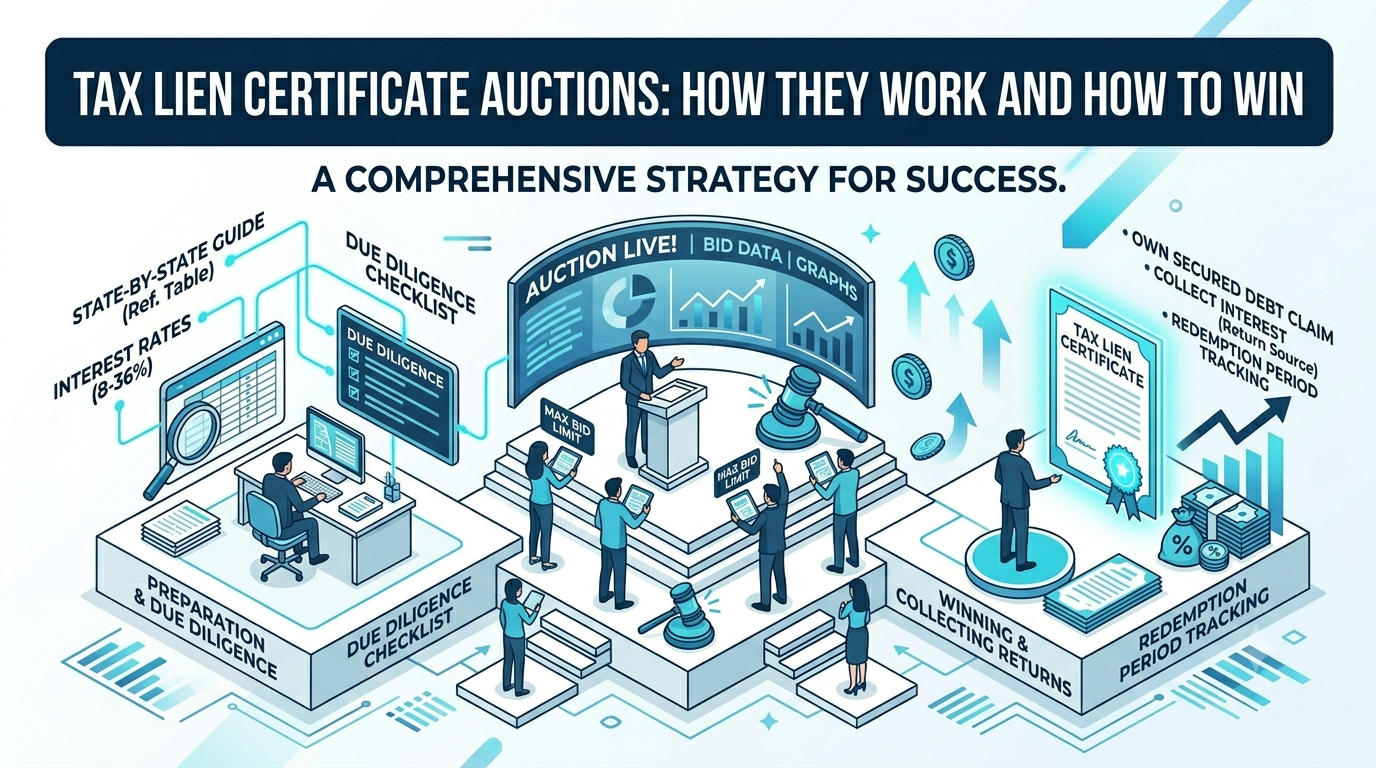
Most investors who look into tax lien investing eventually land on the same question: how does the actual auction work? What are you bidding on, how do you set your number, and what separates the investors who consistently walk away with good certificates from the ones who overpay?
The auction is where the strategy either holds or falls apart. Understanding the format before you register is not optional — it shapes every decision you make from the moment bidding opens.
This guide covers everything you need to know about tax lien certificateA legal document issued by a government authority when a property owner fails to pay property taxes, granting the certificate holder a lien on the property. auctions: the formats counties use, how to prepare, and the bidding approach that produces consistent results.
Foundation First If you're still learning how tax lien certificates work before the auction, start with our full guide on the strategy. |
What Is a Tax Lien Certificate Auction?
A tax lien certificate auction is a public sale run by a county or municipality where investors bid to purchase the government's right to collect delinquent property taxes. When a property owner fails to pay their property taxes, the local government places a tax lien against the property. Rather than waiting for the owner to pay or immediately foreclosing, most tax lien states sell that lien to private investors.
The investor who purchases the lien receives a tax lien certificate — a legal document confirming their position as the holder of the government's claim. That claim carries a senior lien position, ahead of most other creditors including mortgage holders.
The property owner retains possession and has a redemption period — defined by state law, typically one to three years — to repay the investor the face value of the lien plus statutory interest. If they pay, the investor earns their return and the certificate is retired. If they do not pay by the deadline, the certificate holder gains the right to file for tax lien foreclosure, which can ultimately transfer ownership of the property.
How Tax Lien Auctions Are Structured
Not all tax lien auctions work the same way. The format determines how bidding works, how competitive the auction will be, and what your target return should be going in. There are three primary structures.
Bid-Down Interest Auctions
In a bid-down interest state, the statutory rate is the ceiling. Investors start at that ceiling and bid it down. The investor willing to accept the lowest interest rate wins the certificate.
Florida is the most prominent example. The statutory ceiling is 18%, with a guaranteed minimum of 5% regardless of how low the winning bid is. Competitive Florida auctions on desirable properties regularly settle between 5% and 8%. Investors who show up expecting 18% because that is the statutory rate will be outbid immediately.
Arizona uses a similar format. Understanding where competitive rates actually settle in your target county — not just the statutory ceiling — is part of pre-auction research.
Bid-Up Premium Auctions
In a bid-up premium state, investors bid above the face value of the lien. The interest rate is fixed by statute; the variable is the premium. The investor willing to pay the highest total amount (face value + premium) wins.
New Jersey is the primary example, with statutory rates set by state law and competitive auctions often resulting in significant premiums over the face amount. The premium itself earns no interest — only the face value does — which means high premium bids compress the effective return substantially. Calculate your effective return on the face value only, not the total amount you paid.
Random Selection / Rotational Auctions
Some counties use rotational or random selection systems rather than competitive bidding. Every investor who registers receives the same statutory rate, and certificates are allocated by rotation or lottery. Returns are predictable and competition is minimal — but inventory is also limited to what is left after the rotation.
Iowa is the most commonly cited example. For investors who value consistency over maximizing competitive advantages, rotational counties can produce reliable returns with minimal auction pressure.
Not Sure Which States Use Which Format? Our guide to the best states for tax lien investing breaks down auction formats, statutory rates, and redemption periods by state. |
Online Auctions vs. In-Person Auctions
The shift to online platforms has changed tax lien investing significantly. Platforms like RealAuction and Bid4Assets host auctions for counties across the US, removing geographic barriers that previously limited competition to local investors.
The upside: you can bid on certificates in Florida, Arizona, and New Jersey from your desk without traveling. The downside: every other investor can do the same. Online auctions in high-demand states attract institutional bidders, hedge funds, and experienced individual investors — all competing for the same inventory.
In-person auctions at smaller or rural counties remain less competitive. Investors who are willing to attend physically often find better rates and more available inventory than comparable online markets in the same state. The tradeoff is time and logistics — but for investors building a serious tax lien portfolio, in-person auctions can deliver better risk-adjusted returns.
A practical middle ground: identify counties that offer online registration but lower overall competition due to smaller inventory or less desirable property types. These exist in most tax lien states and are worth identifying through pre-auction research.
How to Prepare Before the Auction
Preparation is what separates profitable auction outcomes from costly ones. The work happens before the first bid, not during.
Step 1 — Identify the Auction Type
Confirm the state classification (lien vs. deed vs. hybrid), then confirm the county's specific auction format. The same state can have counties using different bidding mechanisms in rare cases — always verify with the county directly, not just state-level resources.
Step 2 — Pull the Property List Early
Most counties publish a list of available properties and lien amounts before the auction. Pull this list as early as it is available — ideally two to three weeks before the sale date. The list allows you to identify which properties you want to research and which to skip entirely based on initial screening criteria (property type, lien amount relative to assessed valueThe dollar value assigned to a property by a local tax assessor for the purpose of calculating property taxes., location).
Step 3 — Research Every Property You Plan to Bid On
For each property you are considering: look up the assessed value and most recent market sales in the area (county assessor records), check for additional encumbrances (especially federal tax liens via PACER), review satellite imagery for obvious condition issues, and confirm there are no active bankruptcies against the owner.
The core question: if this owner never redeems, is this property worth more than my total costs — certificate purchase, holding costs, and potential foreclosure expenses? If the answer is clearly yes, the certificate has real collateral backing. If the answer is uncertain or no, pass on it. There will be other opportunities.
For a more detailed walkthrough of the due diligenceThe research and investigation process an investor conducts before purchasing a tax lien or tax deed to evaluate the property and assess risk. process for delinquent tax properties, see our guide on buying property with delinquent taxes.
Step 4 — Register and Fund Your Account
Registration deadlines are real. Online platforms typically close registration several days before the auction. In-person counties require showing up with the required documentation and deposit. Missing the registration window means missing the auction.
Know your total capital budget before registering. Decide in advance: how many certificates do you want to win, at what maximum total amount, and at what minimum acceptable rate? These are not decisions to make under auction pressure.
Bidding Strategies That Actually Work
Strategy at auction comes down to discipline — having pre-set numbers and sticking to them regardless of competitive pressure.
Set a Floor — Not Just a Ceiling
Most investors set a maximum bid (the highest premium they will pay, or the lowest interest rate they will accept). Fewer set a floor — the minimum return they actually need to make the investment worth the capital commitment and risk. Your floor should be based on your realistic cost of capital and the opportunity cost of money tied up for one to three years.
In Florida, for example, many serious investors will not bid below 10–12% even though competitive auctions settle lower. For them, winning at 7% is not a success — it is a pass. Knowing your floor in advance prevents you from winning certificates that do not meet your investment criteria.
Avoid Competitive Clusters
In online auctions especially, you can observe bidding activity in real time. Properties that attract heavy early competition are often desirable for reasons other investors have already identified — but they are also where returns get compressed the most. Investors who build profitable tax lien portfolios over time learn to find properties where competition is lighter, often because the property type or location is less obvious to new bidders.
This does not mean avoiding good collateral — it means identifying good collateral that fewer investors have found. Smaller liens on residential properties in modest-demand areas often offer better risk-adjusted returns than large liens on highly desirable properties.
Focus on Collateral Quality, Not Just Rate
Rate is what you earn if the owner redeems. Collateral is what protects you if they do not. The most important variable at auction is not the interest rate — it is whether the property securing your certificate is worth more than your total potential costs if you end up initiating foreclosureThe legal process by which a lienholder forces the sale of a property to recover the debt owed when the property owner fails to pay..
An 18% certificate on a property worth $5,000 and a $4,000 lien balance is not a good investment. A 9% certificate on a property worth $80,000 and a $3,000 lien balance is. The rate is secondary to the collateral math.
Learn Auction Strategy at a Free Live Event Tax Lien Wealth Builders runs free educational events across the US that walk through real auction examples, bidding frameworks, and due diligence processes with experienced instructors. |
What Happens After You Win a Tax Lien Certificate?
Winning at auction is the start, not the finish. Here is what follows:
Certificate issuance. The county issues your tax lien certificate — physical or digital depending on the county. Keep this document. It is your legal proof of the lien.
Recording. Some counties require you to record the certificate with the county recorder. Others record it automatically. Verify the requirement for your county.
Monitoring the redemption periodThe legally defined timeframe during which a property owner can reclaim their property by paying the delinquent taxes plus interest and penalties.. Track the redemption deadline. Set calendar alerts. Monitor for bankruptcy filings against the property owner, which would trigger an automatic stay on foreclosure activity.
Subsequent tax payments. In many states, if subsequent year taxes go unpaid, you can purchase those liens too — which protects your senior position and increases the total balance the owner must repay. This is called 'subsequent taxing' or 'subsequent accrual.' Check your state's rules.
If redemption occurs. The county notifies you, you receive payment, and the investment is complete. Your return is the statutory interest on the face amount from purchase date to redemption date.
If no redemption. You have a defined legal window after the redemption period expires to file for tax lien foreclosure. This window also has a deadline. If you miss it, you can lose your rights. The foreclosure process requires an attorney in most states and takes several months to a year or more depending on the jurisdiction.
Common Mistakes at Tax Lien Auctions
These are the errors that consistently show up among investors who lose money in auctions that should have been profitable.
Skipping property research. The auction moves fast. Investors who arrive without having researched individual properties end up either passing on everything or overbidding on properties they do not understand. Research is done before the auction, not during.
Confusing face value with total costs. Your certificate purchase price is not your only cost. Holding costs, potential foreclosure attorney fees, court filing fees, and any senior encumbrances you discover post-purchase all affect your actual return.
Assuming redemption always happens. Most liens redeem — but not all. Buying a certificate on a property in poor condition or a declining market without accounting for the possibility of foreclosure is a mistake that surfaces when redemption does not come.
Bidding emotionally at auction. Competitive formats create pressure to keep bidding. Investors who have not set firm pre-auction limits consistently win certificates that do not meet their return requirements. Your pre-set numbers are your discipline — follow them.
Missing deadlines post-purchase. Redemption monitoring and foreclosure filing windows are not automatic. If you miss the foreclosure deadline, you lose your rights. Build a tracking system before you buy your first certificate.
Frequently Asked Questions
How do I find out which auction format my target county uses?
The county treasurer's or tax collector's website is the authoritative source. If the information is not clearly stated online, call the office directly. State-level investor groups and county tax sale training resources can also provide county-specific information, but always verify with the county before assuming.
Can institutional investors outbid individual investors at online auctions?
Yes, and they do — particularly in high-demand states like Florida and New Jersey. This is one reason many experienced individual investors focus on smaller counties, rural areas, or states with less institutional activity. Your ability to do thorough property-level research on a smaller number of properties is a competitive advantage that large-scale institutional bidders cannot always replicate for every certificate.
What is the minimum amount I need to start?
There is no universal minimum. Some certificates sell for under $500 in small counties. However, a very small portfolio of tiny certificates requires significant monitoring effort for modest absolute returns. Most experienced investors suggest beginning with a realistic capital plan that accounts for building a meaningful portfolio — not just one or two certificates — while maintaining a reserve for potential foreclosure expenses.
Is it possible to buy tax lien certificates outside my home state?
Yes. There is no residency requirement to participate in tax lien auctions in most states. Online platforms have made investing across multiple states accessible without travel. The practical requirements are registration with each county, compliance with each county's payment rules, and the research capacity to perform due diligence across different jurisdictions. United Tax Liens offers training that covers multi-state portfolio strategies in an online format.
Does buying a tax lien certificate affect my credit score?
No. Purchasing a tax lien certificate is an investment transaction — it does not create debt on your part and has no relationship to your personal credit profile.
Conclusion
Tax lien certificate auctions reward preparation. The investors who consistently build profitable portfolios are not necessarily the ones who win the most certificates at auction — they are the ones who know their target counties, research every property on their bidding list, and hold to their numbers even when competitive pressure pushes against them.
Understand the format before you register. Do the property research before the auction opens. Set both a ceiling and a floor. And build a post-auction tracking system before you ever win a certificate.
If you are ready to move from understanding to practice, our free live events walk through real auction examples with experienced instructors — covering tax lien auction bidding, due diligence processes, and portfolio management in a structured classroom setting.
Take the Next Step Join a free Tax Lien Wealth Builders event near you. Real examples, experienced instructors, zero pressure. Limited seats available. |
Earnings Disclaimer Results vary. Tax lien investing involves risk, including the potential loss of principal. Nothing in this article constitutes financial, legal, or investment advice. See our full earnings disclaimer before making any investment decisions. |
Related reading: Tax Lien vs. Tax Deed: Key Differences · How to Invest in Tax Liens · Buying Property with Delinquent Taxes · How Tax Lien Investing Yields High Profits · Our Blog