
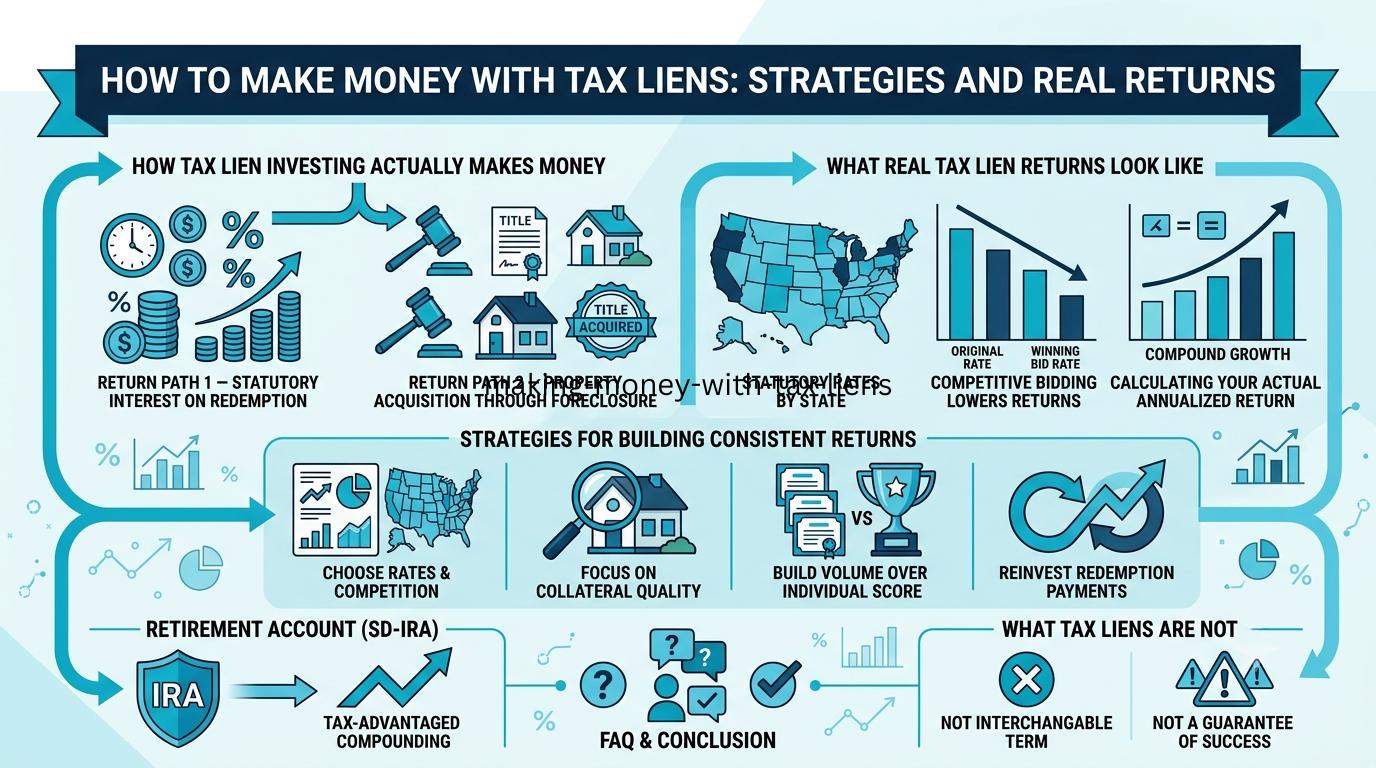
Tax lien investing gets promoted in a lot of places as a way to earn double-digit returns on government-backed investments with minimal effort. The accurate version is more nuanced — and more useful.
Making money with tax liens is real. The return mechanisms are real. The government-backed security is real. But the headline rates and the passive-income framing leave out the parts that actually determine whether an investor builds a profitable portfolio or ends up with a certificate on a property that was never worth what they paid.
This guide covers both paths to returns, what real-world numbers look like after competition and costs, and the specific strategies investors use to build reliable income streams — not just win individual auctions.
Still Building the Foundation? If you're new to tax lien investing, start with how the strategy works before diving into return mechanics. |
How Tax Lien Investing Actually Makes Money
There are two return paths in tax lien investing. Most certificates take the first one. Understanding both determines how you evaluate a certificate before you bid.
Return Path 1 — Statutory Interest on Redemption
The most common outcome in tax lien investing is redemption. The property owner pays the delinquent taxes — plus all statutory interest and penalties — during the redemption period. When that happens, you receive the face value of the certificate plus your earned interest. The investment is complete.
The return on this path is the statutory interest rate set by state law, calculated on the face value of the certificate, accrued from your purchase date to the date of redemption. The statutory rate is the ceiling — competition at auction can compress it below that ceiling — and the actual annualized return depends on when during the redemption periodThe legally defined timeframe during which a property owner can reclaim their property by paying the delinquent taxes plus interest and penalties. the owner pays.
If you purchase a $3,000 certificate in Florida at a bid-down rate of 12%, and the owner redeems after eight months, you earned eight months of interest on $3,000 — approximately $240, or about 8% annualized. The statutory rate was 12%. Your actual return was 8%. That gap is what calculation versus headline rate means in practice. For a deeper breakdown of how tax lien returns are calculated in detail, see our guide on how tax lien investing yields high profits.
Return Path 2 — Property Acquisition Through Foreclosure
When an owner does not redeem by the deadline, the certificate holder gains the right to initiate tax lien foreclosure. A successful foreclosure extinguishes the owner's right of redemptionThe legal right of a property owner to reclaim their property after a tax sale by paying the full amount of delinquent taxes, interest, and penalties. and — after the legal process is complete — results in a deed being issued to the investor.
This path produces a very different kind of return: you acquire a property, potentially at a cost well below its market value. A $4,000 certificate on a property worth $90,000 that proceeds to foreclosure can result in an equity gain many times larger than any interest return.
The important caveat: foreclosure requires legal costs, court fees, and attorney involvement in most states. The process takes months to over a year. And it only produces a positive return if the property's value exceeds your total costs — certificate purchase, interest not earned during foreclosure proceedings, legal fees, and any required property-preservation costs. This is why due diligence on the collateral is the foundation of the entire strategy, not an afterthought.
What Real Tax Lien Returns Look Like
The gap between statutory rates and actual returns is the most important number investors need to understand before their first auction.
Statutory Rates by State
State law sets the maximum interest rate a tax lien certificate can earn. These vary significantly:
Illinois: 36% (applied as a penalty on the lien face value — functions differently from APR interest, which makes direct comparisons complex)
Iowa: 24% in most cases — rotational/random assignment format means no competitive bid-down
Florida: 18% ceiling, 5% guaranteed minimum regardless of bid
New Jersey: 18% fixed statutory rate — competition via premium bidding above face value
Arizona: 16% ceiling — bid-down format
Colorado: 15% — varies by county
Maryland: Varies significantly by county, up to 18%
What Competitive Bidding Does to Returns
The statutory rate is the starting point, not the ending point. Tax lien certificate auctions in high-demand states and online-accessible counties attract significant competition — from individual investors and institutional buyers alike. The result: bid-down interest auctions in Florida's competitive counties regularly settle between 5% and 9% on desirable residential properties. New Jersey premium auctions can result in premiums that push effective yields below 10%.
Less competitive environments — smaller counties, rural areas, lower-demand states — maintain rates closer to the statutory ceiling. Investors who build their strategy around finding less-competitive auctions rather than chasing the most popular markets often achieve better risk-adjusted returns.
Calculating Your Actual Annualized Return
Your actual annualized return accounts for four variables: the rate you won at auction, the face value of the certificate, the date redemption occurred, and your total costs (purchase price + any subsequent taxesAdditional property taxes that become due after the initial tax lien certificate is purchased. Lien holders may need to pay these to protect their investment. paid + incidental costs).
Simple example: $2,500 certificate in Arizona, won at 11% interest, redeemed 14 months later. Statutory interest on $2,500 at 11% for 14 months = $320.83. That is a 12.8% annualized return on $2,500. If you had paid a small processing fee of $25, your net return drops slightly. Scale this across a portfolio of 20 certificates with varying redemption timelines, and portfolio management discipline — tracking actual vs. projected returns — becomes essential.
See How the Numbers Work in Practice Our 3-Day Workshop walks through real portfolio examples, state-by-state rate comparisons, and return calculations with working spreadsheets. |
Strategies for Building Consistent Returns
Individual auctions are not the strategy. A portfolio is the strategy. Here is how experienced investors build reliable income streams rather than just winning individual certificates.
Choose Your States Based on Rate and Competition
The best state for tax lien investing is not necessarily the one with the highest statutory rate — it is the one where the combination of rate, competition level, redemption period, and foreclosure process produces the best risk-adjusted return for your specific capital and timeline. Florida offers lower rates but very high redemption rates. Illinois offers higher rates but a more complex legal process. Iowa offers consistent rates with minimal competition but limited inventory.
Beginners typically do better focusing on one or two states until they understand the local dynamics. Experienced investors often diversify across states to balance redemption timing, competition levels, and return profiles. Our full guide to the best states for tax lien investing covers the key decision factors for each major state.
Focus on Collateral Quality
A certificate on a well-valued property produces a good outcome on both return paths: if the owner redeems, you earn your interest; if they do not, you have a valuable property. A certificate on a property worth less than the lien amount only has one viable outcome — redemption — and even that does not fully protect you from loss in edge cases.
Screening criteria for collateral quality: assessed valueThe dollar value assigned to a property by a local tax assessor for the purpose of calculating property taxes. at least 3–5 times the lien amount, no environmental flags (industrial contamination, proximity to hazardous sites), no active bankruptcy, and a property type that will remain marketable. For detailed due diligence steps, see our guide on buying property with delinquent taxes.
Build Volume Over Individual Score
No single certificate makes or breaks a tax lien portfolio. The strategy is statistical: across a sufficient volume of certificates with solid collateral, the nearly universal redemption rate converts into reliable interest income, with occasional foreclosure-path acquisitions that produce outsized gains.
Investors who put all their capital into two or three certificates are exposed to the tail risk of those specific properties and owners in ways that a diversified portfolio of 20–30 certificates is not. Capital allocation across multiple counties, multiple states, and multiple property types smooths returns and reduces single-certificate risk significantly. See our success stories to see how investors at different capital levels have approached portfolio construction.
Reinvest Redemption Payments
Most tax lien portfolios generate redemption income throughout the year as various certificates pay off. Reinvesting that income into new certificates at the next available auction compounds the portfolio's return over time. The investors who build wealth with tax lien investing are not holding a static portfolio — they are continuously reinvesting redeemed capital into new certificates with fresh research and fresh yield.
Tracking which certificates are active, which are near redemption deadline, and when the next auctions are in your target counties requires a system. A simple spreadsheet tracking certificate number, face value, auction date, rate, redemption deadline, and current status is the minimum necessary for managing even a small portfolio.
Tax Lien Investing in a Retirement Account
One of the less-publicized applications of tax lien investing is inside a self-directed IRA (SDIRA). Tax lien certificates are permissible investments within an SDIRA, which means that the interest income and any property acquisition gains can grow tax-deferred (traditional SDIRA) or tax-free (Roth SDIRA) depending on the account type.
The mechanics of using an SDIRA for tax liens require strict compliance with IRS rules around prohibited transactions and disqualified persons. You cannot, for example, personally manage or benefit from a property acquired through your SDIRA before distribution. But for investors seeking to use tax-advantaged capital, the combination of government-backed returns with tax-sheltered growth is a compelling structure.
See our detailed breakdown of the function of self-directed IRAs in real estate for the full mechanics.
Investors seeking an online training resource that covers IRA applications of both tax lien and tax deed investing should review the curriculum at United Tax Liens, which addresses the tax and legal structure alongside the investment mechanics.
What Tax Liens Are Not
The promotional framing around tax lien investing is sometimes misleading enough that it is worth being direct about what the strategy does not do.
Not a guaranteed high return. Statutory rates are ceilings. Competition compresses them. Actual annualized returns in most competitive markets range from 5–14%, not the statutory headline rates that get cited in marketing materials.
Not entirely passive. You do not manage a property during the redemption period, but the portfolio requires active monitoring — redemption tracking, deadline management, bankruptcy monitoring, and auction research. 'Passive' in the real estate sense; not in the no-work-required sense.
Not risk-free because the government is involved. Government backing means you have a senior lien position — it does not mean the collateral is inherently valuable or that you are protected from every outcome. The government cannot guarantee the underlying property's condition or value.
Not a get-rich-quick strategy. Redemption periods are one to three years. Capital is committed. Compounding returns require time and reinvestment discipline. Investors who have built significant wealth through tax lien portfolios have done so over years, not months.
Frequently Asked Questions
How much money do you need to start making money with tax liens?
There is no fixed minimum. Small certificates sell for a few hundred dollars in rural counties. However, meaningful income requires a portfolio of sufficient size to generate consistent redemption payments. Most investors who treat tax lien investing seriously as an income strategy start with $5,000–$25,000 to build a portfolio with enough certificates to diversify properly. Starting with less is possible — it just means slower growth and less diversification. See our beginner's guide for a practical capital-planning framework.
Are tax lien certificate returns reported as income?
Yes. Interest income from tax lien certificates is taxable as ordinary income in the year you receive it (redemption payment year), unless held inside a tax-advantaged account. Property acquired through foreclosure triggers a separate set of tax considerations depending on how you use or sell the property. Consult a tax professional for guidance specific to your situation.
Can you lose money investing in tax liens?
Yes. The most common loss scenario: buying a certificate on a property whose value is less than the lien amount plus foreclosure costs, and the owner not redeeming. If the property is not worth acquiring, and the owner does not pay, your total costs exceed recoverable value. This is why every certificate requires individual property due diligence — not portfolio-level averages.
Is tax lien investing better than stocks or bonds?
Different instruments serve different roles. Tax liens offer government-backed security, fixed statutory returns, and real estate collateral — a profile that sits somewhere between a corporate bond and a secured real estate investment. For investors seeking to diversify outside traditional markets with an asset class uncorrelated to stock market movements, tax lien investing has a distinct appeal. Comparing it directly to equities or tax-free bonds requires accounting for liquidity differences, tax treatment, and active management requirements that make simple return comparisons misleading.
How long before I see my first return?
The fastest return comes from early redemption — an owner who redeems their lien within the first few months of your purchase date. This is common in some states where property owners arrange financing quickly after a lien sale. The longest path is a certificate that goes all the way through the redemption period and into foreclosure, which can take two to four years from purchase to property acquisition depending on the state. Most redemptions occur within the first half of the redemption period.
Conclusion
Making money with tax liens is a function of understanding the mechanics, doing the property-level research, and building a portfolio with the discipline to hold and reinvest through multiple market cycles. The returns are real. The government backing is real. The competition — and the responsibility for your own due diligence — is also real.
The investors who succeed in this space are not the ones who found a shortcut. They are the ones who learned the auction formats in their target states, built a consistent research process for evaluating collateral quality, and treated portfolio management as an ongoing discipline rather than a set-and-forget strategy.
If you are ready to move from reading about tax liens to actually building a portfolio, our free live events are the right starting point. Experienced instructors, real auction examples, and a curriculum built on what actually works — not what sounds compelling in a headline.
Start With a Free Live Event Find a Tax Lien Wealth Builders event near you. Free, educational, no obligation. Real investors, real strategies, real numbers. |
Earnings Disclaimer Results vary. Tax lien investing involves risk, including the potential loss of principal. Nothing in this article constitutes financial, legal, or investment advice. See our full earnings disclaimer before making any investment decisions. |
Related reading: Tax Lien vs. Tax Deed: Key Differences · Tax Lien Certificate Auctions · How Tax Lien Investing Yields High Profits · Best States for Tax Lien Investing · Our Blog