
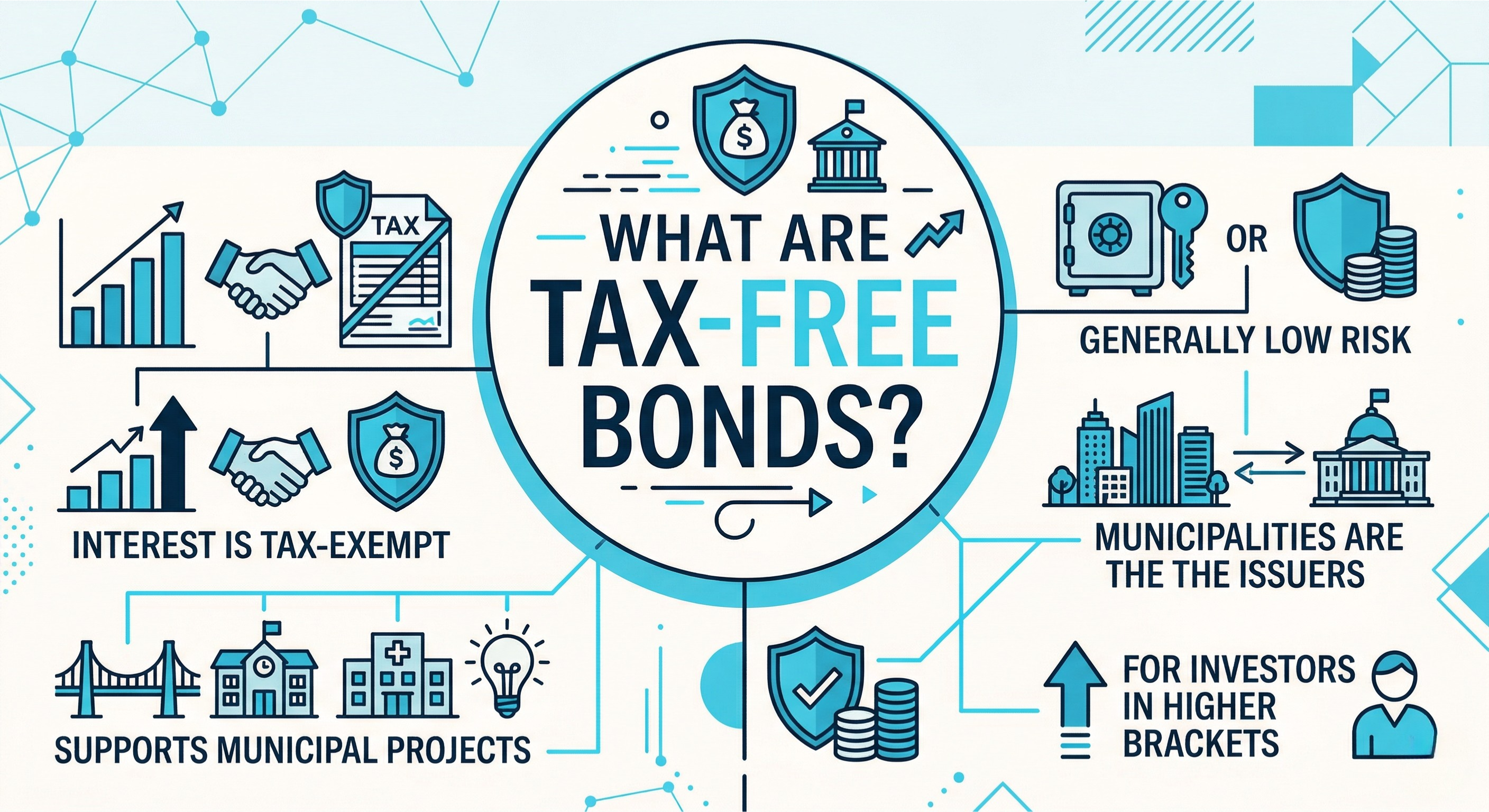
Tax-free bonds have been a staple of conservative investing for decades. The pitch is simple: earn interest, skip the IRS. But the reality is more nuanced — not all "tax-free" bonds are free from every tax, and the after-tax yield rarely looks as attractive once you run the real numbers.
This guide breaks down exactly how municipal bonds, treasury bonds, and other government-backed securities are taxed at the federal and state level. It also introduces an alternative that most bond investors have never seriously considered: tax lien certificates, which offer statutory returns ranging from 8% to 36% annually — also backed by government authority.
If you've been parking money in munis or treasuries and wondering whether you're leaving returns on the table, this article is for you. For a broader look at the investment landscape, the Tax Lien Wealth Builders blog covers how tax lienA legal claim or right against a property that serves as security for a debt or obligation owed by the property owner. investing fits into a real portfolio.
Exploring alternatives to low-yield bonds? Tax lien investing offers government-backed returns that most traditional investors have never heard of. See how Tax Lien Wealth Builders approaches it. |
What Are Tax-Free Bonds?
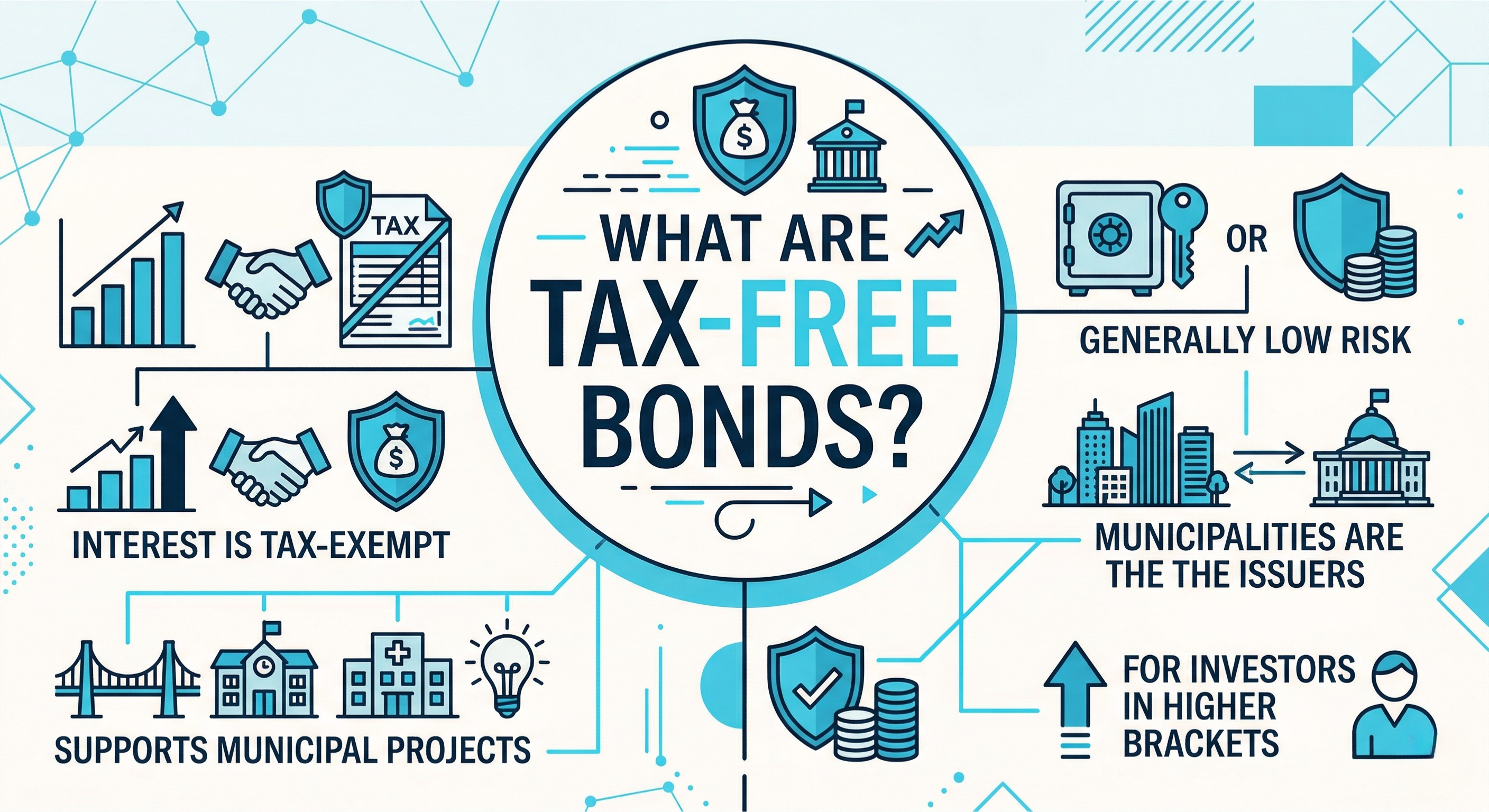
Tax-free bonds — most commonly municipal bonds, or "munis" — are debt securities issued by state and local governments to fund public projects: schools, highways, water systems, hospitals. When you buy a muni bond, you're lending money to a government entity and receiving interest payments in return.
The "tax-free" label refers specifically to federal income tax exemption on the interest earned. In most cases, if you buy a muni bond issued by your own state, the interest is also exempt from state income tax. That double exemption is the core appeal.
But "tax-free" doesn't mean "always completely untaxed." There are important exceptions — and understanding them is essential before you decide whether bonds belong in your portfolio.
Municipal Bond Taxation: What's Actually Exempt
Federal Tax Treatment
Interest income from municipal bonds is generally exempt from federal income tax. This is the foundational rule — and it holds for most standard muni bonds. So if you hold a muni bond paying 4% interest, that 4% doesn't get added to your federal taxable income.
This exemption is what makes taxation of municipal bond interest so appealing to high-income investors. A 4% tax-free yield can be worth more than a 6% taxable yield, depending on your bracket. At the 37% federal rate, the math clearly favors the muni.
State Tax Treatment
Here's where it gets more complicated. State tax treatment of muni bond interest depends on which state issued the bond and which state you live in:
If you buy a bond issued by your home state: interest is typically exempt from state income tax
If you buy an out-of-state muni bond: most states tax that interest as ordinary income
States like California, New York, and Illinois are particularly aggressive about taxing out-of-state muni interest
Some states — Indiana and Wisconsin among them — tax all muni interest regardless of where it's issued
The practical implication: muni bond interest taxable is not a yes/no question. It depends entirely on your state of residence and the bond's issuing state.
The AMT Problem
There's a lesser-known trap in muni bond taxation: certain municipal bonds — specifically private activity bonds — are subject to the Alternative Minimum Tax (AMT). These bonds fund projects that have a private business component, such as airports or certain housing developments.
If you're subject to AMT, interest from these bonds gets added back to your income for AMT calculation purposes. Many investors discover this too late. When evaluating any muni bond, check whether it's AMT-eligible — your brokerage statement or the bond prospectus will indicate this.
Are Municipal Bonds Tax Exempt From Capital Gains?
No — and this is one of the most common misconceptions. The tax exemption applies to interest income only. If you sell a muni bond at a profit, that capital gain is fully taxable at standard capital gains rates. The bond's tax-free status doesn't extend to price appreciation or depreciation.
Looking for returns that don't depend on bond market price movements? Tax lien certificates pay statutory interest — fixed by state law, not by market fluctuations. United Tax Liens explains the model in plain terms. |
Treasury Bond Taxation: Federal Yes, State No
Are Treasury Bonds Taxable?
Yes — at the federal level. Unlike municipal bonds, interest on U.S. Treasury bonds, Treasury notes, Treasury bills (T-bills), and Treasury Inflation-Protected Securities (TIPS) is fully subject to federal income tax. There is no federal exemption for Treasury securities.
T bonds taxation applies to everyone: if you earn interest on a Treasury, it's taxable income on your federal return at your ordinary income rate — the same bracket that applies to wages and salary.
Are US Treasuries Taxable at the State Level?
This is where Treasuries have a genuine edge over munis: interest from U.S. government bonds is exempt from state and local income tax in all 50 states. Federal law prohibits states from taxing income from direct U.S. obligations.
For investors in high-tax states — California (13.3% top rate), New York (10.9%), New Jersey (10.75%) — the state exemption on Treasury interest is meaningful. A Treasury yielding 5% in California effectively yields more than a 5% corporate bond that's subject to state tax.
Taxes on Treasury Bills: What's Different
T-bills are short-term instruments (4 weeks to 52 weeks) sold at a discount and maturing at face value. The difference between purchase price and face value is your return — taxed as ordinary interest income in the year the bill matures, not as a capital gain.
One timing note: if you buy a T-bill late in the year and it matures the following January, you report the interest in the year it matures — not the year you purchased it. This can create flexibility for year-end tax planning.
TIPS and Phantom Income
Treasury Inflation-Protected Securities have a notorious quirk: as inflation adjusts the principal upward, that adjustment is taxable in the year it occurs — even though you don't receive the cash until the bond matures. This is called phantom income, and it can create unexpected tax bills in high-inflation years.
Holding TIPS in a tax-deferred account eliminates this problem. In a taxable account, you're paying tax on money you haven't received yet — a real structural disadvantage worth factoring into your decision.
Tax-Free Bonds vs Tax Lien Certificates: The Comparison Investors Rarely Make
Most investors compare muni bonds to corporate bonds, or Treasuries to CDs. Very few compare them to tax lien certificates — which is a mistake, because the risk/return profile is meaningfully different.
Here's a direct comparison across the metrics that matter:
Muni Bonds | Treasury Bonds | Tax Lien Certs | |
Typical yield | 3–5% | 4–5.5% | 8–36% |
Federal tax | Exempt | Taxable | Taxable |
State tax | Varies | Exempt | Varies |
Gov-backed | Partially | Yes | Yes |
Liquidity | Moderate | High | Low |
Min. investment | $1,000+ | $100+ | Varies ($50+) |
AMT exposure | Possible | No | No |
Complexity | Low | Low | Moderate |
The Yield Gap Is Real
A muni bond yielding 4% tax-free sounds attractive. But a tax lien certificateA legal document issued by a government authority when a property owner fails to pay property taxes, granting the certificate holder a lien on the property. earning 18% in Florida — or 36% in Illinois — is operating in a different return category entirely. Even after accounting for the taxable nature of lien interest income, the gap often remains substantial.
The counterargument is liquidity and complexity. Muni bonds trade on secondary markets and can be sold if you need cash. Tax lien certificates are illiquid — your money is locked in until the property owner redeems or you initiate foreclosure proceedings. And liens require actual due diligence — you can't buy blindly the way you'd buy a Treasury.
Government Backing: Similar, Not Identical
Both Treasuries and tax lien certificates are backed by government authority — but differently. Treasuries are backed by the full faith and credit of the U.S. federal government. Tax lien certificates are backed by the local government's authority to enforce the encumbrance against the property — meaning the collateral is real estate, not federal creditworthiness.
The redemption period protects lien investors in most cases: the owner pays or loses the property. But the quality of the underlying collateral matters, which is why property-level due diligenceThe research and investigation process an investor conducts before purchasing a tax lien or tax deed to evaluate the property and assess risk. is non-negotiable before purchasing any certificate.
The Self-Directed IRA Angle
One underused strategy: holding tax lien certificates inside a self-directed IRA. This eliminates the annual tax on interest income — the same benefit you get from holding bonds in a tax-deferred account, but applied to a much higher-yielding asset. The interest compounds tax-deferred (or tax-free in a Roth IRA) until withdrawal.
This structure is legal, IRS-approved, and used by experienced lien investors. It requires a custodian that permits alternative investments — not all do. The United Tax Liens team can point you toward resources on setting this up correctly.
Want to understand how tax lien certificates fit into a diversified portfolio? Read firsthand accounts from investors who made the shift at United Tax Liens testimonials. |
Who Tax-Free Bonds Actually Make Sense For
Despite their limitations, tax-free bonds are genuinely useful for a specific investor profile. They're not the right tool for everyone, but they're the right tool for some.
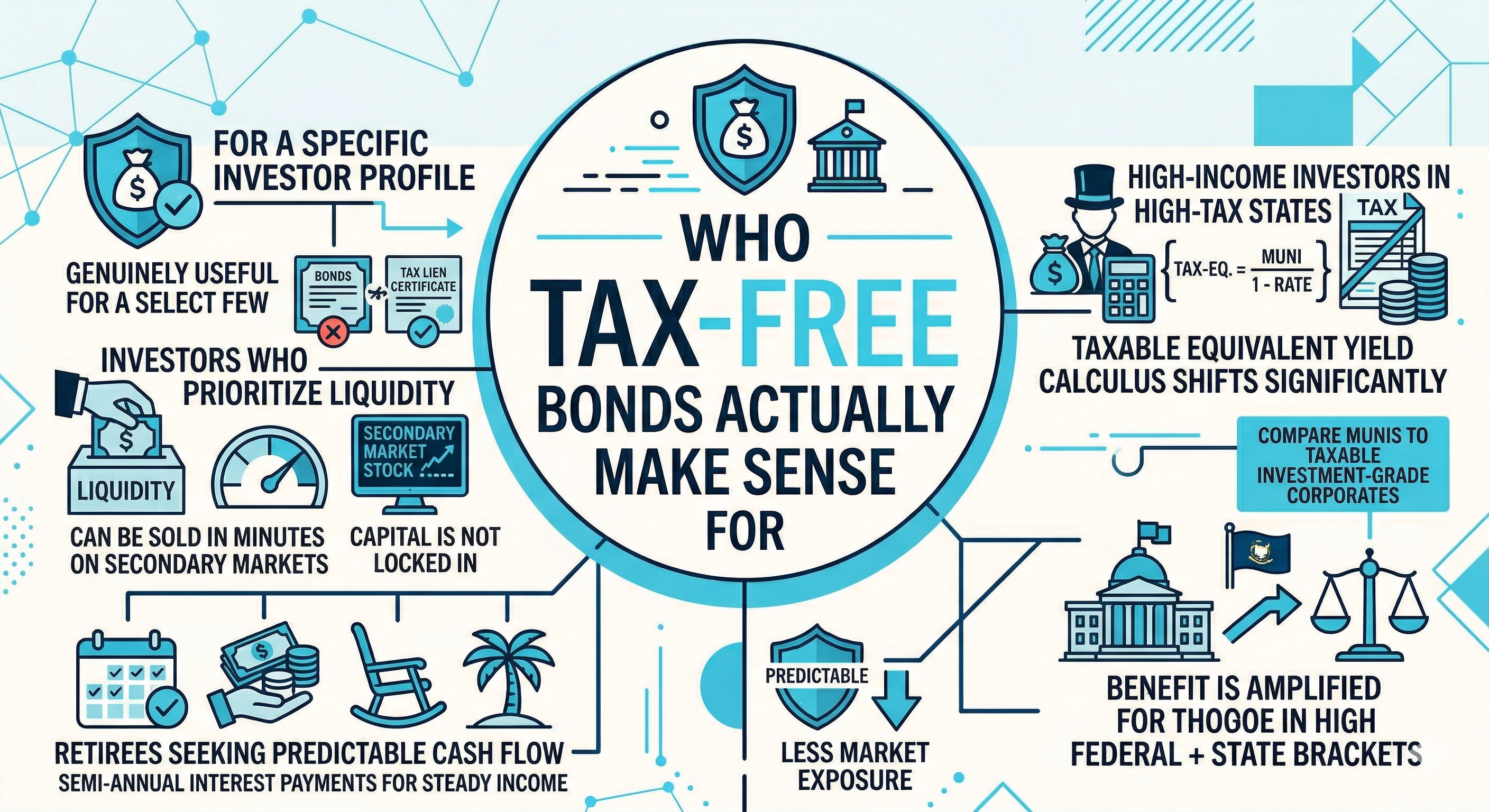
High-Income Investors in High-Tax States
The break-even math on munis only works at higher income levels. If you're in the 22% federal bracket, the tax exemption on a 4% muni often doesn't beat a 5% taxable bond. But at 37% federal plus 10%+ state, the calculus shifts significantly.
The formula: Taxable equivalent yield = Muni yield ÷ (1 − your marginal tax rate). A 4% muni at a combined 47% rate has a taxable equivalent yield of 7.5%. That beats most investment-grade corporates.
Retirees Seeking Predictable Cash Flow
Muni bonds pay interest on a fixed schedule — usually semi-annually. For retirees who want predictable income without market exposure, this is genuinely attractive. The tax efficiency is a bonus, not the primary reason to own them.
Investors Who Prioritize Liquidity
If you may need your capital back on short notice, tax lien certificates are not for you. The right of redemption period locks your investment in place — sometimes for years. Bonds, particularly Treasuries, can be sold on the secondary market within minutes. Liquidity has real value, and bonds price it in.
Tax Treatment of Bonds: Quick Reference
For investors who want the summary version:
Municipal bonds: federal interest exempt, state varies, capital gains fully taxable, AMT possible on private activity bonds
Treasury bonds and notes: federal interest taxable as ordinary income, state and local exempt, capital gains taxable
Treasury bills: taxed as ordinary interest income at maturity, state and local exempt
TIPS: federal taxable including phantom principal adjustments, state exempt — hold in tax-deferred accounts when possible
Agency bonds (Fannie Mae, Freddie Mac): federal taxable, state varies — not the same as direct Treasuries
One clarification on agency bonds: bonds issued by government-sponsored enterprises like Fannie Mae are not backed by the full faith and credit of the federal government, and their state tax treatment differs. Don't assume "government-related" means the same tax treatment as Treasuries.
What Actually Qualifies as a Tax-Free Government Bond
The phrase "tax-free government bonds" is often used loosely. Here's a precise breakdown of what qualifies and what doesn't:
Fully Tax-Free at Federal Level
General obligation municipal bonds — issued to fund public projects with no private component
Revenue bonds in most cases — funded by project revenue such as tolls or utilities
Partially Tax-Free
Private activity bonds — federal exempt but AMT-exposed for affected taxpayers
Out-of-state muni bonds — federal exempt but most states tax the interest
Treasuries — state and local exempt but federal taxable
Not Tax-Free
TIPS principal adjustments — taxed federally as they accrue
Agency bonds (FNMA, FHLMC, SBA) — fully taxable federally unless specifically exempted
I Bonds above the education exclusion — interest is federally taxable at maturity
For a complete breakdown of how specific bond types interact with your tax situation, consult a CPA or tax advisor. The rules are straightforward in principle but depend on your state, income level, and account type.
Ready to look beyond bonds? Tax lien investing is one of the few legal, government-backed vehicles that regularly outperforms fixed income by a wide margin. Learn how Tax Lien Wealth Builders teaches it — or reach out to the United Tax Liens coaching team at their contact page to talk through whether it fits your situation. |
Final Thoughts
Tax-free bonds serve a real purpose in a portfolio — but their advantages are most pronounced for high-income investors in high-tax states who prioritize liquidity and predictability. For everyone else, the after-tax yield advantage is smaller than it appears on the surface, and the structural limitations are more significant than most financial media acknowledges.
The more important question is whether you've looked at the full range of tax-advantaged, government-backed investment options available to you. Most investors haven't. Tax lien certificates sit in a category that most bond investors have never seriously evaluated — offering higher statutory yields, real property collateral, and a legal framework that's been in place for over a century.
That doesn't make them the right choice for everyone. It makes them worth understanding. The Tax Lien Wealth Builders resource library is the best place to start — and the United Tax Liens about page explains the team behind the education program that has helped hundreds of investors make this transition.