
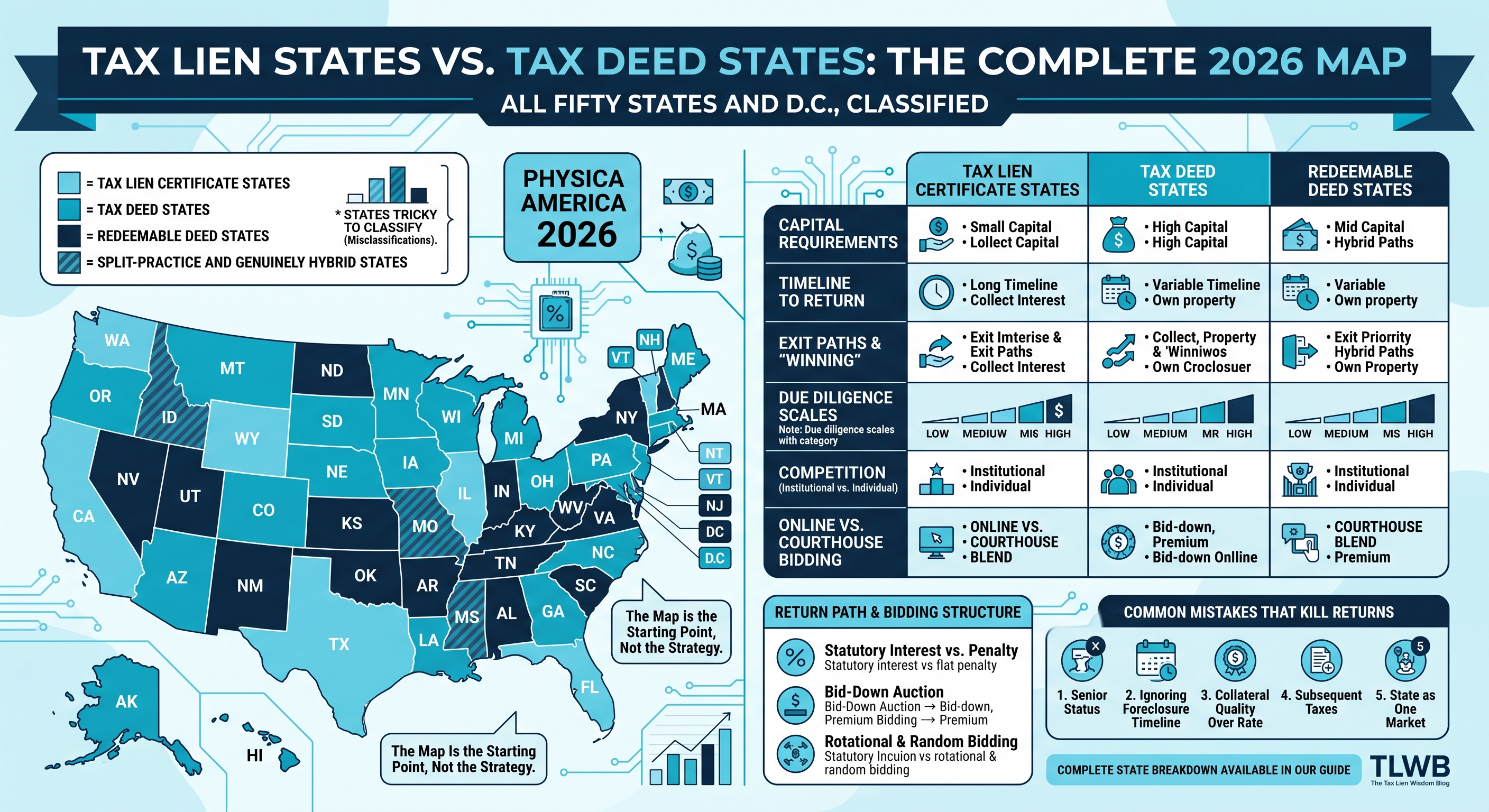
Most investors split the country into two buckets — lien states and deed states — then start bidding. They are wrong before they ever register. There are three systems across the fifty states, not two, and the third one holds some of the richest returns in the country. Texas pays a 25% penalty in year one. Georgia pays 20%. Neither is a tax lien state. Both get skipped by investors who only learned two categories.
The category is not trivia. It dictates how much capital you need, how long that capital sits, what you own when the gavel falls, and how you exit. A $4,000 certificate in Arizona and a $4,000 deed in Arkansas are not the same investment with different labels. One is a secured debt instrument earning a legislated return. The other is real property with a roof and possibly a tenant. Same money, different job. If you are fuzzy on what a tax lien certificate actually is, start there, then come back.
This page is the map. It classifies every state and the District of Columbia, gives the rates and redemption windows we are confident in, and flags every figure that moves by county. One standing rule: statutes change and treasurers interpret them differently, so verify before you wire funds. Classification first. Bidding second.
Three Systems, Not Two
Every state faces the same problem — property taxes fund schools and county services, and some owners do not pay. Every state built a machine to force collection. The machines differ in one respect: what the county sells to recover the money.
Tax Lien States: You Buy the Debt, Not the Dirt
In a tax lien state, the county sells the delinquent obligation. You pay someone else's back taxes and receive a certificate that puts you in a senior lien position against the parcel, entitling you to principal plus a statutory interest rate or penalty when the debt is cured. You do not own the house. You cannot enter it, rent it, or repair it.
The owner then has a defined redemption periodThe legally defined timeframe during which a property owner can reclaim their property by paying the delinquent taxes plus interest and penalties. — commonly six months to four years — to pay you off through the treasurer. Most do. High redemption rates are exactly why the instrument behaves like fixed income with real estate collateral behind it. If nobody redeems, you gain the right to foreclose and pursue title. That is the trade: high probability of a legislated return, low probability of acquiring property, hard ceiling on the upside.
Tax Deed States: You Buy the Property Outright
A tax deed state skips the middle step. The county forecloses its own lien, extinguishes the owner's interest, and auctions the property. The winning bidder receives a deed. Not a certificate. A deed. Opening bids usually start at accumulated taxes and costs, which is why deed sales draw investors who intend to renovate and resell rather than collect 16% on paper.
The upside is immediate control — no waiting on someone else's decision. The downside is that everything you failed to check is now yours: deferred maintenance, environmental problems, an occupant with a lease, code violations, surviving municipal charges. Deed investing is real estate acquisition in a tax-sale costume. Our guide to buying property with delinquent taxes covers the inspection sequence that separates a bargain from a liability.
Redeemable Deed States: The Hybrid Middle Ground
The third system gets left off most maps. You bid at what looks like a deed auction and receive what looks like a deed, but the former owner keeps a statutory right to redeem for a set window. If they redeem, they do not pay annualized interest. They pay a flat penalty on your entire investment.
Texas imposes a 25% penalty on redemption in the first year, with a longer window and higher figure for homestead and agricultural classifications — verify the current schedule and the applicable window, because Texas treats property classes differently. Georgia applies a 20% penalty for redemption within the first year. The penalty is flat, not prorated, so an early redemption annualizes far above any certificate rate. If nobody redeems, you keep the property. It is the only category where both outcomes are attractive on their own terms.
Why the Word "Hybrid" Gets Abused
Half the tax sale content online calls a state hybrid whenever the author is unsure. There are two legitimate uses. The first is the redeemable deed structure above. The second is split practice — a state whose counties run different systems, or one that sells liens first and deeds later for parcels nobody bought.
Florida is the classic second type: certificates at 18%, then a deed sale when an unredeemed certificate holder applies. Ohio runs lien sales in larger counties and sheriff's sales in smaller ones. New York varies so much by county that any statewide label is wrong somewhere. When you see "hybrid," ask which kind — the answer changes your underwriting. Our breakdown of the mechanics of placing a bid covers the workflow in both directions, and the lien-versus-deed distinction covers the instruments side by side.
Learn the System Before You Learn the State Classification only helps if you understand what you are buying in each category. Our training walks through certificates, deeds, and redeemable deeds with real auction examples. |
The 2026 Map: All Fifty States and D.C., Classified
Where we give a rate, it reflects the statutory figure we are confident in. Where a figure varies, we say so rather than inventing precision. County practice is the wildcard — a state can be a lien state on paper while three of its counties have not held a sale in years.
Tax Lien Certificate States
These jurisdictions sell the debt. You hold a certificate, wait out the redemption window, and collect — or move toward foreclosure.
Alabama — 12% on tax lien certificates. Counties may run lien auctions under the newer framework, and adoption has spread unevenly. Confirm your county's format.
Arizona — 16% maximum, bid down. Three years before a foreclosure action may be brought. Heavily institutionalized online market.
Colorado — nine percentage points above the federal discount rate, set annually, so the headline floats. Premium bidding is standard and premium is generally not returned.
Florida — 18% maximum, bid down, with a statutory minimum return in most redemption scenarios unless struck at zero. Two years minimum before a deed application.
Illinois — up to 36% in aggregate, accruing in six-month penalty increments rather than as simple annual interest. A separate scavenger process governs chronically delinquent parcels.
Indiana — tiered penalty that pays more the longer redemption takes inside the first year, plus interest on any overbid. Confirm current tiers and surplus treatment.
Iowa — 24% annually, accrued monthly, awarded by random selection or rotation in most counties rather than a rate auction.
Kentucky — 12%, with a certificate of delinquency system and real restrictions on third-party purchasers, including registration requirements.
Maryland — rate varies by county and the spread is wide. Paired with an unusually short window before foreclosure may be filed.
Mississippi — 18% with a two-year redemption period. County-run sales, with collateral quality varying widely across the state.
Missouri — statutory interest on the certificate plus a separate rate on subsequent taxesAdditional property taxes that become due after the initial tax lien certificate is purchased. Lien holders may need to pay these to protect their investment. you advance. Non-resident provisions apply in some circumstances.
Montana — 10%, multi-year redemption, with a required notice process before a tax deed issues. Low volume, low competition.
Nebraska — 14% with a three-year redemption period. Bidding format varies by county between rotational and premium methods.
New Jersey — 18% ceiling, but the auction bids the rate down to zero and then converts to premium bidding above par. Two-year redemption for most parcels, plus additional penalties on larger delinquencies.
Oklahoma — 8% with a two-year redemption period. Modest rate, modest competition.
South Dakota — 10% with a multi-year redemption period. Very low volume; several counties rarely hold sales.
West Virginia — 12%, with much of the process now administered through the state auditor rather than exclusively at county level.
Wyoming — 15% annual interest plus a 3% penalty, with a four-year redemption period. Long wait, thin inventory.
District of Columbia — 18% with a short redemption window and a fast path to foreclosure, plus purchaser conduct rules that have caught out-of-town investors off guard.
Eighteen states plus the District. To narrow the list rather than memorize it, our state-selection guide ranks them on criteria that matter to a working investor rather than on headline rate.
Tax Deed States
These states sell the property. Redemption, where it exists, happens before the auction.
Alaska — borough foreclosure and sale, with municipalities often retaining a repurchase right for former owners. Very few sales.
Arkansas — administered by the Commissioner of State Lands rather than county by county, which makes it unusually accessible to out-of-state buyers.
California — county tax collector deed sales, generally online, with minimums set at the defaulted amount plus costs. Competition is heavy.
Idaho — county tax deed sales following the statutory delinquency period, with counties controlling timing and terms.
Kansas — judicial tax foreclosure. Title is comparatively clean because the court runs it; timing follows the docket, not the treasurer.
Maine — municipalities acquire title through a tax lien mortgage that matures automatically, then dispose under local policy. No real investor certificate market.
Michigan — county foreclosure then public auction, with governmental rights of first refusal ahead of the public sale. Surplus-proceeds rules have been litigated recently.
Minnesota — tax-forfeited land sales after forfeiture to the state, on county-set terms that often restrict use.
Nevada — trustee's deed sales after the delinquency and redemption period runs at the treasurer level. Confirm the county's actual procedure.
New Hampshire — municipalities execute liens in their own favor and later convey by deed. Investor participation is generally limited to municipal dispositions.
New Mexico — sales conducted by the state Taxation and Revenue Department on behalf of counties, on a statewide calendar.
North Carolina — court foreclosure sales with an upset-bid period, meaning your winning bid is not final until that window closes.
North Dakota — no longer a certificate state. Counties foreclose and sell property directly. Older guides still get this wrong.
Oregon — county sale of tax-foreclosed property on county-controlled terms, with frequently restricted inventory.
Pennsylvania — layered upset, judicial, and repository sales. The upset sale conveys subject to existing liens; the judicial sale generally does not.
Utah — May tax sales conducted by counties after the statutory delinquency period, administered by the auditor.
Virginia — judicial sale of delinquent property, typically run by a court-appointed special commissioner and marketed through auction firms.
Washington — county treasurer foreclosure sales, generally requiring the delinquency to reach a statutory age first.
Wisconsin — county acquisition through in rem foreclosure, then disposition under county policy, sometimes by sealed bid rather than live auction.
Nineteen states, and notice how many route the sale through a court or state agency rather than a treasurer. That structural fact drives most timing differences, which is why how a certificate auction runs reads nothing like a judicial sale calendar.
Redeemable Deed States
These convey a deed subject to a redemption right. Collect a penalty, or keep the property.
Texas — 25% penalty on redemption in the first year, with a longer window and higher second-year figure for homestead, agricultural, and mineral classifications. Non-homestead property carries a much shorter window. Highest-volume redeemable deed market in the country.
Georgia — 20% penalty for redemption within the first year, with additional penalty after that, and a one-year minimum before the purchaser may begin barment. Notice requirements are strict and unforgiving.
Connecticut — municipal tax sales conveying a deed subject to redemption, with statutory interest on the redemption amount. Practice varies by municipality.
Delaware — sheriff's sale with a statutory redemption right and a percentage penalty to the purchaser. Court confirmation is part of the process.
Hawaii — deed sale with a one-year redemption right and statutory interest. Extremely low volume, very high per-parcel pricing.
Louisiana — tax sale title subject to roughly a three-year redemption for most property, with a flat penalty plus monthly interest. Recent constitutional and legislative changes make older figures unreliable.
Rhode Island — tax title at municipal sale subject to redemption, with penalty plus accruing interest, followed by a Superior Court petition to foreclose the redemption right.
South Carolina — one-year redemption with interest stepping up by quarter, so early redemption pays materially less. Premium bidding is typical, and premium treatment decides the deal.
Tennessee — court-ordered sale with a redemption period generally running one year, shortened in some abandonment circumstances, plus statutory interest to the purchaser.
Vermont — municipal tax sale with a one-year redemption right and monthly interest accruing to the purchaser. Small towns, small inventory.
Ten states, and the most misunderstood segment of the market. The way where the yield actually comes from differs between a 16% annualized certificate and a 25% flat penalty is not a rounding difference. It is a different asset.
Split-Practice and Genuinely Hybrid States
Three jurisdictions resist a single label because their counties genuinely operate different systems.
Ohio — larger counties sell certificates, often in bulk portfolios to institutional buyers, with individual sales available in some jurisdictions. Smaller counties go to sheriff's sale. Access depends entirely on which county you target.
New York — practice varies dramatically by county and city. Some sell liens or bundle receivables to third parties; others foreclose in rem and auction property. New York City runs its own framework.
Massachusetts — municipalities take title through a tax taking, with interest accruing on the redemption amount, then petition the Land Court to foreclose. Some municipalities assign receivables to private buyers.
County practice is the operative unit of analysis. A state label tells you which statute governs, not the sale date, the deposit, or the format. Our overview of how our process works starts at county level for that reason.
The States Almost Everyone Misclassifies
Five errors show up in nearly every free state list online.
Texas is not a tax lien state. It is the flagship redeemable deed state. Investors search "Texas tax liens," see 25%, and assume certificates. They are buying deeds with a redemption right, and the diligence burden is entirely different.
Florida is not purely a lien state. It is a lien state that generates deed sales downstream from unredeemed certificates. Both markets run at once, and the deed side is where property changes hands.
North Dakota is no longer a lien state. The move to county foreclosure and deed sale has been in effect long enough that anyone still publishing the old classification is not maintaining their content.
Alabama is mid-transition. The same state, in the same year, can present two formats depending on which county you drive to.
Maryland is a lien state that behaves like a deed state. The certificate is real, but the window before a purchaser may file to foreclose is short enough that Maryland attracts investors who want title, not yield. If your list got any of these wrong, reset with a beginner's roadmap.
How the Category Changes Your Strategy
Each category imposes a different operating model. Get the model wrong and you run out of capital, patience, or both.
Capital Requirements Are Not Comparable
A certificate costs what the delinquent taxesProperty taxes that remain unpaid past the due date, which may result in penalties, interest, and eventually a tax lien being placed on the property. cost — frequently hundreds or low thousands. An investor with $10,000 can hold eight or twelve positions and diversify redemption risk. Diversification is not a luxury here. One certificate on one parcel is a bet. Twelve across twelve parcels is a portfolio.
A deed costs what somebody will pay for real property, in full, usually within a day or two of the sale. There is no financing at a tax sale. Redeemable deeds inherit those same demands with a consolation prize attached. Working through a step-by-step walkthrough of one transaction shows how differently the money moves.
Timeline to Return
Lien states pay when the owner redeems, and you do not control when. Some certificates redeem in six weeks. Others run the full statutory period — in a three-year state like Arizona, your capital may be committed for most of three years. Fine if you planned for it. Ruinous if you needed the money in eight months.
Deed states pay when you sell, rent, or refinance, so the timeline is yours, constrained by rehab scope and any challenge period. Redeemable deed states resolve on a defined schedule: at the end of the window you either received a penalty payment or you own real estate. Fewer unknowns than either alternative, which rarely gets credited.
Exit Paths and What "Winning" Looks Like
In a lien state, the base case is redemption and the tail case is acquisition. You want redemption — it is clean and delivers the return the statute promised. Acquisition means legal fees, a quiet title actionA lawsuit filed to establish clear ownership of a property and resolve any disputes or claims against the title. in many states, and a property you underwrote as collateral rather than as something to hold.
In a deed state there is one case: you own it, and your exit is retail sale, wholesale assignment, rental hold, or write-off. In a redeemable deed state both outcomes are genuine wins if you underwrote correctly. The failure mode is bidding so far above the tax amount that a flat penalty on your total investment stops being attractive. Understanding turning certificates into cash is the same discipline on the lien side.
Due Diligence Scales With Category
Lien-state diligence is a collateral quality question. Does the property support the debt? Is there a structure? Is the parcel landlocked, in a floodway, contaminated, or a strip of grass the county cannot give away? You are checking whether your security is worth more than your certificate.
Deed-state diligence is full acquisition work: title search, lien survey, occupancy check, physical inspection, code violations, utility arrears, and an honest repair estimate. Redeemable deed diligence adds one thing — underwrite the redemption scenario as its own outcome. A parcel whose owner will clearly redeem is a fixed-income trade. A parcel abandoned for six years is an acquisition. Know which one you are making before you raise your hand.
See a Real Auction Before You Bid in One Reading about bid-down mechanics is not the same as watching a rate collapse in real time. Our live sessions walk through actual sale calendars and county terms. |
Interest Rates, Penalties, and What the Numbers Actually Mean
Every state list leads with rates. Almost none explain what the rate is attached to, and the attachment is where the money hides.
Statutory Interest Versus Flat Penalty
An annualized rate accrues over time. Arizona's 16% means 16% per year, so a certificate redeemed after four months earned roughly a third of the headline. Iowa's 24% accrues at 2% monthly, so a two-month redemption pays 4%. The number on the brochure is a ceiling, not an outcome.
A flat penalty ignores time. Texas's 25% is 25% whether redemption comes in week three or month eleven, so an early redemption annualizes to a figure no interest-rate state can match. The inverse holds too: a penalty collected at the end of a long window annualizes down toward ordinary. Match the structure to how quickly you expect redemption in that specific market.
The Bid-Down Auction and the Race to Zero
In Arizona, Florida, Illinois, and New Jersey, the auction does not bid the price up. It bids the rate down. The certificate always costs the tax amount. What competitors surrender is yield.
So the advertised rate rarely survives contact with a competitive sale. Florida's 18% routinely clears in low single digits in populous counties, and fractional winning bids are unremarkable in automated online sales. New Jersey goes further: the rate bids to zero, then bidders compete by paying premium above the tax amount — capital that generally earns nothing. When you see "New Jersey pays 18%," that is the rate on parcels nobody else wanted, which raises an obvious question about why.
Premium Bidding and Negative Real Yield
Premium bidding is the quiet killer. Colorado's statutory rate sounds excellent, but bidders compete by paying premium over the tax amount, and that premium is generally not returned on redemption. Pay $600 in premium on a $1,000 certificate and your yield on $1,600 of deployed capital is a fraction of the statutory rate — potentially negative if redemption comes fast.
Your true yield is the statutory return on the tax amount, divided by total capital deployed, adjusted for whether premium is refundable. If premium is not returned, there is a ceiling above which the trade cannot work regardless of the headline rate. The math only works one way. Write your ceiling down before the auction opens and do not move it because the room got competitive.
Rotational and Random-Selection Bidding
A few states remove competitive bidding almost entirely. Iowa is the standout: in most counties, when multiple bidders want the same parcel, the winner is chosen by random selection or rotation. The 24% is not bid down. It is awarded at full statutory value.
That is enormously favorable to individual investors, because capital size stops being an advantage on rate. A bidder with $2 million cannot buy a better rate than one with $20,000 — only more parcels. Nebraska and several others use variations of rotational assignment, and any state that does deserves a hard look. Our state rankings weight bidding structure heavily for exactly this reason.
Competition: Who You Are Actually Bidding Against
The biggest gap between tax sale marketing and tax sale reality is competition. The statute sets the ceiling. Competition sets the outcome.
Institutional Capital in the Big Lien States
Florida, Arizona, New Jersey, and Illinois host funds and specialist firms deploying eight and nine figures through automated bidding. They bid thousands of parcels at once, accept yields an individual would consider pointless, and optimize at the portfolio level rather than per certificate. You cannot outbid them and should not try.
Where the Individual Investor Still Has an Edge
Three edges are durable. Local knowledge: a fund's model sees a parcel ID and an assessed value, while you can see that the lot backs onto a new development or that the road washes out every spring. Selectivity: institutions must deploy capital, and you can attend four sales, bid on nothing, and still be ahead of the fund that had to buy.
The third is willingness to do unglamorous work — driving parcels, calling municipal offices, reading title, sitting through a rural sale with eleven bidders. That work does not scale to thousands of parcels, which is why those parcels stay available. Investors who have built results this way tell it better than we can; our investors who have done it page has the specifics.
Online Platforms Versus Courthouse Steps
Online auctions democratized access and destroyed a lot of yield at the same time. More bidders, lower winning rates, faster clearing. In-person sales still matter, particularly in smaller deed and redeemable deed counties, because the friction of showing up is a filter and filters create opportunity.
Neither format is superior; they select for different advantages. If yours is capital and speed, go online. If it is travel and local judgment, the courthouse steps are still there. Registration rules, deposits, and payment deadlines differ substantially between formats, and missing one voids your bid — which is why auction formats deserve as much study as the rate table.
Get a Second Set of Eyes on Your Target County County terms, deposit rules, and bidding formats change more often than statutes do. We help investors verify the details before capital is committed. |
How to Pick Your First State
Most investors pick their first state off the highest number on a rate chart. That is how people end up bidding a quarter point in a Florida online sale against an algorithm. Choose on fit.
The Five-Filter Framework
Capital. Under $25,000, you belong in a certificate market where positions are small enough to diversify. Above that, deed and redeemable deed markets open up.
Timeline. Map the redemption period against when you need the money back. A four-year Wyoming window is not a place to park capital you need next year. This filter eliminates more states than any other.
Bidding structure. Bid-down states erode yield. Premium states erode it differently and more dangerously. Rotational states preserve it. If you are new, structure matters more than the rate.
Access. Can you bid remotely? Are non-residents permitted? Does the county require an in-state entity or registered agent? Some jurisdictions quietly exclude first-timers through purchaser qualifications.
Inventory. A great rate on eleven parcels a year is not a business. Check three years of sale lists before committing to learn a market. Whatever survives all five is your shortlist — then learn one state completely before adding a second, which is the core of the investing process we teach.
Distance, Residency, and Remote Bidding Rules
Distance matters more in deed and redeemable deed states, for the obvious reason that you may end up owning a building. Owning a building four states away that you have never seen is a specific and avoidable mistake.
Residency rules are the trap nobody warns about. Some jurisdictions restrict who may purchase, require registration well before the sale, demand a W-9 and deposit days in advance, or bar purchasers who owe delinquent taxes themselves. "Online" does not mean "unrestricted" — verify eligibility, entity requirements, and funding deadlines, and note that the deposit deadline is usually earlier than you think.
Matching the State to Your Capital
Under $10,000: certificate states with small positions and, ideally, rotational bidding. Iowa, Mississippi, and lower-volume counties let you build eight or ten positions and learn the redemption cycle with limited exposure.
$10,000 to $50,000: the full certificate universe plus selective redeemable deed participation on land and low-value parcels. This is also where a retirement account starts to make sense, since certificate income is ordinary income — our explainer on a self-directed IRA covers the custodian mechanics, and investors benchmarking against conservative alternatives often start with tax-free bonds. Above $50,000, deed markets become viable — but the capital is the easy part, and operating capability is what limits most investors at that level.
Three Investor Profiles and Where They Should Start
The yield seeker wants predictable returns without becoming a landlord. Certificate states with non-competitive bidding — Iowa first. Twelve small positions, not three large ones. No deed sales.
The property acquirer wants real estate at a discount and has renovation capability. Redeemable deed states first, where a failed acquisition still pays a penalty. Texas and Georgia are the training ground.
The retirement-account investor wants long-duration, low-touch positions in a tax-advantaged wrapper. Certificate states with longer windows, where illiquidity is irrelevant. Wyoming's four years is a problem for one profile and a non-issue for another. Identify which you are before registering for anything, and if you are unsure, start-here material for new investors is the right first stop.
Common Mistakes That Kill Returns
Five errors account for most of the capital destroyed in this asset class. None are exotic.
Assuming Every Tax Lien Is Senior
Property tax liens generally outrank mortgages and most private encumbrances. Generally — not universally. Certain federal claims carry their own post-sale redemption rights. Municipal charges, special assessments, and some environmental liens survive in some states. In Pennsylvania, buying at an upset sale rather than a judicial sale leaves existing liens attached. Confirm what survives at that specific type of sale; our primer on the underlying lien instrument explains where priority stops.
Ignoring the Foreclosure Timeline
The redemption period is how long the owner has to pay. The foreclosure timeline is how long it takes you, afterward, to convert a certificate into marketable title — notice, service on all interested parties, a court action in many states, and a quiet title suit in many more. That can add twelve to twenty-four months and five figures of legal cost on top of a redemption period that already ran for years. Model the full timeline before you bid.
Buying the Rate Instead of the Collateral
An 18% return secured by a landlocked strip of wetland is not an 18% return. It is a coin flip on whether anyone ever pays those taxes again. The rate is the reward; the parcel is the risk. Every certificate should pass one test: if nobody redeems and you end up owning this, are you glad? The certificates clearing at the highest rates are frequently the ones nobody wanted after looking at the collateral. Our discussion of high-yield certificate returns makes the point from the other direction.
Forgetting Subsequent Taxes
In many lien states the certificate holder may — and often must, to protect priority — pay the following year's taxes. Sometimes those advances earn the statutory rate, sometimes a different one, and in a few states failing to pay lets another investor buy a competing certificate. A $1,200 certificate in a three-year state can require another $2,400 before it resolves. Investors who deploy every dollar at the sale are the ones who lose priority in year two. Avoidable arithmetic.
Treating a State as One Market
One county runs online sales in June with a 10% deposit while the county next door runs an in-person sale in October with certified funds due same-day. Within one state you will find heavy institutional competition and sales where six people show up. Pick the state from the map, the county from the data, then read that county's terms in full — every year, because terms change even when statutes do not. When something does not parse, reach out to the team rather than guessing at a sale where funds are due on the spot.
Frequently Asked Questions
Which states are tax lien states in 2026?
Eighteen states plus the District of Columbia sell certificates as the primary mechanism: Alabama, Arizona, Colorado, Florida, Illinois, Indiana, Iowa, Kentucky, Maryland, Mississippi, Missouri, Montana, Nebraska, New Jersey, Oklahoma, South Dakota, West Virginia, Wyoming, and D.C. Ohio, New York, and Massachusetts have certificate or receivable markets in some jurisdictions and not others. Verify at county level.
Are tax deed states better than tax lien states for beginners?
No. Deed states demand full acquisition diligence, full cash payment on short notice, and the ability to handle a property you now own. Certificate states let you build small, diversified positions and learn the redemption cycle before property risk lands on you. Start with certificates. Add deeds when you have both capital and a disposition plan.
What is the highest statutory rate available in a tax lien state?
Illinois tops the annualized list at up to 36% in aggregate, accrued in six-month increments. Iowa's 24% is the highest rate that generally cannot be bid down. Florida, D.C., New Jersey, and Mississippi sit at 18%, Arizona at 16%. Among redeemable deed states, Texas's 25% and Georgia's 20% beat any certificate rate over a short holding period because they are flat rather than annualized.
Can I buy tax liens in a state where I do not live?
In most jurisdictions, yes — online platforms have made remote participation standard in the larger markets. But several states and counties impose registration deadlines, entity requirements, deposit timing, or purchaser qualifications that exclude the unprepared. Missouri and Kentucky both have provisions worth reading. Check eligibility weeks before the sale, not the week of.
How long is the redemption period in most tax lien states?
One to three years is the common range. Arizona runs three years before foreclosure may be initiated, Florida requires two before a deed application, New Jersey is generally two, and Wyoming runs four. Maryland is materially shorter, which is why it draws acquisition-focused investors. Confirm the current statutory window, since several states have amended theirs.
Do I actually get the property if the owner never redeems?
Not automatically. In nearly every lien state you must initiate a foreclosure or deed application, satisfy strict notice requirements to every interested party, and frequently pursue quiet title before the title is marketable. That takes time and money. Statistically, most certificates redeem, so acquisition is the exception rather than the plan.
What happens to the mortgage when a tax lien forecloses?
In most states a properly conducted tax foreclosure extinguishes junior interests including most mortgages, which is why lenders usually pay the delinquent taxes long before it gets that far. But "most" is not "all," certain federal claims carry their own post-sale redemption rights, and some sale types convey subject to existing liens. Pennsylvania's upset sale is the standing example.
How much money do I need to start?
In a certificate state, a few thousand dollars is a genuine starting point, and $10,000 supports a reasonably diversified first portfolio. Deed and redeemable deed states require whatever the property costs, in full, on the county's timeline — usually five figures minimum on anything with a structure. Never bid capital you cannot leave illiquid for the full redemption period.
How is a redeemable deed different from a tax lien certificate?
With a certificate you hold a lien and never take possession unless you foreclose. With a redeemable deed, title conveys at the sale subject to the former owner's right to redeem within a statutory window, and redemption pays a flat penalty rather than accrued interest. If nobody redeems, the property is yours without foreclosing the lien, though clearing title may still require action. Our side-by-side on deed versus lien mechanics goes deeper.
Are online tax lien auctions worth entering, or is competition too heavy?
Both are true depending on the market. Florida and Arizona online sales are dominated by automated institutional bidding and routinely clear at low single-digit rates. Smaller counties and less publicized platforms remain workable. Check the previous year's winning rates for the specific county before investing time — if last year cleared under 3%, this year will look similar.
Can I use a self-directed IRA to buy liens or deeds?
Yes, and it is common, particularly for certificates. The account must hold the asset through a qualified custodian, all funds must flow through the account, and prohibited-transaction rules bar you from personally benefiting from or working on the property. The rules are strict and the penalties severe. Our overview of retirement-account investing outlines the custodian relationship; confirm specifics with a tax professional.
How do I verify a state's current rate and redemption period?
Go to the primary source. Find the statute governing delinquent tax sales, read the interest or penalty section, then read the redemption section. Then read the county treasurer's published sale terms, which control the operational details the statute leaves open. Never rely on a rate chart — including this one — as final authority. Charts go stale; statutes get amended.
Why do sale calendars matter as much as the classification?
Because most jurisdictions hold one sale a year. Miss the registration deadline and you have lost twelve months no matter how well you know the statute. Build a calendar of your target counties' sale dates, registration windows, and deposit deadlines before anything else — the answers in our general FAQ come back to timing more often than to law.
The Map Is the Starting Point, Not the Strategy
Knowing that Arizona pays 16% and Texas pays a 25% first-year penalty puts you ahead of most people who type "tax lien states" into a search bar. It does not make you an investor. The classification tells you which rulebook applies — not which county to work, which parcels to screen out, or whether last year's winning rates left any yield on the table.
Here is the sequence that works. Pick a category that matches your capital and timeline. Pick one state inside it. Pick two or three counties. Read the statute and the county terms front to back. Pull three years of sale results. Attend one sale without bidding. Then bid small, on parcels you would be content to own, with capital you can leave alone for the full redemption period. Slower than the pitch you have heard — and the version that survives a bad auction and an eighteen-month foreclosure.
Every state-specific guide we publish links back to this page, so bookmark it and check the classifications against the statute each sale season. Background on our approach lives on who we are, ongoing analysis sits in the blog archive, and the operational sequence is documented in our workflow. Live events cannot reach every market on this map, so investors building a multi-state strategy often pair what they learn here with the online training at United Tax Liens.
If you want the whole progression in one place — instrument, category, county, bid — Tax Lien Wealth Builders was built around that path, from the how-to guide through acquiring delinquent-tax property to profit mechanics of liens, with which states rank best as the shortlist you actually bid from.
Turn the Map Into a Bidding Plan Classification is step one of a process that ends with funded, verified bids in counties you understand. Our training covers every step in between. |
EARNINGS DISCLAIMER Results vary. Tax lien and tax deed investing involves risk, including the potential loss of principal. Past performance is not indicative of future results. Nothing in this article constitutes financial, legal, or investment advice. See our full earnings disclaimer before making any investment decisions. |
Related reading: What Is a Tax Lien? | How to Invest in Tax Liens | Best States for Tax Lien Investing | Tax Lien Certificate Auctions | Investor Glossary