
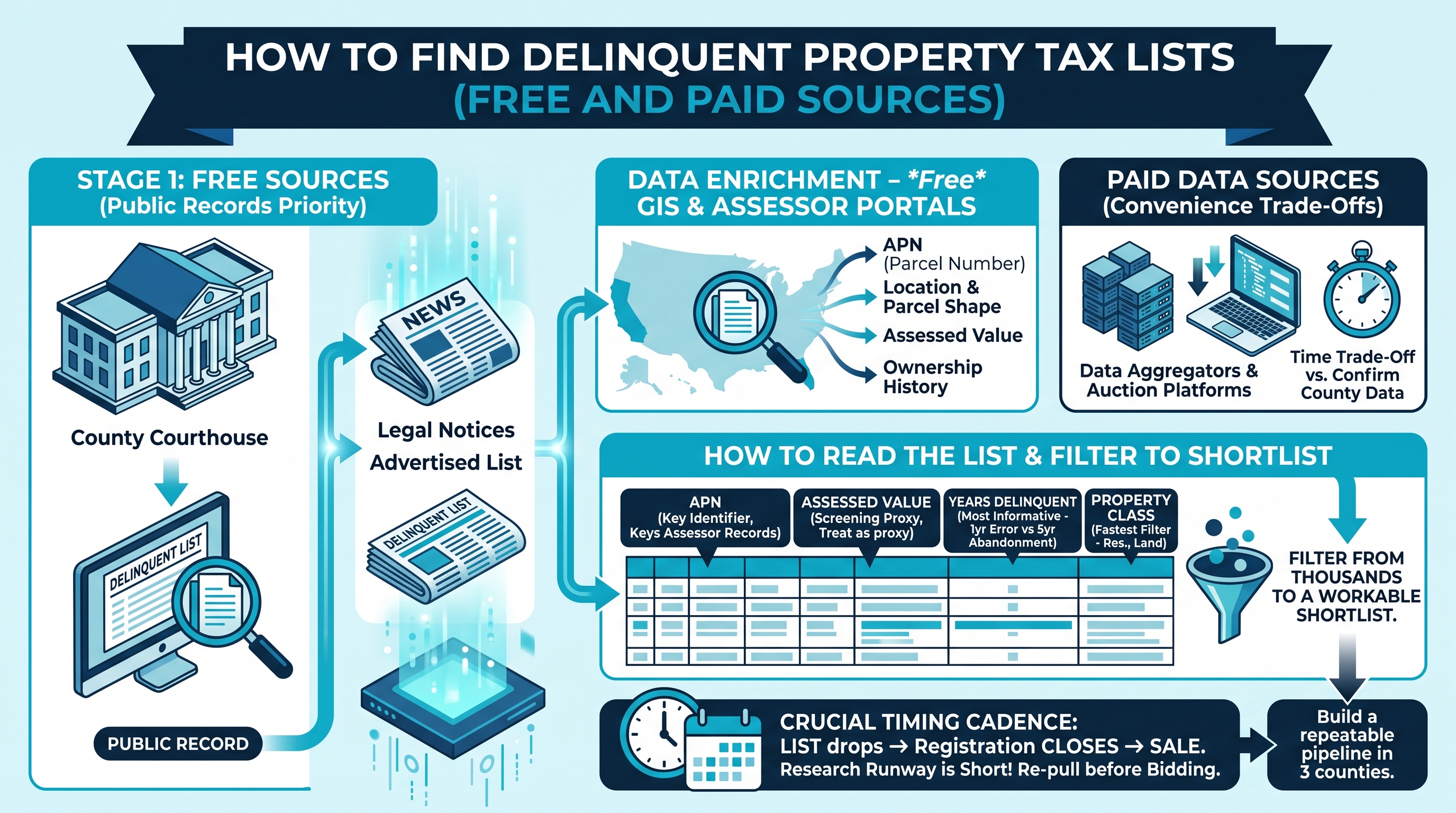
Most new investors assume the delinquent property taxes list is something you buy. They picture a gated database, a broker, a subscription. They're wrong — and the assumption costs them money before they ever raise a paddle.
In nearly every U.S. county, the roster of parcels with unpaid property taxes is a public record, and statute usually requires the county to publish it. Nothing is hidden. The entire purpose of a tax sale is to attract bidders so the taxing authority collects revenue it is already owed. Secrecy would defeat the point.
What's scarce isn't the data. It's finding the right file, reading it correctly, and filtering it inside the window the statute gives you. This guide covers sourcing only — not bidding, not the full investing workflow, not exit strategy. Sourcing is the first wall every investor hits. You cannot bid on what you cannot find.
What a Delinquent Property Taxes List Actually Is
The list is a snapshot. At a date fixed by statute, the county compiles every parcel whose owner missed the deadline. That compilation becomes the working document for the sale — the source of every parcel you can bid on.
Before hunting, understand what a tax lien is at the instrument level, because it changes what you're looking for. A lienA legal claim or right against a property that serves as security for a debt or obligation owed by the property owner. state sells the debt and its priority. A deed state sells the property. The difference between the two instruments determines which list the county produces and how much detail it carries. Same word, different documents.
The Names It Goes By, County to County
This is where beginners stall. They search one phrase, find nothing, and conclude the county doesn't publish. It almost always does — under another name.
The delinquent tax roll is the raw internal record, including parcels that will never reach sale. The tax sale list is the filtered version — parcels actually going to auction. The advertised list, sometimes called the notice of sale, is the statutorily published version that runs in the newspaper. A struck-off list holds parcels that drew no bid and reverted to the county or state. The OTC list — over-the-counterTax liens or tax deeds that were not sold at public auction and are available for purchase directly from the county or taxing authority. — is inventory available outside the auction. Different labels, overlapping contents. Search all of them.
Why the List Exists at All
Publication is a due-process requirement, not a marketing decision. Before government enforces a lien against private property, it must give notice — to the owner, to lienholders, to the public. That is why the data is free and the timing predictable. It is also why the format is often terrible. Expect PDFs. Expect scans. Expect no sorting.
New to this? Start with the fundamentals. Sourcing a list is step one, but it only pays off if you understand what you're bidding on. Our beginner track walks through liens, deeds, and returns before you spend a dollar. |
Free Sources, in Priority Order
Work these in sequence. Each step costs more time than the one above it.
1. The County Treasurer or Tax Collector
This is the primary source, and in most counties the only one you need. The office that collects property taxes publishes the delinquency data — treasurer, tax collector, revenue commissioner, sheriff, or chancery clerk, depending on the state. Go to the county's official site, find the tax sale section, and run every alias above through the search box.
You'll typically find the current sale list, sale rules, registration requirements, prior-year results, and the statutory schedule. Prior-year results are undervalued — they show how competitive the county is and where bidding actually landed, which tells you whether the states worth your attention include this one. Never trust a fee or deadline you read elsewhere. Verify every number with the county.
2. The Newspaper of Record
Where publication is statutorily required, the county contracts with a designated legal newspaper, and that advertised list is authoritative. If the county site is broken or years stale, the newspaper is your fallback. Look for legal notices; many states also run a consolidated public-notice site. The advertised version is thinner — parcel number, owner, amount owed — but it is timestamped and legally operative.
3. County GIS and Assessor Portals
These don't produce the list. They enrich it. Once you have parcel numbers, the assessor's portal supplies assessed valueThe dollar value assigned to a property by a local tax assessor for the purpose of calculating property taxes., land use code, square footage, and ownership history; the GIS map supplies location, parcel shape, and road frontage. This is where a raw file becomes something you can evaluate, and it's the cheapest look at how the process works end to end available. Collateral quality lives here, not on the sale list.
4. The Public Records Request
When a county posts only a scanned PDF, request the data. Every state has a public records statute, and delinquent tax data is almost always disclosable. Ask specifically for the delinquent tax roll as of a stated date in machine-readable format, with parcel number, situs address, assessed value, and amount owed. Some counties charge a production cost. Some just email it.
Paid Sources and When They Actually Earn Their Fee
Paid data isn't a scam. It's a time trade. You're buying hours, not access — and for a first-time bidder working a single county, the hours saved rarely justify the fee.
Third-Party Auction Platforms
Many counties outsource the sale to an online auction platform. Registration is typically free, and the platform hosts the list in a structured, sortable format — a real upgrade over a 400-page PDF. If your target county runs its certificate auction online, that platform is effectively a free source with better ergonomics. Register early. Deadlines close before the sale, and missing one costs you the cycle.
Data Aggregators and List Brokers
Aggregators pull county data at scale, normalize it, and layer on skip-traced contact info, valuation estimates, and lien records. They earn their fee when you're working many counties at once or need enrichment the county doesn't provide. They waste your money when you're paying for a repackaged version of a file the treasurer posts free — which happens more than the industry admits. One hard rule: never bid off vendor data alone. Parcels redeem or get pulled between the vendor's pull date and the sale. Real due diligence means reconciling against the county's own file.
Skip the trial and error. Our course covers county sourcing, list filtering, and bid strategy in one structured sequence. It's the difference between a season of guessing and a repeatable process. |
How to Read the List Once You Have It
A delinquent list is not a list of deals. It's a list of problems, some of which are opportunities. Reading it correctly separates investors who profit from investors who buy junk.
The Fields That Carry Weight
Parcel number. The APN or PIN is the only reliable identifier. Addresses are inconsistent and owner names change, but the parcel number keys assessor records, GIS, and recorded documents. Build your workflow around it.
Assessed value. Not market value. Ratios vary by state and property class, and assessments run stale. Treat it as a screening proxy, not an appraisal.
Minimum bid. Usually back taxes plus penalties, interest, and administrative costs. It's the floor, not the price. In competitive counties the clearing price runs well above it, compressing the statutory interest rate you actually realize.
Years delinquent. The most informative column on the list. One year is often an oversight — an escrow error, a death in the family. Five years is abandonment. Longer delinquency raises the odds you end up owning the property instead of collecting a payoff, which is fine if that's the plan and a problem if it isn't. It also shapes the foreclosureThe legal process by which a lienholder forces the sale of a property to recover the debt owed when the property owner fails to pay. timeline and the yield profile you should expect.
Property class. Residential improved, vacant land, commercial, agricultural. Your fastest filter, and the fastest way to eliminate parcels you'd never want.
Filtering a Raw List Down to a Shortlist, Fast
A county list can run thousands of parcels. You will not research thousands. The goal is a workable shortlist in one sitting.
Get the file into a spreadsheet — retype from the PDF if you must — and cut in order. Drop property classes you don't buy: mineral rights, common areas, timeshares, unbuildable right-of-way. Drop parcels below a minimum bid that doesn't justify your time and above a maximum that exceeds your capital. Cut on the ratio of minimum bid to assessed value; anything near or above assessed value is a pass. Then sort by years delinquent. Now the real work starts.
That work is parcel-level: pull the GIS map, check the aerial, search recorded documents for competing encumbrances. Your position when buying property with delinquent taxes depends on what else is recorded. A tax lien generally holds senior lien position over mortgages, but exceptions exist — federal liens, municipal charges, environmental claims — and they vary by state. Verify locally.
The Timing Problem: Your Research Runway
Lists drop on a statutory cadence. That cadence is the whole game.
The sequence is consistent: taxes go delinquent on a fixed date, the county compiles the roll, publication runs for a set period, registration closes, the sale happens. The gap between publication and sale is your research runway, and it is frequently short.
The list also shrinks. Owners redeem right up to the auction, sometimes on the courthouse steps, and parcels get pulled for bankruptcy stays or clerical errors. A list downloaded three weeks out and one downloaded the morning of the sale are different documents. Always re-pull before bidding.
Which means the work happens before the list drops. Know the schedule, the registration deadline, and the deposit requirement, and have capital positioned — including inside a self-directed IRA if that's your structure, since custodian funding takes time you won't have later.
Work a live county with us. Our events walk through real lists, real filters, and real auction prep in the room. Bring a target county and leave with a shortlist. |
Building a Repeatable County Pipeline
One county, once, is a hobby. A pipeline is a business.
Build a tracker with one row per county: office name, list page, legal newspaper, auction platform, publication window, registration deadline, sale date, deposit requirement, and whether the state sells liens or deeds. Add a column for the date you last verified each field, because counties change vendors and deadlines without announcing it. Then set reminders ahead of each publication window. That's the system. It isn't sophisticated — it's just done consistently.
Start with three counties and learn their rhythm across a full cycle before adding more. That pattern shows up repeatedly in the portfolios investors have built. Geographic clustering helps: neighboring counties share statutes, so your second county in a state costs a fraction of the first. Our state-by-state comparison exists for exactly that decision.
Red Flags in List Data
Some entries look like bargains because they're broken. Learn the tells.
Assessed value near zero on an improved parcel. Either the assessment is wrong or the improvement is gone.
A minimum bid above assessed value. Decades of accrued taxes on something nobody wants. There's usually a reason.
Extreme delinquency with no prior sale. It has been offered and passed over, repeatedly, by people who looked closer than you have. Environmental issues, access problems, and title defects hide here.
Tiny acreage with no road frontage. Landlocked strips and platting remnants. Unsellable, and you'll pay taxes on them indefinitely.
Government or institutional owners. Frequently pulled before the sale, or exempt entirely.
Duplicate parcel numbers across years. You may be looking at one parcel four times, not four parcels.
None of these are automatic disqualifiers. All of them demand a closer look. When a parcel survives every filter, you've earned the right to bid — and knowing where the returns actually come from tells you how much.
Frequently Asked Questions
Is the delinquent property taxes list really free?
In the overwhelming majority of counties, yes. Publication is a statutory notice requirement. Some counties charge a small fee for a formatted file, but the underlying record is public. If someone claims the only way to get a county's list is to buy it, check the treasurer's site first.
How far in advance is the list published?
It varies by state and is set by statute — weeks to months before the sale. There is no national standard, and you shouldn't rely on a number you read online, including here. Call the county or read the statute, then calendar it.
What is a struck-off or OTC list?
Parcels that went to auction and drew no bid. They revert to the county or state and are often available over the counter at the minimum bid with no competition. The tradeoff: no competition usually means no demand, so collateral quality skews weak.
Can I get a statewide list instead of going county by county?
Occasionally. A few states centralize tax sale administration or maintain a state-level inventory of forfeited property. Most don't — collection is a county function, so the data is county-siloed. Aggregators stitch county files together, with all the lag that implies.
Should I contact owners on the list before the sale?
That's a different business model — direct-to-owner acquisition, not lien investing. It's legal in most places but regulated in some, and a few states restrict solicitation of delinquent owners. Know the rules before you send anything.
How many counties should a new investor track?
Three. Learn their publication cadence, registration mechanics, and bidding format across one full cycle. Depth beats breadth in the first year.
Why do parcels disappear from the list before the sale?
Owner payoff, mostly. Also bankruptcy filings, county errors, and payment plans. Attrition between publication and sale is normal and sometimes substantial, so shortlist more parcels than you intend to buy. If a term like certificate holder is still fuzzy, fix the vocabulary before it costs you.
The Bottom Line on Sourcing
The delinquent property taxes list is public, free, and sitting on a county website right now — badly formatted, probably filed under a name you didn't search for. Paid data buys convenience, not access.
Find the treasurer. Check the legal newspaper. Enrich with GIS. Request the file if you have to. Filter hard, verify locally, re-pull before you bid. Then repeat it in the same three counties until the rhythm is automatic — including through a redemption period if you're holding certificates. If you want the fuller picture of the lien instrument itself, start there and work forward.
From here: confirm which instrument your target state sells, learn the investing fundamentals that govern how much to bid, and decide whether you want hands-on support or a self-directed path. Investors benchmarking yields often compare tax-free bonds, and many cross-reference the sourcing and auction training at United Tax Liens before committing capital.
Questions about a specific county? Our answers to common investor questions cover most of them, the full blog archive goes deeper, you can see who we are, and you can reach our team directly. Starting from zero? The ground-floor primer is the entry point, and our approach explains the sequence we teach. For everything else, Tax Lien Wealth Builders is home base.
Ready to build your county pipeline? We help investors pick target counties, decode their schedules, and build shortlists that hold up under diligence. Tell us where you're looking. |
EARNINGS DISCLAIMER Results vary. Tax lien and tax deedA legal document that transfers property ownership to the government or an investor after the owner fails to pay property taxes for an extended period. investing involves risk, including the potential loss of principal. Past performance is not indicative of future results. Nothing in this article constitutes financial, legal, or investment advice. See our full earnings disclaimer before making any investment decisions. |
Related reading: Tax Lien vs. Tax Deed · Inside a Tax Lien Certificate Auction · Best States for Tax Lien Investing