
Most people walk into a tax deed saleA public auction where the actual ownership of tax-delinquent properties is sold to the highest bidder, transferring the deed to the winning investor. believing they're about to buy a house for the price of a used car. They're wrong. What you buy at a tax deed auction is not a clean, move-in-ready property—it's a legal claim wrapped in unknowns. The upside is real. So is the downside. The investors who profit are the ones who treat every risk as a line item to price, not a surprise to absorb.
This guide breaks down the specific risks of buying tax deed properties and—more importantly—how to manage each one before your paddle goes up. If you're new to this asset class, start with the fundamentals, then come back here. At Tax Lien Wealth Builders, we teach investors to win by losing fewer deals, not by chasing every bargain.
Learn the Full System Before You Bid Our live workshops walk you through tax deed due diligenceThe research and investigation process an investor conducts before purchasing a tax lien or tax deed to evaluate the property and assess risk. step by step, with real auction lists and real numbers. |
What You're Actually Buying at a Tax Deed Sale
A tax deed transfers ownership of a property after the owner fails to pay property taxes. That's different from a tax lien certificateA legal document issued by a government authority when a property owner fails to pay property taxes, granting the certificate holder a lien on the property., which is a claim on the debt rather than the real estate itself. Understanding the difference between a tax lien and a tax deed is the foundation for everything that follows—the risk profiles are not the same.
When you win a tax deed, you typically receive a deed with limited or no warranty. The county sells you whatever interest it can convey, and nothing more. It does not guarantee clear title, a habitable structure, or a vacant property. If you assumed otherwise, you've already made your first mistake. Before you bid, make sure you understand what a tax lien actually is and how to invest in tax liens, because many deed states run hybrid systems where liens and deeds overlap.
The Real Risks of Buying Tax Deed Properties
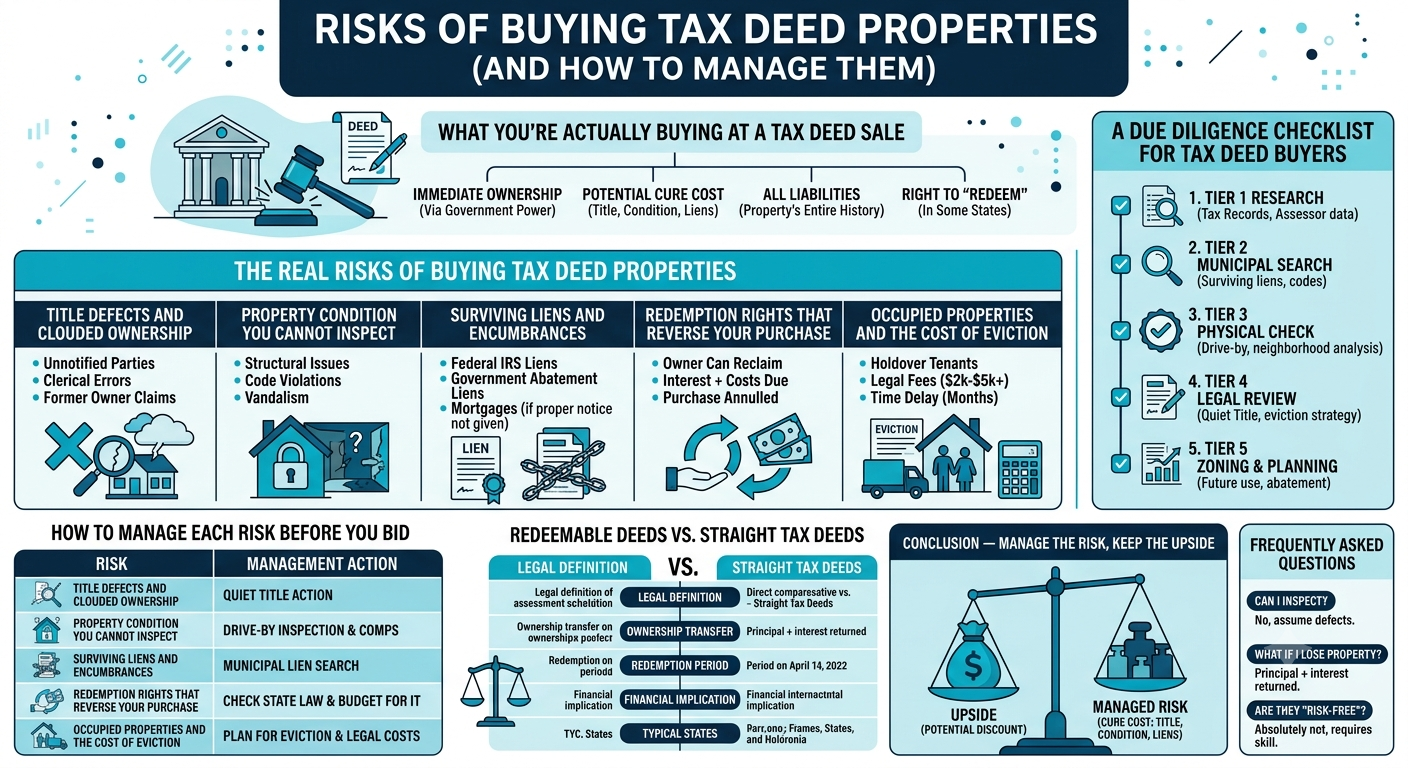
Every tax deed carries risk in five predictable places. Learn to see all five and you'll price deals like a professional instead of gambling like a tourist.
Title Defects and Clouded Ownership
The biggest risk is title. A tax deed rarely gives you marketable title on day one. There may be gaps in the chain of ownership, competing heirs, or procedural defects in how the county conducted the sale. Until you clear these, you cannot easily sell or refinance the property. Most investors resolve this through a quiet title actionA lawsuit filed to establish clear ownership of a property and resolve any disputes or claims against the title. or a title-clearing service—budget for both time and legal fees. The certificate of title you eventually obtain is what turns a speculative purchase into a sellable asset.
Property Condition You Cannot Inspect
You almost never get to walk through a tax deed property before buying. Interiors may be gutted, fire-damaged, or hoarder-packed. Assume the worst and inspect everything you legally can from the outside—roofline, foundation, utilities, and neighborhood comparables. A property that looks like a bargain on the auction list can hide $40,000 in deferred repairs. The number on the screen is not the number you'll spend.
Surviving Liens and Encumbrances
A tax deed usually wipes out junior liens, but not all of them. Federal tax liens carry a 120-day IRS redemption right. Municipal liens, code-enforcement fines, and certain HOA assessments can survive the sale and become your problem. Pull a full lien search before you bid. The specifics vary by state, so confirm exactly which encumbrances your target county extinguishes—and which ones follow the property to you.
Redemption Rights That Reverse Your Purchase
In many jurisdictions the delinquent owner can reclaim the property during a statutory redemption period—sometimes months, sometimes years—by repaying taxes plus interest and penalties. In redeemable-deed states, your “purchase” can be undone. That's not automatically bad; you earn a return when they redeem. But it changes your exit plan, and you need to know the redemption window before you commit capital. This is where knowing how the process works pays off.
Occupied Properties and the Cost of Eviction
Winning the deed doesn't hand you the keys. If the former owner or a tenant occupies the property, you may need a formal eviction—governed by landlord-tenant law, not auction rules. Evictions take time and money, and cash-for-keys negotiations are common. Factor possession costs into every occupied deal, and read up on buying property with delinquent taxes to see how experienced buyers take control of a property after the sale.
Get the Tax Deed Due Diligence Checklist Our services team helps investors vet parcels, run lien searches, and set disciplined maximum bids before every auction. |
How to Manage Each Risk Before You Bid
Risk management in tax deeds is not complicated, but it is disciplined. Every risk above has a corresponding control. Title risk is managed with a pre-bid title search and a post-sale quiet-title budget. Condition risk is managed with a strict maximum bid that assumes heavy repairs. Lien risk is managed with a county-specific encumbrance search. Redemption risk is managed by reading the statute and pricing the interest you'd earn if the owner redeems. Occupancy risk is managed by budgeting for eviction up front.
Learn how tax deed auctions run so the mechanics never catch you off guard, and study the mechanics of investing until they're second nature. Our structured coursework breaks each control into a repeatable habit, so due diligence stops feeling like guesswork and starts feeling like a routine.
A Due Diligence Checklist for Tax Deed Buyers
Before every auction, work the same checklist. Confirm the parcel number and legal description. Run a title and lien search. Verify the redemption periodThe legally defined timeframe during which a property owner can reclaim their property by paying the delinquent taxes plus interest and penalties. and any surviving owner rights. Estimate repairs conservatively. Check the neighborhood's recent sales. Set a hard maximum bid—and refuse to cross it. Confirm the county's payment deadline and accepted forms of funds. This routine is what separates disciplined investors from gamblers.
If you want structured support, our professional due diligence support and our beginner's guide walk you through each step. You can also see how the returns stack up once the risk is properly priced—because a deal you understand is a deal you can profit from.
Redeemable Deeds vs. Straight Tax Deeds
Not every deed is final. Redeemable-deed states—Texas and Georgia among them—sell you the property subject to a redemption window during which the former owner can buy it back at a penalty. Straight tax-deed states convey ownership outright, subject only to title clearing. The distinction changes your entire risk model, your holding period, and your exit strategy.
For a deeper contrast, review the state-by-state statutes and how they treat redemption. Online training programs like United Tax Liens cover these state differences for investors who can't attend live sales, and you can also learn to make money with tax liens using a redeemable-deed approach. Some investors hold these deals inside a self-directed IRA or weigh them against the stability of tax-free bonds when building a balanced portfolio.
Join a Live Tax Deed Workshop Watch experienced investors evaluate real deed auctions in real time—and learn which deals they walk away from and why. |
Frequently Asked Questions
Are tax deed properties really sold for pennies on the dollar?
Sometimes—but the sticker price is only part of the cost. Once you add title clearing, repairs, surviving liens, and possible eviction, the true cost can climb fast. A disciplined investor prices all of it before bidding. Our our FAQ covers the most common misconceptions in more detail.
Can I lose my entire investment on a tax deed?
It's possible, though uncommon with proper due diligence. The two most likely ways to lose money are overpaying for a property with hidden defects and buying into surviving liens you didn't account for. Both are preventable with a pre-bid checklist.
How long does it take to get clear, sellable title?
It varies. A quiet title action commonly takes several months, depending on the state and the complexity of the ownership history. Some investors sell with a title-insurance workaround sooner, but a full quiet title is the cleanest path to a marketable property.
Do I have to pay off other liens on the property?
Only the ones that survive the tax sale. Most junior liens are extinguished, but federal tax liens, certain municipal charges, and some HOA dues can remain. A lien search tells you exactly what you're inheriting before you bid.
What happens if someone is living in the property?
You take possession through the legal eviction process, not by changing the locks. Budget for the time and cost. Many investors negotiate cash-for-keys to speed things along and avoid a drawn-out court process.
Is tax lien or tax deed investing safer for a beginner?
Tax lien certificates are generally lower-touch, since you're buying a debt with a fixed return rather than managing real estate. Tax deeds offer bigger upside but more operational risk. Read more across the blog to decide which fits your goals and risk tolerance.
Conclusion — Manage the Risk, Keep the Upside
Tax deeds reward preparation and punish assumptions. The property is real, the discount can be real, but so is every risk on this page. Price them in, walk away when the numbers don't work, and you'll build a portfolio that survives its own mistakes. Everything we teach reflects our approach to tax deed investing: fewer deals, better deals.
Ready to go deeper? Our tax lien investing course and live training events turn this checklist into a repeatable system, and our investors who've done it show what disciplined execution looks like. Questions about your first deal? Get in touch or meet our team.
Start Investing with Confidence Turn risk management into a system. Our course gives you the checklists, templates, and state guides used on real deals. |
Earnings Disclaimer Results vary. Tax deed investing involves risk, including the potential loss of principal. Past performance is not indicative of future results. Nothing in this article constitutes financial, legal, or investment advice. See our full earnings disclaimer before making any investment decisions. |
Related reading: Tax Lien vs. Tax Deed · Tax Lien Certificate Auctions · Making Money with Tax Liens