
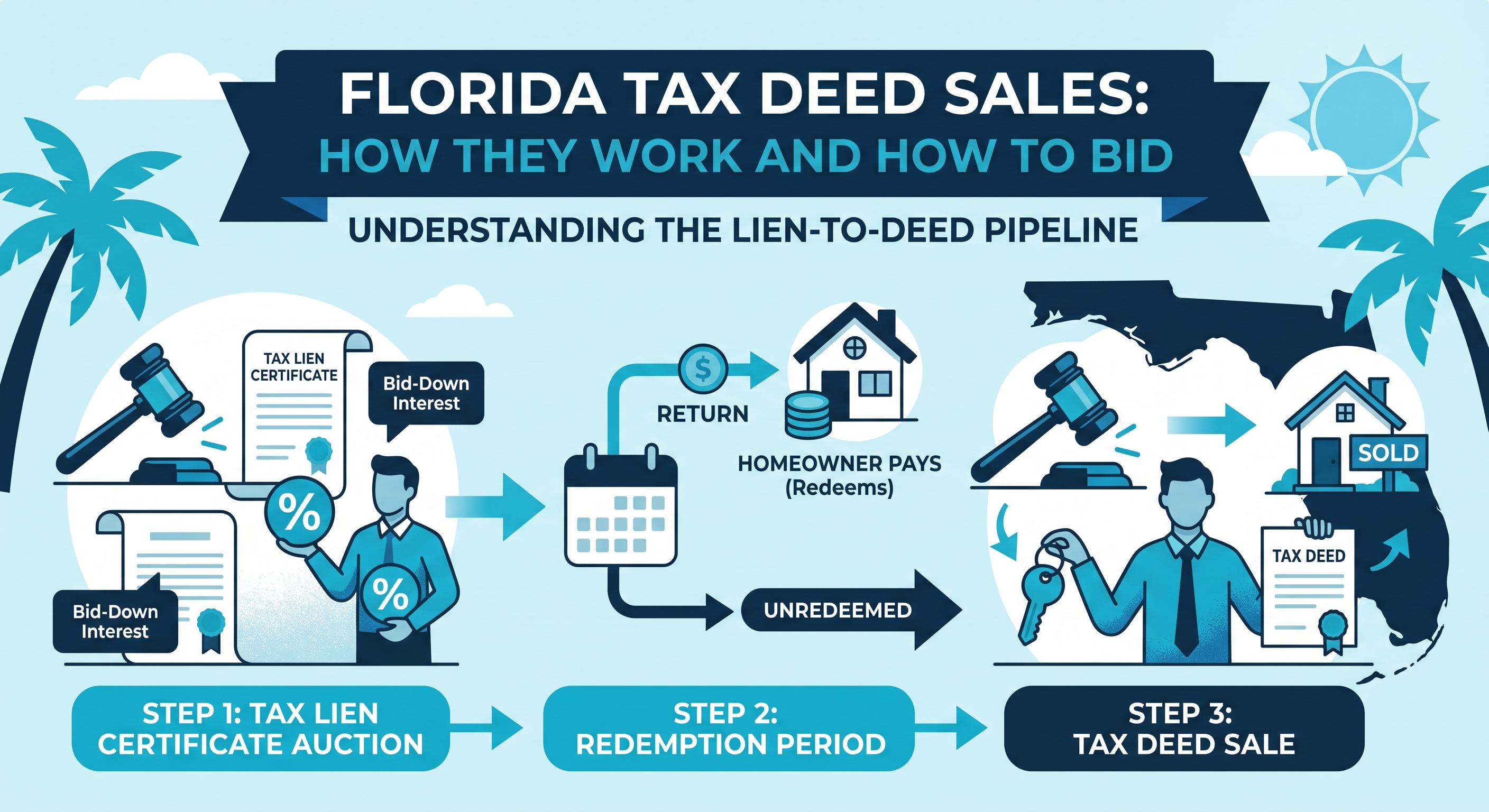
Florida Is a Lien State That Ends in Deed Sales
Most investors researching a tax deed sale in Florida assume they are shopping a deed state — show up, bid, own the house by dinner. They're wrong. Florida is a lien state. Every delinquent parcel begins as a tax lien certificateA legal document issued by a government authority when a property owner fails to pay property taxes, granting the certificate holder a lien on the property. sold by the county tax collector, and only a fraction of those certificates ever mature into a deed auction. The difference between a tax lien and a tax deed is not academic here — it is the structure of the entire market.
The pipeline in one paragraph: taxes go unpaid, the tax collector auctions a certificate against the parcel, and that certificate carries a statutory interest rate of 18% maximum, bid down competitively. If the owner pays the back taxes plus accrued interest during the redemption period, the holder collects and exits. If nobody pays, the holder may apply for a tax deed and the clerk of court schedules a public sale. Stage two does not exist without stage one.
People search for Florida deed auctions, land on county calendars full of parcels, and never realize each listing is the tail end of a lien that failed to redeem. Investors who grasp what a tax lien actually is before they bid price risk correctly. Investors who skip that step buy landlocked strips of swamp.
New to Florida's two-stage system? Our training walks through certificate auctions and deed sales side by side, with real county examples. Learn the sequence before you risk capital on it. |
Stage One: The Tax Lien Certificate Auction
Florida property taxes become delinquent on April 1, and counties run certificate sales online in late spring. The county is not selling you property — it is selling the government's claim to an unpaid tax so it can make its budget whole immediately, which is why your position is senior. Anyone new to this should start with the fundamentals of lien investing before touching a Florida bid screen.
How the Bid-Down Works
Certificates start at 18% and bidders compete downward. The winner accepts the lowest rate, and in competitive counties popular residential parcels clear at fractions of a percent. Florida softens that with a statutory minimum: on early redemption the holder generally collects a mandatory 5% minimum on the certificate face amount rather than the thin interest actually earned. The one exception is a certificate struck at zero percent, which earns no interest and no minimum. That is why disciplined bidders stop at 0.25% instead of going to zero — the quarter-percent bid still collects the floor, the zero bid collects nothing. Rate and ownership pull in opposite directions. You win rate, or you win a chance at the parcel.
If you want yield, you are buying rate and volume, and the certificate auction is your entire game. If you want real estate, you are buying certificates on parcels you would happily own, accepting a thin rate as the cost of the option. Our breakdown of the profit models behind tax liens covers both paths.
What the Certificate Holder Actually Owns
A certificate holder owns a first-priority claim, not a deed. You cannot enter the property, collect rent, evict anyone, or list it. You hold a lien in senior lien position that accrues interest and, after a waiting period, lets you force a sale. Florida certificates also expire seven years from issuance if no deed application is filed, so investors who understand where the yield actually comes from treat that window as a hard operating constraint.
Stage Two: The Tax Deed Application
The Trigger and the Timeline
A certificate does not become a deed sale on its own. Somebody has to apply. Under Florida law, the holder may file a tax deed application once two years have passed from April 1 of the year the certificate was issued. Filing costs money: the applicant pays off all other outstanding certificates, pays current taxes, and funds the title search and clerk fees. Those amounts vary by county and parcel — confirm the schedule with the clerk handling the sale, because fee structures are not uniform statewide.
Once the application is complete, the clerk orders a title search, notifies the owner and every party of record, advertises, and sets an auction date. The process behind that pipeline is administrative rather than judicial, which is why Florida's foreclosure timeline runs faster than court-driven processes elsewhere.
Why Applicants Redeem More Often Than They Foreclose
Most applications never reach the block. The moment one is filed, the owner, the mortgage servicer, or a junior lienholder usually wakes up and pays — the applicant recovers everything advanced plus statutory interest. For yield-focused investors, the application is a collection tool, not an acquisition strategy, a point we hammer in our step-by-step guide to buying liens.
Parcels that do reach sale are, by definition, the ones nobody with money wanted to save. Sometimes the owner is deceased or unreachable; sometimes the property is worth less than the taxes owed. That second category is the trap, and sorting one from the other is a due diligence problem, not a bidding problem.
How a Florida Tax Deed Sale Actually Runs
County-by-County Online Platforms
Most Florida counties have moved deed sales online, and each clerk contracts with its own vendor — separate registrations, deposit rules, bidding interfaces, and cutoff times for every county you work. There is no statewide portal. Compare that friction against other states worth your capital before concentrating here.
Parcel lists publish ahead of the sale and change constantly, because parcels get pulled the moment someone redeems. Never fall in love with a parcel.
Deposits, Payment Windows, and Fees
Expect to post a deposit before bidding and to face a same-day or next-business-day deadline for the balance if you win. Winners also owe documentary stamp tax and recording costs on top of the bid. Deposit percentages, funding deadlines, and any buyer's premium differ by county — verify each with the clerk's office and the platform's published rules before registering.
Want the county-by-county workflow? We show investors how to build a repeatable research and bidding process across multiple Florida counties. Bring your questions to a live session. |
How the Opening Bid Is Calculated
The opening bid is an accounting number, not a market number. It is built from the applicant's certificate amount and accrued interest, other certificates the applicant redeemed, current and delinquent taxesProperty taxes that remain unpaid past the due date, which may result in penalties, interest, and eventually a tax lien being placed on the property., the title search, clerk and advertising fees, and any statutory additions tied to the parcel type. Nothing in it references what the home is worth.
On a well-located parcel with modest taxes, the opening bid may sit far below market — and thirty bidders will notice, pushing the price toward retail. On a distressed or unbuildable parcel, it can exceed anything the property is worth, and the listing draws zero bids. Weighing collateral quality against that opening number is the highest-leverage thing you do as a bidder.
What Survives the Sale and What Gets Wiped
Generally Extinguished
A Florida tax deed generally wipes properly noticed private encumbrances of record: mortgages, judgment liens, HOA assessments accrued before the sale, and most private claims junior to the tax lien. That is what makes buying property with delinquent taxes structurally different from a mortgage foreclosure auction, where you can inherit senior debt.
Generally Surviving
Plenty survives. Governmental liens and judgments held by a municipality or county — code enforcement liens, utility liens, special assessments, nuisance abatement charges — frequently ride through, and Florida case law on municipal claims is more nuanced than any blog paragraph can settle. Federal liens can carry a redemption right for the government, and easements, restrictive covenants, and rights of record generally remain.
Practice on municipal claims is inconsistent across Florida. Pull code enforcement history from the municipality and confirm treatment with that county's clerk before you bid. The auction platform's disclaimer is not a title opinion.
Homestead Property Changes the Math
Florida adds a protective layer for owner-occupied homes. When the parcel is homestead property, the statutory opening bid includes an additional amount equal to one-half of its latest assessed valueThe dollar value assigned to a property by a local tax assessor for the purpose of calculating property taxes.. That can push an opening bid from a few thousand dollars to six figures on an ordinary house — the legislature did not want families losing homes over small tax bills.
Homestead parcels rarely offer the spreads newcomers imagine, and the inflated opening bid means fewer of them sell at all. Check exemption status on the property appraiser's site before you build any model, and confirm the assessed value the clerk used. Investors arriving from tax-advantaged fixed income are routinely surprised by how much statutory detail moves the outcome here.
The Biggest Florida Counties by Volume
Volume concentrates where population does. Orange, Miami-Dade, Polk, Lee, Duval, Hillsborough, Pinellas, and Broward generate the deepest certificate and deed pipelines in the state.
Miami-Dade and Broward draw heavy institutional participation, which compresses certificate rates and pushes deed prices toward market. Orange and Hillsborough pair metro depth with steady suburban inventory. Polk and Lee produce large volumes of vacant and semi-rural land, with wide quality dispersion and more genuine mispricing for bidders willing to do field work. Duval and Pinellas sit between, with older urban inventory where code enforcement history matters more than comps.
Pick two counties and learn them cold rather than skimming eight. Depth beats breadth — and reps are what our investors who have done this point to when asked what changed their results.
How to Research a Florida Tax Deed Property
The Due Diligence Sequence
Start with the clerk's parcel file: the application, the title search the clerk ordered, and the list of noticed parties. Then pull the property appraiser's record for assessed value, homestead status, land use, and sales history. Then pull official records for mortgages, judgments, easements, and liens, and query the municipality separately for code enforcement actions.
Next, verify the physical asset. Confirm legal access; Florida deed sales are full of parcels with no road frontage. Confirm zoning and buildability with county planning, check flood zone and elevation, and establish whether the lot is usable or a plat remnant. Drive it if you can. Photos lie by omission.
Then price it. Build a conservative resale or rental value, subtract rehab, surviving liens, carrying costs, and title-clearing legal work, and set a maximum bid. Write the number down. Investors funding through a self-directed IRA should add custodian rules and funding lead times to that sequence.
Bidding Discipline on Auction Day
Set your maximum before the sale opens and do not move it. Online platforms are engineered to keep you engaged, and the last two bidders in any contested lot are usually the two who stopped doing math. If a parcel clears your number, let it go.
Bid on several parcels where the economics work, expect to lose most, and treat every win as the start of a project rather than the end of a transaction. That mindset is the core of a repeatable investing approach in any state.
Not sure how to evaluate a parcel? Our team helps investors build a due diligenceThe research and investigation process an investor conducts before purchasing a tax lien or tax deed to evaluate the property and assess risk. checklist that fits their capital and risk tolerance. Start with a conversation, not a bid. |
After the Hammer: Surplus Funds and Title
When a parcel sells above the opening bid, the excess becomes surplus funds held by the clerk and distributed by statutory priority — to lienholders of record who file valid claims, then to the former owner. As the buyer you receive the deed, not the surplus.
The deed conveys title, but not automatically insurable title. Most title companies want a quiet title actionA lawsuit filed to establish clear ownership of a property and resolve any disputes or claims against the title. or a statutory waiting period first, so budget for that legal work. If the property is occupied, an eviction or ejectment process follows. Neither point argues against Florida; both argue for capitalizing the deal properly — a theme running through our investor blog.
Frequently Asked Questions
Is Florida a tax lien state or a tax deed state?
Both, in sequence. Certificates sell first, and unredeemed certificates convert into deed sales through an application — the confusion our lien-versus-deed comparison exists to clear up.
Can I buy a Florida tax deed without ever owning a certificate?
Yes. Any eligible bidder may participate in a scheduled deed sale. Owning the certificate only gives you the right to trigger the sale — no property, no discount. Many buyers work the deed side and never touch the underlying lien instrument.
Do I get insurable title from a Florida tax deed?
You get title. Insurability usually requires a quiet title action or a statutory waiting period. Talk to a Florida real estate attorney before assuming a fast resale.
Can the former owner challenge the sale afterward?
Challenges based on defective notice do happen, which is why the clerk's notification file belongs in every serious review and why the timeline from certificate to deed deserves attention.
Do mortgages survive a Florida tax deed sale?
Properly noticed private mortgages are generally extinguished. Governmental liens, certain municipal claims, easements, and covenants commonly survive — confirm treatment with the county running the sale.
Can I inspect the interior before bidding?
No. You are bidding on a property you cannot enter, so every valuation needs a rehab contingency wide enough to absorb an unpleasant surprise. Assume the worst interior condition consistent with the exterior.
How much capital do I need to start?
It varies enormously by county and parcel type. What matters is reserve — enough to fund the balance on deadline, cover title work, and carry the asset. Our answers to common investor questions go deeper.
Building a Florida Strategy That Holds Up
Florida rewards investors who respect the sequence: certificate first, application second, deed sale third, with a redemption at any point that ends the story profitably for the holder. Treat the certificate side as a yield business and the deed side as real estate.
The investors who last here share three habits. They pick a small number of counties and learn each clerk's practice cold. They verify every county-specific rule instead of importing assumptions from the last auction. And they walk away from parcels that clear their maximum, every time. Discipline is the entire edge.
Before committing capital, compare Florida against the states with the strongest lien statutes, then see how national investors frame the same question at United Tax Liens. The volume here is real. So is the complexity. Both are manageable with a process, and building that process is what our team spends its time on — laid out in our beginner-level training material and refined in the practical mechanics of acquiring liens.
Start narrow. Verify everything with the county. Bid the number you wrote down.
Ready to work Florida seriously? Tax Lien Wealth Builders gives investors the frameworks, county research process, and support to bid with confidence. See how we help investors get started. |
EARNINGS DISCLAIMER Results vary. Tax lien and tax deed investing involves risk, including the potential loss of principal. Past performance is not indicative of future results. Nothing in this article constitutes financial, legal, or investment advice. See our full earnings disclaimer before making any investment decisions. |
Related reading: How Tax Lien Certificate Auctions Work · Buying Property With Delinquent Taxes · Making Money With Tax Liens · Tax Lien Wealth Builders Home