
Most articles about tax lienA legal claim or right against a property that serves as security for a debt or obligation owed by the property owner. investing are sales pitches wearing an analyst's suit. They list the upside, wave off the risk, and promise a passive income machine. That is not this article. Tax lien investing is a legitimate, time-tested strategy with genuine advantages — and it also has real drawbacks that will cost you money if you ignore them. The honest answer to whether it is worth it is: it depends on you.
This breakdown gives you both sides without the spin. If you understand what a tax lien is and how liens differ from deeds, you already know the basics. What you need now is a clear-eyed view of the trade-offs so you can decide whether this belongs in your portfolio. For the full mechanics, keep our guide to how to invest in tax liens open alongside this one.
Get the full picture before you decide Pros and cons on paper are one thing. Watching the strategy work in real time is another. Our live sessions show you the good and the bad honestly. |
The Pros of Tax Lien Investing
The advantages are real, and they are the reason serious investors keep coming back to this asset class. Here is what actually works in its favor.
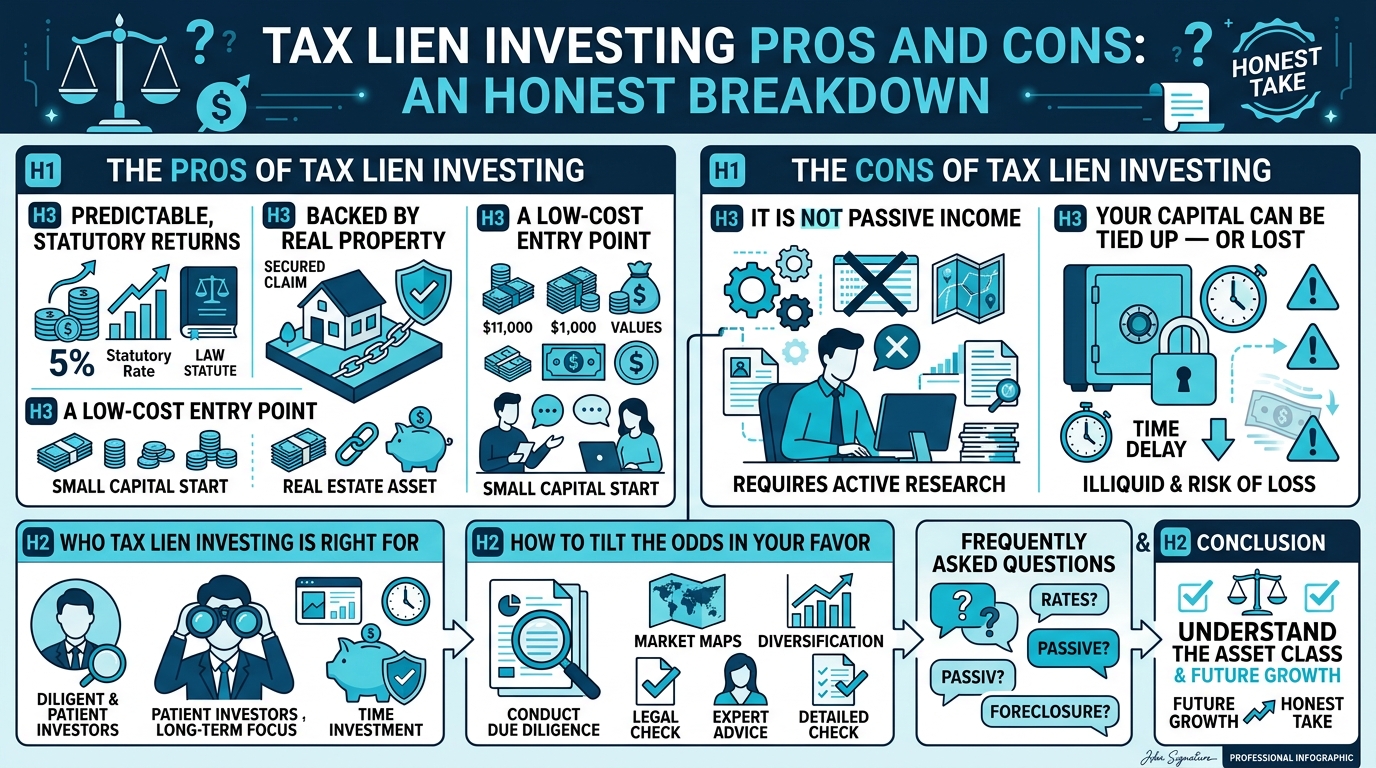
Predictable, Statutory Returns
When you buy a tax lien, the interest you earn is set by law, not by a market. The statutory interest rate is fixed by the state, so you know your maximum return the moment you buy. There is no guessing what a stock will do or whether rents will hold — the rate is on the books. That predictability is rare, and it is the single most attractive feature of the strategy. Our breakdown of how liens yield high profits shows how those fixed rates translate into real returns.
Backed by Real Property
A tax lien is secured by real estate, and in most jurisdictions the tax lien holds a senior lien position — ahead of the mortgage and most other claims. That means if the owner does not pay, your claim is near the front of the line, and your fallback is the property itself. Few fixed-return investments are backed by a hard asset you could ultimately own. That security is why the strategy appeals to investors who want yield without the naked risk of an unsecured loan, a point we cover further in how the process works.
A Low-Cost Entry Point
You do not need a fortune to start. Individual liens can cost a few hundred dollars, which makes this one of the most accessible ways to invest in real estate. That low barrier lets new investors learn with small amounts before scaling, and it is why our beginner's roadmap treats liens as an ideal first step. You can build a diversified position across many liens without the down payment a single rental property would demand.
See what realistic returns look like Fixed statutory rates sound great — but the real yield depends on the state, the competition, and your process. Learn how the numbers actually shake out. |
The Cons of Tax Lien Investing
Now the part the pitches skip. These drawbacks are manageable, but only if you go in with your eyes open.
It Is Not Passive Income
The biggest myth is that liens are hands-off. They are not. You have to research counties, vet properties, track redemption deadlines, and sometimes navigate foreclosureThe legal process by which a lienholder forces the sale of a property to recover the debt owed when the property owner fails to pay.. Skip the work and you will eventually buy a lien on a worthless property. Real returns come from real diligence — the same effort that separates success from loss when buying property with delinquent taxes or bidding at a tax lien certificate auction. Anyone selling this as effortless is selling you the risk along with the dream.
Your Capital Can Be Tied Up — or Lost
Two related problems. First, liquidity: your money is committed until the owner redeems, which follows the redemption period set by the state and can run months or years. You cannot sell a lien like a stock. Second, real loss: if the property behind the lien is worthless and the owner never redeems, your fallback — taking the property — leaves you with an asset you cannot sell, and your principal is gone. Diversification and diligence reduce this risk, but they never eliminate it, which is exactly why we point investors to the best states for tax lien investing before they commit capital anywhere.
Learn to avoid the liens that lose money Most losses trace back to skipped due diligenceThe research and investigation process an investor conducts before purchasing a tax lien or tax deed to evaluate the property and assess risk.. Our team helps investors build a vetting process that keeps worthless collateral off their books. |
Who Tax Lien Investing Is Right For
This strategy fits patient, detail-oriented investors who want asset-backed yield and are willing to do research. It suits people building long-term wealth rather than chasing a quick payday, and it works especially well inside a self-directed IRA, where the interest can compound tax-advantaged. It complements other conservative holdings like tax-free bonds for investors who want a yield sleeve backed by hard assets. It is a poor fit for anyone who needs liquidity, wants truly passive income, or refuses to do due diligence. Be honest about which describes you.
How to Tilt the Odds in Your Favor
The gap between a good outcome and a bad one is process. Diversify across many liens so no single bad property sinks you. Specialize in a few counties and learn their rules cold. Vet every property before you buy — value, access, and surviving liens. Track every redemption deadline as the certificate holder with a real stake in the timing. And keep learning: our step-by-step how-to and the wider library on the TLWB blog exist to shorten your learning curve. The investors who do this consistently are the ones whose success stories we get to share.
One more habit separates the professionals: they size positions to survive being wrong. No single lien should be large enough that its failure hurts. Spread your capital, keep a cash reserve for foreclosure or title costs, and treat your first year as tuition rather than a profit target. The strategy rewards investors who compound steadily over years, not those who bet big on one property and hope. Patience is not a personality trait here — it is a risk-management tool, and it is the quiet reason disciplined lien investors outlast the ones chasing headline yields.
Frequently Asked Questions
Is tax lien investing worth it?
For the right investor, yes. It offers predictable, statutory returns backed by real property at a low entry cost. But it demands due diligence and ties up your capital, so it is worth it only if you value asset-backed yield over liquidity and are willing to do the research. Our guide to making money with tax liens covers realistic expectations.
Can you lose money investing in tax liens?
Yes. If the property behind the lien is worthless and the owner never redeems, your principal can be lost because your fallback is an asset you cannot sell. Diversification and thorough due diligence sharply reduce this risk, but they do not remove it. Never treat a lien as risk-free.
Is tax lien investing passive income?
No, despite the common claim. It requires researching counties, vetting properties, tracking deadlines, and sometimes foreclosing. It can become more efficient with experience, but it is never truly hands-off. Anyone marketing it as passive is downplaying the work and the risk.
How much can you earn on a tax lien?
Returns are capped by the state's statutory interest rate, which varies widely by jurisdiction. In competitive auctions, bidding can lower your effective rate. The state sets the ceiling; your diligence and the specific auction set the reality. Compare rates using the best states guide.
How long is my money tied up?
Until the owner redeems, which depends on the state's redemption periodThe legally defined timeframe during which a property owner can reclaim their property by paying the delinquent taxes plus interest and penalties. and can range from months to a few years. If the owner never redeems, your timeline extends into the foreclosure process. Liens are not liquid — plan to commit the capital for the full period.
Is it better than tax deedA legal document that transfers property ownership to the government or an investor after the owner fails to pay property taxes for an extended period. investing?
Neither is universally better; they serve different goals. Liens are a yield strategy, deeds are an acquisition strategy. Many investors do both. Read our full comparison and reach out through our contact page or meet our team if you want help deciding.
Conclusion
Tax lien investing is not a miracle and it is not a scam. It is a legitimate strategy with a clear profile: predictable, asset-backed returns in exchange for illiquidity and the demand for real diligence. If that trade appeals to you, it can be a powerful part of a portfolio. If it does not, no amount of marketing should talk you into it. Know yourself, do the work, and let the fixed rates do their job. For investors building a nationwide approach, the online training at United Tax Liens is a useful companion, and everything ties back to the fundamentals at Tax Lien Wealth Builders and our FAQ page.
Decide with clarity, not hype Join a live session, see the real pros and cons in action, and build a plan that fits your goals and your risk tolerance. |
EARNINGS DISCLAIMER Results vary. Tax lien investing involves risk, including the potential loss of principal. Past performance is not indicative of future results. Nothing in this article constitutes financial, legal, or investment advice. See our full earnings disclaimer before making any investment decisions. |
Related reading: How to Invest in Tax Liens · Tax Lien vs. Tax Deed · Tax Lien Investing for Beginners · How It Works