
Most investors think you have to fight through a crowded auction to buy a tax lienA legal claim or right against a property that serves as security for a debt or obligation owed by the property owner.. You don't. Every year, thousands of liens go unsold at auction and land on a county list where anyone can buy them directly — no bidding war, no auction-day pressure, no competition driving your return into the ground. They are called over-the-counterTax liens or tax deeds that were not sold at public auction and are available for purchase directly from the county or taxing authority. tax liens, and for the right investor they are one of the most overlooked entry points in the entire field.
The catch is exactly what you would expect: these liens went unsold for a reason. Some are on undesirable properties, some carry more risk, and some are simply leftovers nobody got to. Your edge comes from telling the difference. This guide covers what over-the-counter liens are, why they exist, how they compare to buying at a live tax lien auction, and how to buy them without stepping on a landmine. If the term itself is new, start with what a tax lien is and then come back.
New to lien investing? Start with the fundamentals Over-the-counter liens are a great entry point — but only if you understand how liens work first. Our live sessions cover the mechanics from the ground up. |
What Are Over-the-Counter Tax Liens?
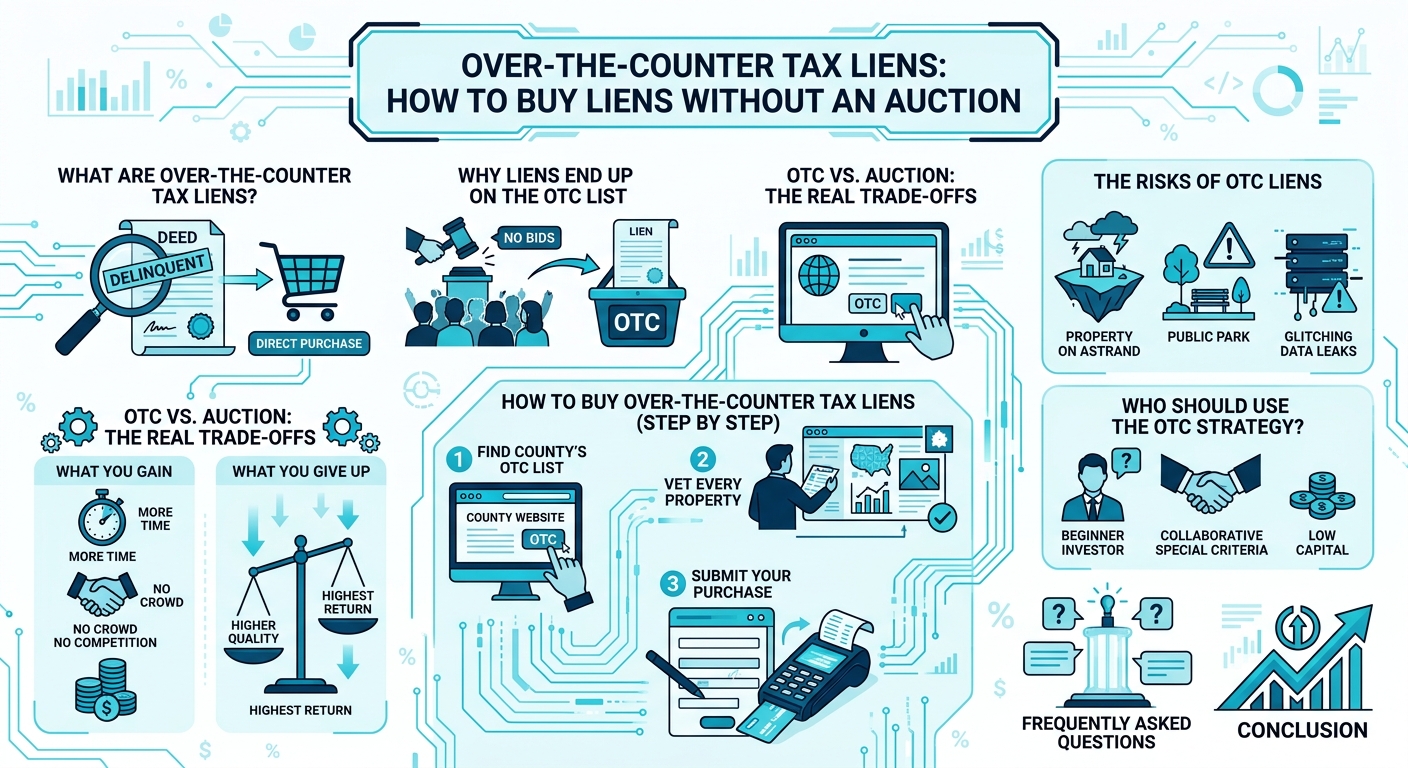
Over-the-counter tax liens — often called OTC or county-held liens — are tax liens that did not sell at the county's public auction and are now available for direct purchase from the county. Instead of bidding against other investors, you simply buy the lien at a fixed price: the back taxes, penalties, and fees the county is owed. In most jurisdictions you still earn the same statutory interest rate you would have earned at auction, and you become the certificate holder with the same rights to collect or eventually foreclose.
The core mechanics are identical to auction liens. The property owner still owes the taxes. They still have a redemption period to repay you with interest. If they never redeem, you can still move toward acquiring the property. The only thing that changes is how you acquired the lien — quietly, off a list, rather than in a competitive room. For the full picture of how liens generate returns, our guide to how to invest in tax liens lays out the mechanics that apply here too.
Why Liens End Up on the OTC List
Understanding why a lien went unsold is the whole game. Liens land on the over-the-counter list for a mix of reasons, and not all of them are bad. Some auctions simply have more inventory than buyers, so perfectly good liens go unsold purely because the room ran out of capital or attention. Those are the ones you want.
Others went unsold because investors looked at the underlying property and passed — a worthless parcel, a property with a surviving lien, land with no road access, or a structure not worth the taxes owed. Those are the ones that will quietly drain your capital. The list mixes both types together with no label, which is why the OTC strategy rewards research over enthusiasm. This is the same discipline that separates winners from losers when buying property with delinquent taxes through any channel.
OTC vs. Auction: The Real Trade-Offs
Over-the-counter buying is not automatically better than the auction — it is a different tool with a different profile. Knowing what you gain and what you give up keeps your expectations honest.
What You Gain
You gain convenience and, often, a better yield. Because there is no bidding, nobody competes your interest rate down. In states that use bid-down-interest auctions, competition can shrink returns dramatically, so buying at the fixed statutory rate off the OTC list can actually pay more. You also buy on your own schedule, from anywhere, without traveling to an auction or racing a registration deadline. For investors who value time and a steady rate over the thrill of the room, that is a real advantage — and it is a big part of why the strategy shows up so often in stories about making money with tax liens.
What You Give Up
You give up the cream of the crop. The strongest liens — the ones on solid, well-located properties — usually sell at auction. What remains skews toward weaker collateral, so your average property quality is lower and your due-diligence burden is higher. You are trading competition for risk, and the only way to come out ahead is to vet harder than the investors who already passed on these same liens. If you are still building that skill, our beginner's roadmap is a good place to sharpen it before you buy.
How to Buy Over-the-Counter Tax Liens (Step by Step)
The process is straightforward once you know where to look. Follow the same disciplined sequence every time, and lean on our step-by-step how-to for the details that carry over from auction buying.
Step 1 — Find the County's OTC List
Contact the county treasurer or tax collector, or check their website, for the list of county-held or unsold liens. Some counties call it the OTC list, others call it assignment purchases or struck-off liens. Availability varies enormously — some counties keep large standing lists, others rarely have any. Knowing which counties consistently carry inventory, and which rules govern them, is where a resource on the best states for tax lien investing earns its keep.
Step 2 — Vet Every Property
Treat every lien on the list as guilty until proven innocent. Confirm the property exists and has value, check for road access and buildability, review the assessed and market value against the taxes owed, and research any senior liens or encumbrances that could survive. A lien is only as good as the property behind it. This is non-negotiable, and it is exactly the discipline that our broader coverage of how the process works is built to reinforce.
Step 3 — Submit Your Purchase
Once a lien clears your vetting, buy it. The county will have a process — an application, a payment method, and a fee. You pay the amount owed, and the lien is assigned to you. From that point you hold the same rights as any lien buyer: collect on redemption, or pursue the property if the owner never pays. Track your purchase details carefully, because your redemption timeline and foreclosureThe legal process by which a lienholder forces the sale of a property to recover the debt owed when the property owner fails to pay. rights depend on precise dates.
Want a vetting process that actually protects you? The OTC list is where weak liens hide in plain sight. Our team helps investors build a repeatable due-diligence checklist so the liens you buy are the ones worth owning. |
The Risks of OTC Liens
The central risk is simple: you may be buying what smarter money already rejected. A lien on a worthless or unsellable property earns you nothing if the owner never redeems, because your fallback — taking the property — leaves you with an asset you cannot use or sell. There is also condition and title risk, the same as any lien, plus the reality that thin OTC lists can tempt investors into buying marginal liens just to put money to work. Discipline beats deployment: an idle dollar is better than a dollar in a bad lien. For a balanced view of the upside against these risks, our breakdown of how liens yield high profits is worth reading alongside this section.
Learn to read a lien list like a pro Structured training turns a confusing county list into a ranked set of opportunities. Learn what to buy, what to skip, and why. |
Who Should Use the OTC Strategy?
Over-the-counter liens suit patient, research-driven investors who want to buy on their own schedule and do not need to be in the room. They are a strong fit for anyone building a portfolio remotely, and they pair well with retirement-account investing — buying liens inside a self-directed IRA lets the interest compound tax-advantaged. They are a poor fit for investors who cannot resist a bargain-shaped trap or who skip due diligenceThe research and investigation process an investor conducts before purchasing a tax lien or tax deed to evaluate the property and assess risk.. If that is you, the auction's competition is actually a form of protection. Investors who also hold tax-free bonds and similar instruments often like OTC liens as a higher-yield complement to their fixed-income sleeve.
Frequently Asked Questions
Are over-the-counter tax liens a good deal?
They can be, especially in states where auction competition drives interest rates down — buying at the fixed statutory rate off the OTC list can pay more. But the average property quality is lower, so the deal is only good if you vet each lien carefully. The difference between a lien and a deed also matters here, because your fallback if the lien is not redeemed is the property itself.
Do OTC liens earn the same interest as auction liens?
In most states, yes — county-held liens carry the same statutory interest rate. Because there is no bidding to compete that rate down, OTC liens can sometimes deliver a higher effective yield than the same liens would after a competitive auction.
Where do I find the over-the-counter list?
From the county treasurer or tax collector, usually on their website or by request. The list may be called OTC, county-held, struck-off, or assignment purchases. Availability varies widely by county, so identifying counties that consistently carry inventory is part of the strategy.
Why would a good lien go unsold?
Sometimes an auction simply has more liens than buyers, so solid liens go unsold for lack of capital in the room. Those are the opportunities. Others went unsold because investors inspected the property and passed. The list does not tell you which is which — your research does.
Can I buy OTC liens from another state?
Yes. Many investors buy remotely, which is one of the strategy's biggest advantages. You still must do full due diligence on each property and follow the specific county's purchase process, but you do not need to travel to a sale.
Is this better for beginners than auctions?
It removes auction-day pressure, which helps, but it raises the stakes on due diligence because the collateral is weaker on average. Beginners do well with OTC liens only if they commit to vetting every property. Talk through your situation with our team or browse the TLWB blog to build a foundation first.
Conclusion
Over-the-counter tax liens trade competition for responsibility. You skip the auction, you often keep a better rate, and you buy on your own terms — but you take on the full burden of separating the genuine bargains from the liens that were left behind for good reason. Do the research, respect the list, and the OTC channel becomes a quiet, repeatable way to build a lien portfolio. For investors comparing nationwide strategies, the online training at United Tax Liens is a useful companion, and you can always contact our team to talk through where OTC fits in your plan. The results our investors get, captured in our success stories, come from process — not from chasing the cheapest lien on the page.
Build your OTC lien strategy the right way From finding the list to vetting each property, we help investors turn the over-the-counter channel into a disciplined, repeatable process. |
EARNINGS DISCLAIMER Results vary. Tax lien investing involves risk, including the potential loss of principal. Past performance is not indicative of future results. Nothing in this article constitutes financial, legal, or investment advice. See our full earnings disclaimer before making any investment decisions. |
Related reading: Tax Lien Certificate Auctions · How to Invest in Tax Liens · Making Money with Tax Liens · Tax Lien Wealth Builders home