
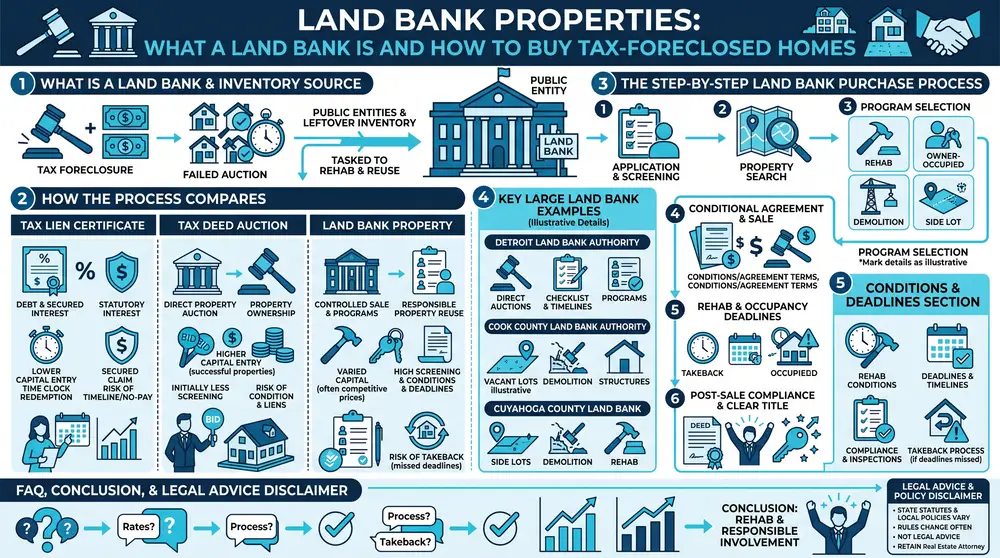
Most new tax deed investors think the auction is the last chance to buy a tax-foreclosed house. If it doesn't sell at the courthouse or online, they assume it disappears. It doesn't. In a growing number of states, a land bank property is exactly that leftover inventory: parcels that went through tax foreclosure, failed to sell, and landed with a public entity whose job is to get them back into responsible hands.
That makes the land bank the natural next stop after a tax deed sale. It is also a very different buyer experience. Land banks screen buyers, attach rehab and occupancy conditions, and in many programs take the property back if you miss a deadline. Investors who treat a land bank like a cheaper auction tend to lose their deposit, their rehab budget, or both.
This guide covers what a land bank is, where its inventory comes from, buyer programs and conditions, pricing, how the largest land banks (Detroit, Cook County and Cuyahoga County) sell, and how a land bank purchase compares with a tax deed auction and a tax lien certificate. It does not cover bank-owned REO or HUD homes. Land bank rules are set by state statute and local policy, and they change often. Nothing here is legal advice. Retain a licensed real estate attorney in the county where the property sits.
What a Land Bank Actually Is
A land bank is a public entity, created under state law, that acquires vacant, abandoned and tax-foreclosed properties, holds and maintains them, and transfers them to new owners whose plans match community goals. In plain terms, a land bank is the government's tool for putting properties that the private market rejected back into productive use.
The Center for Community Progress, the national nonprofit that tracks the field, defines a land bank as "a public entity with unique powers to put vacant, abandoned, and deteriorated properties back to productive use according to community goals." The phrase that matters for investors is "according to community goals." Price is one factor. It is rarely the deciding one.
Land Banks vs. Land Banking Programs vs. Land Trusts
The terms get blurred, and the difference affects what a seller can legally do.
Land banks. Created under a state-enabling statute granting special powers such as clearing title and holding property tax-exempt. Some are called a "land reutilization authority" or "redevelopment authority."
Land banking programs. Run by a city, county or nonprofit in a state with no enabling law, usually without those powers.
Community land trusts. Nonprofits that keep land permanently affordable through ground leases. Not the same thing.
According to the Center for Community Progress National Land Bank Map, roughly 90 percent of U.S. land banks were created under state-enabling statutes. As of June 2026 it lists 20 states plus Puerto Rico with enabling laws, from Michigan (2004) and Ohio (2009) to Louisiana (2025) and Washington (2026), and counts more than 300 land banks and land banking programs nationwide.
Why Land Banks Exist
Land banks exist because the traditional tax sale fails in weak markets. Nobody bids and the parcel sits, or a speculator buys it cheap, does nothing and lets the taxes lapse again. The land bank takes the property off that treadmill, clears the title, and sells it with conditions that force the next owner to fix it. If you have read the risks of buying tax deed properties, you already know the problems land banks were designed to solve.
Where Land Bank Property Comes From
Most land bank property comes from the property tax foreclosure process, either as unsold auction inventory or through a direct transfer that skips the auction. The Center for Community Progress 2025 State of Land Banking survey reports that an average of 58 percent of land bank acquisitions came from tax and public lien foreclosure, a share that has been declining since 2023. The rest comes from donations, purchases, code enforcement actions and transfers from other public agencies.
Exactly how a parcel reaches the land bank depends on the state. Three models cover most of what you will see.
The Michigan Model: Unsold Auction Inventory
Michigan built the first statewide framework. Under MCL 211.78m, after a county forecloses on delinquent taxes, the state, then the city, village or township, then the county, and then a county land bank authority each get a right of first refusal before the public auction. Parcels that don't sell at auction transfer to the local unit unless it objects, and parcels the local unit refuses vest in the state's land bank fast track authority.
In practice, many local governments direct that inventory to their land bank, which is how Detroit's land bank came to hold so many houses and lots that never found an auction buyer.
The Ohio Model: Direct Transfer Without a Sale
Ohio lets counties form county land reutilization corporations under Revised Code Chapter 1724, and it gives them a faster pipeline. Under Chapter 5722, land that receives no minimum bid at a tax foreclosure sale can pass to an electing subdivision or land bank. More importantly, under Section 323.78, when a county treasurer uses the expedited foreclosure process for abandoned land, the court or board of revision can order the parcel transferred by deed directly to the land bank "without appraisal and without a sale."
That means some Ohio properties never appear at a public auction at all. If you only watch the sale list in an Ohio county with an active land bank, you are seeing part of the inventory. The current version of Section 323.78, effective April 3, 2025, added resale and excess-proceeds provisions, so read the statute as it stands now.
The Illinois Model: Scavenger Sale and No-Cash Bids
Illinois runs a scavenger sale for properties with multiple years of unpaid taxes. A 2022 fact sheet from DePaul University's Institute for Housing Studies notes that a land bank, as a governmental agency, can acquire scavenger sale properties through a no-cash bid, and that the Cook County Land Bank Authority may hold tax certificates nearer the end of their redemption period. The land bank then takes those certificates through the tax deed process itself and sells the resulting property.
That is a lien-to-deed pipeline run by a public agency. If you know the structural difference between liens and deeds, you can see why lien-state land bank inventory looks different.
Other Sources
Deeds in lieu. Owners who can't pay sometimes deed the property to the land bank instead. Ohio's Section 5722.10 allows this with county auditor consent.
Intergovernmental transfers. Cities hand over surplus lots and buildings acquired through code enforcement.
Purchases. Some land banks buy strategic parcels to assemble land for redevelopment.
One more piece of context. The 2023 U.S. Supreme Court decision in Tyler v. Hennepin County held that a government can't keep a former owner's surplus equity beyond the tax debt. States have been amending their foreclosure and transfer rules since, so verify the current rules in your target state before you build a sourcing plan around them.
Know Which Pipeline You Are Fishing In Whether a property reaches you through an auction, a direct transfer or a land bank listing changes its title status, price and conditions. Our team maps that pipeline county by county before an investor commits capital. |
What Land Banks Can Do That Ordinary Sellers Can't
Land banks hold three statutory powers that set their properties apart: they can sell at whatever price serves the community, clear title through expedited court proceedings, and hold property tax-free. Michigan's Land Bank Fast Track Act (2003 PA 258, effective January 5, 2004) is the model worth reading.
Flexible pricing (MCL 124.757). The authority may sell or convey property on terms and for an amount of consideration it "considers proper, fair, and valuable, including for no monetary consideration." That is why you see $100 side lots next to houses priced closer to market.
Expedited quiet title (MCL 124.759). The authority can file an expedited action to quiet title to property it holds and obtain a judgment vesting absolute title "without right of redemptionThe legal right of a property owner to reclaim their property after a tax sale by paying the full amount of delinquent taxes, interest, and penalties.."
Tax exemption (MCL 124.763). Property of an authority is exempt from state and local taxes and special assessments while the land bank owns it.
The second power matters most to investors. A typical tax deed buyer files a quiet title action at their own cost before a title company will insure; our walkthrough of the quiet title process after a tax deed puts that at several thousand dollars and four to eight months uncontested. Many land banks do that work before they sell. Detroit's land bank states that its auction houses are sold with clear title. That is real value, and it is part of why the conditions are stricter.
The land bank cleared the title. You still have to clear the conditions.
Land Bank Buyer Programs and Conditions
Land banks sell through a small set of program types: side lot sales to neighbors, owner-occupant home sales, online auctions, fixed-price or offer-based listings, rehab programs with a deed held in escrow, and project-based sales to developers. Each comes with eligibility screens and post-closing obligations. Program names differ from one land bank to the next, so treat the categories below as a map, not a menu.
Side Lot Programs
Side lot programs sell a vacant lot to the owner next door for a nominal price. Detroit lists side lots at $100, and Cuyahoga County's land bank charges $100 to owner-occupants and $500 to investment owners or LLCs, according to its side yard application. Eligibility is tied to owning the adjacent property, and some programs add maintenance restrictions. If you already own a rental next to a land bank lot, a side lot can add yard space cheaply.
Owner-Occupant Home Programs
Many land banks reserve houses for buyers who will live in them. Cook County's Homebuyer Direct program sells to owner-occupants below market value. Detroit offers discounts, including 50 percent for eligible veterans on select auction properties and 20 percent for homebuyer counseling, and those discounts require an individual buyer, not an LLC.
Investors are usually shut out of these programs. Buying through someone else to get around an owner-occupancy rule is how you end up in a dispute with a public agency that can take the property back.
Online Auction Programs
Some land banks auction houses online with conditions attached. Detroit's auctions open at $1,000 and require the winner to rehab to code and have the house occupied within six months, or nine for a designated historic property, or risk forfeiture. Buyers are limited to one auction property until the first is compliant.
That is the biggest difference from a county tax lien auction or deed sale. At a land bank auction, winning starts a compliance clock.
Fixed-Price and Offer-Based Listings
Other programs list a property at a minimum price and take offers. Detroit's Own It Now program accepts offers at or above the land bank's minimum price at any time, then gives other buyers 72 hours to counter with hidden offers. Own It Now houses are sold as-is, without the cleaning and securing that auction houses receive, and they carry the same rehab-and-occupy requirement.
Rehab Programs With a Deed in Escrow
A deed-in-escrow program holds the deed until you finish the required work. The Cuyahoga Land Bank uses this model: you renovate to a written renovation specification within 120 to 180 days, the land bank inspects, and title transfers when the work passes final inspection, according to its buyer FAQ. Work can't begin without a written notice to proceed.
The structure protects the land bank, not you. You are putting money into a property you don't yet own, so don't start work you can't finish inside the window.
Project-Based and Developer Sales
Larger deals, such as multiple parcels or commercial buildings, go through an application and proposal process: project plan, budget, proof of funds, timeline and experience. Detroit's Land Based Projects program prices lots at market value and requires a three-year completion and maintenance commitment. These sales are negotiated and slower.
Common Eligibility Screens
Nearly every land bank screens the buyer before the offer. These tests recur.
No delinquent taxes. Detroit requires no delinquent property taxes in Wayne County.
No recent tax foreclosures. Detroit excludes buyers who lost property other than a primary residence to unpaid Wayne County taxes in the past three years; Cuyahoga excludes foreclosure filings or title losses in that period.
No open code or blight violations on property you own in the city.
Local presence. Detroit requires Michigan residency (or a commitment to move to Detroit and occupy) or a company licensed in Michigan. Cuyahoga requires county residence or a designated local agent.
Proof of funds. Cuyahoga asks for documentation covering the offer, renovation, closing costs and a 10 percent renovation reserve.
Compliance history. If you bought before and missed a deadline, expect to be turned away.
One forgotten tax bill on an old rental can disqualify an otherwise strong buyer.
How Land Bank Pricing Works
Land bank prices are set by policy, not by open competition, which is why they range from $100 for a side lot to near-market value for a renovated house. Most land banks use one of four approaches, and many use all four for different property types.
Nominal and Fixed Prices
Vacant lots are often sold at a flat price. Detroit's published land programs list side lots at $100, neighborhood lots at $250 and oversized lots at $200, with higher pricing for lots whose value exceeds $2,500. These prices reflect the land bank's goal of getting lots maintained and back on the tax roll, not the land's fair market value.
Minimum Price With Offers
Offer-based programs set a floor and let buyers compete above it. Detroit's Own It Now is the clearest example. The minimum price is the land bank's number; the final price depends on how many buyers want the same house during the 72-hour counter window.
Auction and Comparable-Sales Pricing
Land bank auctions start low but don't stay there. Detroit's opening bid is $1,000 with $100 increments, and final prices depend on neighborhood, condition and bidder count. Don't anchor on the opening bid. Work backward from after-repair value, the same discipline you would use at a Florida tax deed sale. Homes in stronger markets are usually priced from comparables; Cook County's Homebuyer Direct program prices below market value using MLS sales.
The Real Cost: Price Plus Rehab Plus Compliance
Most new buyers assume a cheap purchase price means a cheap deal. They're wrong. The purchase price on a land bank house is often the smallest line in the budget. A full budget has five parts:
Purchase price, from a few hundred dollars for lots to tens of thousands for homes in better areas, depending on the program and market.
Deposit. Detroit requires $1,000 or 10 percent of the price, whichever is greater, on Own It Now, and $1,000 or 10 percent of bids over $10,000 at auction. Cook County's Homebuyer Direct requires a $1,000 non-refundable application fee credited at closing.
Closing costs. Detroit's published estimates for title, recording, tax certification and title insurance total roughly $1,000 on a low-priced house. Check the current schedule.
Rehab. Long-vacant houses often need roofs, mechanicals, plumbing and electrical. Get two contractor bids before you commit.
Carrying costs. Vacant-property insurance, utilities, security and subsequent taxes once the property leaves the land bank's exemption.
An illustration, not a quote from any land bank: a house won for $5,000 that needs $40,000 of work, $1,500 to close and $3,000 to carry has an all-in basis of about $49,500. If renovated comps nearby sell for less, the cheap price was a trap. Our breakdown of where the profit actually comes from makes the same point.
Price the Rehab Before You Price the Bid Land bank deals are won or lost on the rehab budget and the compliance deadline, not the opening bid. Our training walks through after-repair value, rehab estimating and maximum-bid math on real county examples. |
The Largest Land Banks and How Their Programs Work
The three land banks investors search for most are the Detroit Land Bank Authority, the Cook County Land Bank Authority and the Cuyahoga Land Bank in Cleveland. Program details below come from each land bank's official site or published documents; they change, so verify before you apply.
Detroit Land Bank Authority
The Detroit Land Bank Authority (DLBA), at buildingdetroit.org, holds inventory built largely from unsold Wayne County tax foreclosures. Its sales split into home programs and land programs.
Auction. Houses listed with an auction date and open for bidding in a daily 9 a.m. to 5 p.m. window. Opening bid $1,000, $100 increments. Auction houses are cleared out and secured and sold with clear title. Rehab to code and occupancy required within six months (nine for historic properties).
Own It Now. Offers accepted at any time at or above the minimum price, with a 72-hour counter-offer window. Sold as-is. Same rehab-and-occupy obligation.
Rehabbed & Ready. Homes that are move-in ready or nearly finished, sold through a separate program.
Land programs. Side lots ($100), neighborhood lots ($250, for owner-occupants within 500 feet with a neighborhood endorsement, up to three per year), oversized lots, improved lots and project-based land sales, per its land reuse programs page.
Read the DLBA FAQ in full before you bid. Eligibility, deposit rules and the closing timeline (roughly 30 days after the purchase agreement is countersigned) are all there.
Cook County Land Bank Authority
The Cook County Land Bank Authority (CCLBA) was established in 2014 and states that it has acquired and transformed more than 2,500 properties since. Because Illinois is a lien state with a scavenger sale, much of its inventory comes through the tax certificate and tax deed process.
Homebuyer Direct. Homes offered to owner-occupants below market value, as-is, with no income restrictions. You apply online, inspect, submit an offer with pre-approval or proof of funds, and pay a $1,000 non-refundable application fee credited at closing. Details are on the Homebuyer Direct page.
Pre-qualification for other buyers. Developers, nonprofits and investors submit a pre-qualification application; priority goes to applicants whose use, experience and capacity align with the land bank's goals.
Other programs. The CCLBA site also lists a Home Giveaway program, a Purchase Assistance (Equity Fund) program and a Tax Certificate Program. Their terms were not published in detail; contact the land bank.
If you work Illinois, understand the certificate of purchase and how it becomes a deed. The land bank is working the same pipeline you are.
Cuyahoga Land Bank
The Cuyahoga Land Bank, formally the Cuyahoga County Land Reutilization Corporation, was formed in 2009. Its website reports more than 10,500 demolitions of abandoned and blighted properties since then. Its home sales lean heavily on conditions.
Deed in escrow. The main program for houses. You renovate to the land bank's specification within 120 to 180 days, pass a final inspection, and then receive the deed.
Owner-occupant sales. Owner-occupant buyers accept a three-year deed restriction against resale. The 2024 buyer FAQ also describes a renovation grant of up to $15,000 for owner-occupants on completion; confirm whether it is still offered.
Side Yard. Adjacent lots for $100 to owner-occupants or $500 to investment owners, conveyed as-is by quitclaim deed, with a reverter if maintenance requirements aren't met.
Cuyahoga is the clearest example of a land bank as a quality filter. Investors who can execute a code-compliant rehab on schedule do fine. Investors who can't never get the deed.
Other City Land Banks
For another city, start with the National Land Bank Map and go to the land bank's own site. Philadelphia, Pittsburgh, Atlanta and St. Louis all have land banks or land reutilization authorities, each with its own programs. Michigan, Ohio, New York and Pennsylvania also have many county land banks in smaller markets, where competition is lighter.
How to Find a Land Bank Property List
The fastest way to find a land bank property list is to go straight to the land bank's own website, because most now publish searchable inventory with maps, photos and program labels. Third-party listing sites often lag by weeks or show properties that are already under contract.
Official inventory portals. Detroit, Cook County and Cuyahoga all publish online listings. Detroit's shows auction dates and program type; Cook County uses an interactive property viewer.
Board meeting agendas. Boards approve larger sales in public meetings, so agendas show what is moving early.
County tax foreclosure results. In Michigan and Ohio, parcels that failed to sell at auction preview future land bank inventory. Our guide to free and paid delinquent property tax lists covers where to pull those records.
Pull a property profile on anything interesting, including the assessed value, recent block sales and open code cases. The listing tells you what the land bank wants to sell. Your research tells you whether to buy it.
How to Buy Land Bank Property: Step by Step
Buying land bank property follows the same basic sequence everywhere: confirm you qualify, pick the right program, inspect, budget, apply or bid, close, and then satisfy the post-closing conditions. Deadlines and forms vary by land bank, so read the program rules for the specific property.
Step 1: Confirm You Are an Eligible Buyer
Check yourself against the eligibility list first. Pay delinquent taxes, resolve code violations, and set up a local agent if one is required.
Step 2: Choose the Program That Fits Your Strategy
Owner-occupant programs are mostly closed to investors; auction and offer programs carry rehab clocks; developer programs need a proposal. Pick the program before the property, because the program decides the rules.
Step 3: Inspect the Property in Person
Go to the open house and bring a contractor. Look for roof failure, foundation movement, water damage and stripped mechanicals. Photos rarely show the worst of a long-vacant house.
Step 4: Do Your Own Due Diligence
The land bank's clear-title promise is valuable, but it is not a substitute for your own due diligence. Order or review a title search, confirm what the land bank is conveying and on what deed form, and check for any surviving encumbrance such as easements, deed restrictions or municipal assessments. Our step-by-step due diligence guide and our post on how to find a lien on a property cover the records to pull.
Step 5: Build a Full Budget and Timeline
Add written contractor bids, closing and carrying costs, and a contingency. If the work can't realistically be done in six months, don't bid on a six-month program.
Step 6: Apply, Bid or Submit an Offer
Have proof of funds or pre-approval ready. Detroit notes that a proxy maximum bid can't be lowered or deleted once entered, so set it carefully.
Step 7: Close on the Land Bank's Timeline
The land bank runs its eligibility check and issues a purchase agreement. Detroit targets closing within about 30 days. Missing a closing date can cost your deposit.
Step 8: Satisfy the Post-Closing Conditions
Start work immediately, keep permits and receipts, and get the compliance release in writing after final inspection. Until you have it, assume the land bank can still reclaim the property.
Watch the Full Acquisition Path Live Land banks, tax deed auctions and lien certificates are three doors into the same tax-foreclosure pipeline. Our live sessions show how experienced investors choose which door to use for each county. |
Land Bank vs. Tax Deed Auction vs. Tax Lien Certificate
A land bank purchase buys a property with cleared title and strings attached, a tax deed auction buys a property outright with fewer conditions but more title risk, and a tax lien certificateA legal document issued by a government authority when a property owner fails to pay property taxes, granting the certificate holder a lien on the property. buys a debt that usually earns interest rather than a property. They are three stages of one process, and the right choice depends on what you want to own and how much risk you will carry.
Factor | Land bank purchase | Tax deed auction | Tax lien certificate |
|---|---|---|---|
What you buy | The property, usually with title cleared by the land bank | The property, typically by a deed with no warranties | A lien on the property; you own the right to be repaid with interest |
Who can buy | Screened buyers who meet eligibility rules; some programs owner-occupant only | Generally any registered bidder who pays the deposit | Generally any registered bidder; some states allow over-the-counterTax liens or tax deeds that were not sold at public auction and are available for purchase directly from the county or taxing authority. purchases |
How price is set | Policy: nominal, minimum-plus-offers, auction or comparable sales | Competitive bidding from a minimum or opening bid | Bidding on interest rate, premium or other method depending on state |
Title status | Often cleared before sale (verify per land bank) | Frequently needs quiet title before insurable | Not applicable until you foreclose and take a deed |
Post-purchase conditions | Rehab, occupancy, deed restrictions, possible reverter | Usually none beyond local code | Must follow statutory steps to foreclose if not redeemed |
Redemption risk | Generally none after the land bank holds clear title | Varies; some states have post-sale redemption | Owner can redeem; most certificates end in repayment, not property |
Typical holding period | Rehab window, often 4 to 9 months, then your exit | Depends on title cure and exit, often months to a year or more | Redemption periodThe legally defined timeframe during which a property owner can reclaim their property by paying the delinquent taxes plus interest and penalties., from months to several years by state |
Main risk | Missing the compliance deadline and losing the property | Title defects, occupancy, hidden condition | Worthless collateral, procedural errors, low yield after premiums |
Best fit | Rehabbers and owner-occupants who can execute on schedule | Investors comfortable with title work and wider exit options | Investors seeking interest income with property as a fallback |
When the Land Bank Is the Better Path
The land bank wins when title risk is the biggest obstacle and you have a real rehab plan. You skip the quiet title actionA lawsuit filed to establish clear ownership of a property and resolve any disputes or claims against the title. and the courthouse crowd, and sometimes pay well below market. The trade is control: you work on the land bank's terms and calendar.
When the Tax Deed Auction Is the Better Path
The auction wins when you want flexibility to wholesale, hold or resell immediately, and you accept the title risk. New to deeds? Start with the complete 2026 guide to tax deed investing, then check which states sell liens and which sell deeds.
Where Tax Lien Certificates Fit
A certificate is a different investment. You are lending against the property, and usually the owner repays you with interest before you get near the deed. Depending on the state, you compete by bidding down the interest rate or through premium bidding, and some counties sell leftover liens over the counter. See what a tax lien is, how certificate auctions work and our over-the-counter lien guide.
A lien that isn't redeemed can become a deed. A deed that doesn't sell can become land bank inventory. Know the whole chain and you can choose where to enter it.
What Can Go Wrong With Land Bank Property
Investors most often lose money on land bank property by missing a post-closing condition, not by overpaying.
Missed rehab deadline. Detroit warns that failing to bring an auction property up to code within six months can result in forfeiture. You can lose the house and everything you put into it.
Rehab budget blowout. Once walls open, scope grows, and a fixed deadline turns overruns into forfeiture risk.
Deed restrictions and reverters. Occupancy periods, resale bans and maintenance covenants can last years, and some conveyances let the land bank take title back. Cuyahoga's side yard terms say so directly.
Neighborhood risk. Land bank inventory sits where the market already failed once. Cheap entry doesn't guarantee the resale or rent your model assumes.
Junior interests and assessments. Even on cleared title, confirm whether any junior lien, municipal assessment or recorded lis pendens survives. Ask the land bank what it cleared and what it didn't.
For a broader view of the risk side of distressed acquisitions, our honest pros and cons breakdown applies here as well.
Get a Second Set of Eyes on a Live Deal Before you sign a land bank purchase agreement, make sure the budget, deadline and exit actually line up. Our team can walk through the numbers and the conditions with you. |
Is Land Bank Property a Fit for Your Strategy?
Land bank property fits investors who can rehab to code on a deadline and then hold or sell a finished property. It fits poorly for anyone who wants to flip paper or hold land passively.
Good fits. Local buy-and-hold rehabbers, contractors who control their own schedule, qualifying owner-occupants, and neighbors who can use a side lot.
Wholesalers. Poor fit. Most programs block assignment or resale before compliance.
Remote investors with no local team. Poor fit. Residency rules plus a six-month clock punish absentee owners.
Retirement accounts. A self-directed IRA can't buy a home you will live in, and IRA rules restrict you from personally doing the rehab work. Talk to your custodian and tax advisor first.
If you are still deciding which strategy suits your capital and time, our foundational guide for new investors and our walkthrough on how to invest in tax liens are the right starting points, and our state-by-state comparison shows where each strategy is practical. For a different angle on deed acquisition, United Tax Liens offers another perspective worth reading alongside ours.
Frequently Asked Questions
What is a land bank?
A land bank is a public entity created under state law to acquire, hold and sell vacant, abandoned and tax-foreclosed property so it returns to productive use. Most were created under state-enabling statutes that give them special powers, such as clearing title and selling below market. More than 300 land banks and land banking programs operate in the United States, according to the Center for Community Progress.
How do I buy a land bank property?
You buy land bank property by applying, bidding or making an offer through the land bank's own website after confirming you meet its eligibility rules. Most require you to be current on property taxes, free of code violations and able to show proof of funds. After closing, you must usually rehab the property and have it occupied within a set period.
Are land bank houses really sold for $1,000?
Not necessarily. Detroit's auctions open at $1,000, but that is a starting bid, and final prices depend on demand. The rehab usually far exceeds the purchase price.
Can investors buy from a land bank, or only homeowners?
Yes, investors can buy from many land banks, but not through every program. Owner-occupant programs and many discounts are limited to individuals who will live in the home. Auction, offer and developer programs are often open to investors and companies that meet eligibility and local-presence rules.
Where can I find a land bank property list?
The most reliable land bank property list is the inventory page on the land bank's official website. Detroit, Cook County and Cuyahoga all publish searchable listings. To find a land bank near you, use the Center for Community Progress National Land Bank Map and then go to that land bank's site.
Do land bank properties come with clear title?
Often yes, but verify it for each property. Michigan's Land Bank Fast Track Act lets land banks run expedited quiet title actions, and Detroit states that its auction homes are sold with clear title. Still review the deed form, any recorded restrictions and whether you can get a title insurance policy.
What happens if I don't finish the rehab on time?
You can lose the property. Detroit warns that failing to bring an auction home to code within six months, or nine for historic homes, can result in forfeiture. Deed-in-escrow programs such as Cuyahoga's simply never transfer the deed if the work doesn't pass inspection.
Can I finance a land bank purchase?
Yes, in many programs, though cash is more common on low-priced homes. Cook County's Homebuyer Direct program accepts a pre-approval letter and suggests purchase-rehab loans such as FHA 203(k). Some lenders are cautious about deed restrictions, so find one experienced with land bank sales.
Is buying from a land bank better than a tax deed auction?
It depends on your strategy. A land bank usually offers cleaner title and sometimes a lower price, but adds rehab, occupancy and resale conditions. A tax deed auction gives you more freedom to flip or hold but leaves the title cure to you.
How long does it take to buy a land bank property?
Expect roughly one to three months from offer to closing, then a rehab window of four to nine months. Detroit targets closing about 30 days after the purchase agreement. Cuyahoga cites 7 to 14 business days for application review and 120 to 180 days to renovate.
Do land banks pay property taxes on their inventory?
Generally no. In Michigan, MCL 124.763 exempts land bank property from state and local taxes and special assessments. Once you buy it, the property returns to the tax roll.
Where the Tax Sale Pipeline Ends
A tax lien is a debt. A tax deed is a transfer. A land bank property is what is left when both failed to find a responsible owner. Land banks sell that inventory with cleaner title and lower prices than you will find almost anywhere else, and they charge for it in conditions and deadlines. Treat the compliance clock as the real price of the property.
Next steps:
Find the land bank serving your target county and read its sales policy in full.
Clear any taxes or code violations on every property you and your entities own.
Pick one program and learn its rules before looking at listings.
Walk two or three properties with a contractor and budget against the program's deadline.
Compare each deal with what the same capital would earn at the next tax deed sale or lien auction.
Building a tax-foreclosure strategy from scratch? Start with how to buy property with delinquent taxes, then our complete tax deed guide for the auction side. See results in our case studies from the field, browse answers to the questions investors ask most, read the rest of our published articles, meet the people behind this firm, and see how Tax Lien Wealth Builders supports investors at every stage. To watch the pipeline worked live, join our upcoming sessions.
Choose the Right Door Into Tax-Foreclosed Property Liens, deeds and land banks each reward a different investor. Get a framework for choosing among them, county by county, before you put capital at risk. |
EARNINGS DISCLAIMER. Results vary. Tax lien and tax deed investing involves risk, including the potential loss of principal. Past performance is not indicative of future results. Nothing in this article constitutes financial, legal, or investment advice. See our full earnings disclaimer before making any investment decisions. |
Related reading: Tax Deed Investing: The Complete 2026 Guide · Risks of Buying Tax Deed Properties · Quiet Title Action After a Tax Deed