
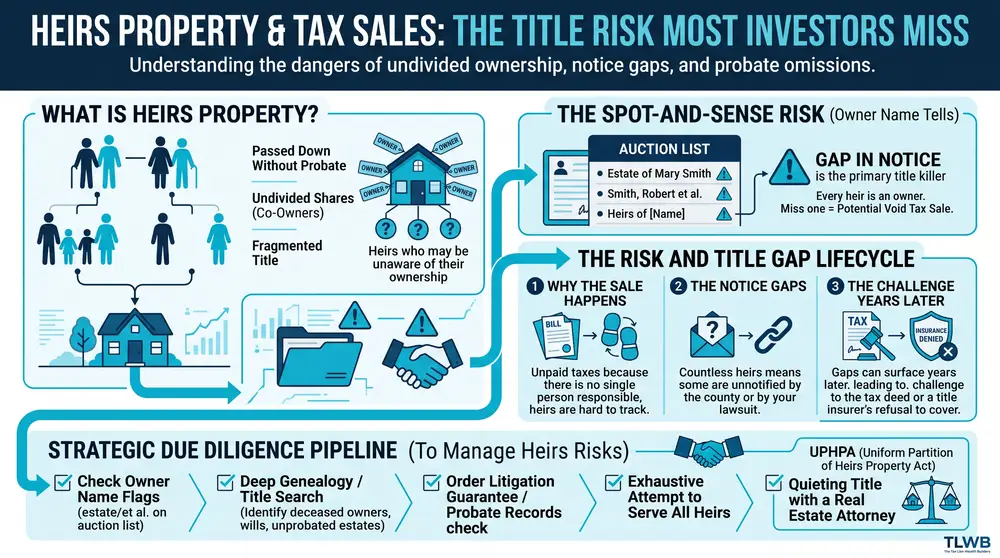
Most tax deedA legal document that transfers property ownership to the government or an investor after the owner fails to pay property taxes for an extended period. buyers read the owner column on a sale list as one name. "Estate of Mary Smith" or "Smith, Robert et al." looks like any other delinquent owner. Often it signals heirs property: land passed down without probate and now owned, in undivided shares, by every heir the law recognizes. Some don't know they own it.
Every heir is an owner. If the county's notice missed one, or your lawsuit did, the gap can surface years later as a challenge to your tax deed or a title insurer's refusal to cover the sale.
This post covers spotting heirs property, who pays the taxes, who must be notified, and how partition and the Uniform Partition of Heirs Property Act affect your exit. For the lawsuit itself, see our step-by-step guide to quiet title after a tax deed. Nothing here is legal advice. Retain a licensed real estate attorney in the county where the property sits.
What Heirs Property Actually Is
Heirs property is real estate inherited without a probated will or estate, so ownership passes under state intestacy law to the decedent's heirs, who hold it as tenants in common. Each heir owns an undivided fractional interest in the whole parcel, while the recorded deed usually still names the deceased owner.
The USDA describes it as family land whose estate did not clear probate, where heirs can use the land but lack clear or marketable title. A USDA-funded Southern Rural Development Center (SRDC) study notes a parcel can accumulate hundreds of owners over generations, few of them on any deed.
Each heir can occupy the whole property, sell their own share without consent, and sue for partition. No single heir can convey the full fee simple.
How to Spot Heirs Property on a Tax Sale List
You spot heirs property through owner-name patterns on the list, then confirm it in probate and recorder records. The list is the lead. The records are the answer.
Estate labels in the owner field. Look for "Estate," "Heirs," "Deceased," "Et al." and abbreviations like "Est" or "Decd." The SRDC researchers found labeling inconsistent: Macon County, Alabama listed 1,138 parcels as heirs property, while similar Sumter County listed one.
A decades-old last deed. If the latest conveyance predates the owner's likely lifespan, someone inherited it.
Tax bills mailed to a dead owner. Returned mail is a strong signal.
To confirm, pull the property profile, search the probate index where the owner died, and use obituaries to identify surviving children. Order a full title search and look for affidavits of heirship or a lis pendens. Our guides to sourcing delinquent tax lists and finding liens on a property cover the record pulls.
Read the Owner Field Like a Title Examiner Heirs property is cheapest to handle before you bid. Our team shows investors how to flag estate parcels early and price the cure into the bid. |
Who Pays Taxes on Heirs Property
All co-owners of heirs property share responsibility for its taxes, even though the bill usually stays in the deceased owner's name. In practice one relative, whom the SRDC report calls the "heir on record," often pays for years. When that person dies or stops paying, the parcel falls into delinquent taxes and lands on the list.
Paying does not usually make that heir the sole owner, and in many states courts won't let one co-owner use a tax sale purchase to cut out the rest. Verify locally.
Who Must Be Notified Before a Tax Deed Holds Up
Everyone with a recorded or reasonably ascertainable interest is entitled to notice, which for heirs property means the record owner's estate and the known heirs, plus mortgage holders and lienholders. State statutes set the list. The Constitution sets the floor.
In Mennonite Board of Missions v. Adams (1983), the Supreme Court held that notice by publication and posting is not enough for a party whose name and address are reasonably ascertainable. In Jones v. Flowers (2006), it held that when mailed notice comes back unclaimed, the government must take additional reasonable steps if practicable. Heirs named on no recorded document sit in a gray zone. That is the risk.
In most deed states, the county sends notice before the tax deed sale, and you inherit the quality of its work. In many lienA legal claim or right against a property that serves as security for a debt or obligation owed by the property owner. states, the holder of a tax lien certificate must serve interested parties before the redemption period ends or during foreclosure. Check which applies with our 2026 map of lien and deed states.
Surplus matters too. In Tyler v. Hennepin County (2023), the Court held that a county keeping proceeds beyond the tax debt violated the Takings Clause. When the owner has died, the heirs are typically the claimants.
Learn the Notice Rules Before You Need Them Notice defects are a leading way tax deeds get attacked. Our course covers how notice works in lien and deed states and where heirs fall through the cracks. |
Partition, Quiet Title, and Heirs Property After the Sale
After a tax deed saleA public auction where the actual ownership of tax-delinquent properties is sold to the highest bidder, transferring the deed to the winning investor., heirs property affects you through quiet title, which must name every heir, and through partition, if you hold only part of the ownership.
A quiet title action on heirs property can name dozens of defendants, plus "unknown heirs" served by publication. Each one adds service cost, time, and another potential contest. Budget for that before you bid.
Fractional ownership is the second trap. If you buy one heir's share by quitclaim, or a sale reached only some owners, you are a cotenant. Your exit is negotiation or a partition suit. Partition by auction used to be the lever. In UPHPA states, it is much weaker.
The Uniform Partition of Heirs Property Act (UPHPA)
The Uniform Partition of Heirs Property Act is a model law approved by the Uniform Law Commission in 2010 that changes how courts handle partition suits over family-held land. It does not stop tax sales. It governs what happens when a co-owner asks a court to divide or sell heirs property.
Per the ABA's 2025 uniform laws legislative update, it has been enacted in 24 states, the U.S. Virgin Islands, and the District of Columbia, with Michigan and New Jersey added in 2025. Adopters include Alabama, Arkansas, Florida, Georgia, Mississippi, South Carolina, Texas, and Virginia. Confirm your state on the ULC tracker.
Florida's version, sections 64.201 through 64.214 of the Florida Statutes, tracks the model act:
Heirs property test. Tenancy in common, no written partition agreement, title received from a relative, and family ties covering at least 20 percent of interests or cotenants.
Court-ordered valuation. A disinterested licensed appraiser sets fair market value for the whole parcel, not a discounted fraction.
Cotenant buyout. If someone requests a sale, the other cotenants get 45 days to elect to buy that person out at appraised value times their share.
Partition in kind first. The court divides the land physically unless that would prejudice the cotenants as a group.
Open-market sale. If a sale is ordered, a licensed broker lists it at no less than appraised value unless the court finds sealed bids or an auction better.
Buying a small share to force an auction is slower and less certain in these states. In a UPHPA state, a fractional interest is a seat at the table, not a key to the front door. Model the buyout as the likely outcome and read our breakdown of tax deed risks first.
Get a Second Set of Eyes on Title Partition rules, heir searches, and curative costs change the math. Our team helps investors decide whether an heirs parcel is worth bidding on at all. |
Who Heirs Property Affects
Heirs property is more common in counties with higher poverty and older populations, and African American communities in the Southern Black Belt have been particularly affected. The SRDC report also documents it in Appalachia, on Native American land, and in South Texas colonias, and cites a conservative estimate of 1.5 million acres, valued at $4.2 billion, held as heirs property in Black Belt counties.
For investors, the practical response is exhaustive notice, fair dealing on fractional purchases, and clear information about surplus rights. The steps that protect your title also protect the families on the other side of it.
Frequently Asked Questions
What is heirs property?
Heirs property is land inherited without probate and owned jointly by the deceased owner's heirs as tenants in common. The deed usually still names the deceased owner, which clouds title.
Who pays taxes on heirs property?
All co-owners share responsibility. In practice one heir often pays while the bill stays in the deceased owner's name, and when payments stop the whole parcel can go to a tax sale.
What are heirs property rights?
Each heir can occupy the whole property, sell their own share, request partition, share in proceeds or surplus, and receive proper notice before a tax sale. No single heir can sell the entire parcel.
What does the Uniform Partition of Heirs Property Act do?
It adds a court appraisal, a cotenant buyout right, a preference for dividing the land, and an open-market sale at appraised value to heirs property partition suits. It does not stop tax sales.
Does a tax deed wipe out the heirs' interests?
Generally yes, if the sale and notice met state law and due process. An heir who should have been notified but wasn't may challenge the deed, which is why quiet title names every heir.
Can I buy one heir's share and force a sale?
Not easily in a UPHPA state. The other cotenants can buy you out at appraised value, and courts prefer dividing the land. Talk to a local attorney before buying any fractional interest.
The Name on the List Is Not the Owner
On heirs property, the name on the list is a starting point. Your deed is only as strong as the notice that reached every heir. A deed you can defend starts with a family tree you can defend.
Flag every estate-labeled parcel before auction day.
Search probate, death records, and the chain of title for likely heirs.
Confirm who must be notified, and whether the county or you send it.
Price a multi-defendant quiet title into your maximum bid, or pass.
Check your state's UPHPA status before buying any fractional interest.
Heirs parcels belong inside a disciplined due diligence routine, and our property vetting checklist shows where they fit. For the bigger picture, read the complete 2026 guide to tax deed investing and the structural difference between liens and deeds. Florida buyers should pair this with our Florida tax deed sale walkthrough. New investors can start with our beginner's roadmap and upcoming live training sessions. United Tax Liens offers another perspective on researching properties, and you can meet the people behind this firm and see what Tax Lien Wealth Builders does for investors.
Have an Estate Parcel on Your List? Before you bid on an estate-labeled parcel, talk it through with someone who has cleared these titles. |
EARNINGS DISCLAIMER. Results vary. Tax lien and tax deed investing involves risk, including the potential loss of principal. Past performance is not indicative of future results. Nothing in this article constitutes financial, legal, or investment advice. See our full earnings disclaimer before making any investment decisions. |
Related reading: Quiet Title Action After a Tax Deed · Risks of Buying Tax Deed Properties · Investor FAQ