
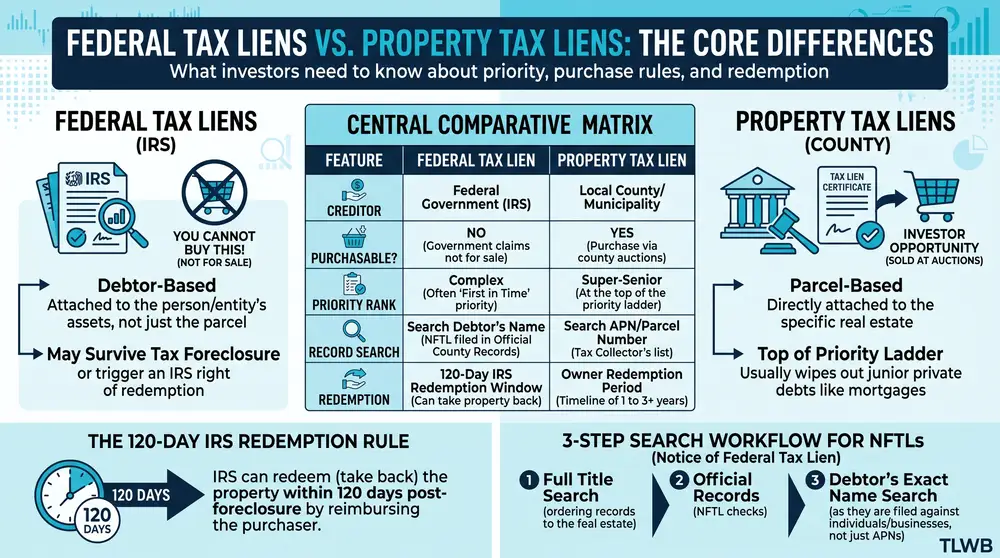
Every month, thousands of people look up "federal tax lien" hoping to find an IRS version of the county lien sale. They picture the government auctioning its claims the way a county sells a tax lien certificate. That market does not exist. You cannot buy an IRS lien.
The federal tax lien still matters to you, from the other side of the table. It shows up in your title search as an encumbrance that can survive a tax sale, or that gives the IRS 120 days to take the property back after you buy it.
This post covers how a federal tax lien differs from a county property tax lien, lien priority, where the Notice of Federal Tax Lien is filed and how to search for one, and the IRS right of redemptionThe legal right of a property owner to reclaim their property after a tax sale by paying the full amount of delinquent taxes, interest, and penalties.. Nothing here is legal or tax advice. Retain a licensed real estate attorney in the county where the property sits, and a tax professional for anything involving an IRS account.
What a Federal Tax Lien Actually Is
A federal tax lien is the United States government's legal claim against all property and rights to property of a person who neglects or refuses to pay an assessed federal tax after the IRS demands payment. It arises automatically under 26 U.S.C. § 6321, dates from the assessment under § 6322, and attaches to the taxpayer, not to one parcel.
That is the whole difference. The IRS says the lien attaches to all of a taxpayer's assets "and to future assets acquired during the duration of the lien" (IRS, Understanding a Federal Tax Lien). It follows the person. A property tax lien follows the land.
How a County Property Tax Lien Differs
A property tax lien secures unpaid ad valorem taxes on one parcel. When those delinquent taxes go unpaid, the county sells either the lien or the property, depending on state law. For the foundation, read our primer on what a tax lien is.
Feature | Federal tax lien | County property tax lien |
|---|---|---|
Secures | Unpaid federal taxes, penalties and interest | Unpaid property taxes on one parcel |
Attaches to | All of the taxpayer's property, including later acquisitions | The parcel that was taxed |
Can investors buy it | No | Yes, in lien states |
Enforced by | IRS levy and sale of seized property | Lien foreclosureThe legal process by which a lienholder forces the sale of a property to recover the debt owed when the property owner fails to pay. or tax deed saleA public auction where the actual ownership of tax-delinquent properties is sold to the highest bidder, transferring the deed to the winning investor. |
Why You Cannot Buy a Federal Tax Lien
You cannot buy a federal tax lien because the Internal Revenue Code gives the IRS no mechanism to sell its liens to investors. The IRS collects by levy: it seizes property under § 6331 and sells it under § 6335. A lien secures the debt; a levy takes the property.
Treat any pitch for "IRS lien certificates" as a red flag. What you can buy are county instruments: certificates at a tax lien auction, leftover liens sold over the counter, or property at a tax deed sale, depending on whether the state sells liens or deeds.
Know Which Liens Are Actually for Sale The investable lien is the county one. Our process starts with the statute and the delinquent list, not internet myths about IRS auctions. |
Lien Priority: Property Taxes vs. a Federal Tax Lien
Property tax liens generally prime a federal tax lien on real estate, even one filed first, wherever state law ranks property taxes ahead of earlier mortgages. The rule is 26 U.S.C. § 6323(b)(6).
The IRS manual puts it plainly: "If real estate taxes (whenever they accrue) are ahead of mortgages under local law, they will also be ahead of federal tax liens" (IRM 5.17.2.6.5.6). The protection covers value-based property taxes, special assessments for public improvements such as sewers or sidewalks, and charges for utilities or public services. It does not cover personal property, income or franchise taxes. Verify the ranking in your state.
Priority tells you who gets paid first. It does not tell you whether the federal lien disappears when the county sells. Knowing the IRS holds the junior lien is only half the job. The other half is notice and redemption.
The Notice of Federal Tax Lien and Where It Is Filed
The Notice of Federal Tax Lien (NFTL), IRS Form 668(Y), is the public filing that alerts creditors to the government's claim. Until it is filed, the lien is not valid against purchasers, secured lenders, mechanic's lienors or judgment creditors under § 6323(a).
Section 6323(f) sets the location. For real property, the notice goes to the office the state designates where the property sits, usually the county recorder. For personal property, it goes to the designated office where the taxpayer resides. Many states route notices against corporations and partnerships to the secretary of state alongside UCC filings.
The IRS generally has 10 years from assessment to collect under § 6502, and a notice must be refiled in a window ending 30 days after that mark to keep its original standing. Once the debt is paid, the IRS says it releases the lien within 30 days.
How to Do a Federal Tax Lien Search
A federal tax lien search is a name search, not a parcel search, because the NFTL is indexed against the taxpayer. For the broader process, see our guide to finding a lien on a property.
Step 1: Pull Every Owner Name
From the property profile, list every owner: spouses, co-owners, trusts and LLCs, with spelling variants.
Step 2: Search the County Recorder's Index
Search each name, plus "United States" and "Internal Revenue Service" as filing party. Pull the document, not just the index line, and note the filing date.
Step 3: Search the Secretary of State for Entity Owners
If an LLC or corporation holds title, look up federal tax liens in the state's UCC and lien search.
Step 4: Look for a Release, Then Confirm
Search for a recorded certificate of release. Treat an unreleased notice as live, and order a title report before bidding on anything you might take to deed.
Build the Search Into Your Routine A name search takes minutes per parcel once you know the indexes. Our training walks through lien research county by county. |
The IRS 120-Day Right of Redemption After a Tax Sale
After a nonjudicial sale of real estate to satisfy a lien senior to the federal tax lien, the IRS may redeem the property within 120 days or the state redemption periodThe legally defined timeframe during which a property owner can reclaim their property by paying the delinquent taxes plus interest and penalties., whichever is longer. That is 26 U.S.C. § 7425(d), and a county tax sale under a statutory lien can fall inside it.
Whether the lien survives at all depends on notice. Under § 7425(b), if the NFTL was filed more than 30 days before the sale, the IRS must receive written notice by registered or certified mail or personal service at least 25 days before the sale, following IRS Publication 786. Without it, the sale is made subject to the federal lien. With it, the lien is discharged as local law provides, but the redemption right remains.
If the IRS redeems, 28 U.S.C. § 2410(d) sets the price: what you paid, 6 percent annual interest from the sale date, and necessary expenses minus income or rental value. You get your money back. You do not get the deal.
What Redemption Means for Your Exit
The IRS looks at redemption when it can resell for more than the cost (IRM 5.12.5). The better your bargain, the more interesting it is to the government. Plan to hold through the window rather than flip. The Treasury regulation defines which date counts as the sale date. Judicial sales naming the United States follow a parallel 120-day rule under § 2410(c).
Whether the county notifies the IRS is a question to answer before you bid. It is one of the real risks of buying tax deed properties.
Found an NFTL on a Parcel You Like? Do not guess at notice, priority or timing. Talk the parcel through with someone who has worked these before you commit capital. |
Why a Federal Tax Lien Belongs on Every Due Diligence Checklist
A federal tax lien belongs on every checklist because it can survive the sale or claw the property back afterward. Add these to your due diligence routine and our property vetting process.
Name search on every owner. Parcel searches miss NFTLs.
Filing date against sale date. More than 30 days before the sale triggers the notice requirement.
Notice to the IRS. If nobody will give the 25-day notice, assume the lien survives.
A 120-day hold. Longer where the state redemption period runs past it.
Curative cost. Budget for a quiet title action; see how quiet title works after a tax deed.
Certificate holders meet the issue later, at foreclosure or deed issuance.
Frequently Asked Questions
Can I buy a federal tax lien from the IRS?
No. The IRS does not sell its liens to investors. It collects by levy and sells seized property, a different transaction with different risks.
What is a federal tax lien?
It is the government's legal claim against all of a taxpayer's property after an assessed federal tax goes unpaid following demand. It attaches to the person's assets, not one parcel.
How do I look up a federal tax lien on a property?
Search the county recorder's index by every owner's name, and the secretary of state's lien records for entity owners. Confirm with a title report.
Does a property tax lien take priority over a federal tax lien?
Generally yes. Under § 6323(b)(6), real property tax liens prime a federal tax lien wherever local law ranks them ahead of earlier mortgages.
Does a tax deed sale wipe out a federal tax lien?
Only if notice rules are followed. If the NFTL was filed more than 30 days before the sale and the IRS got no proper notice, the lien survives. Even with notice, the IRS keeps a redemption right.
How long does the IRS have to redeem after a tax sale?
120 days from the sale, or the state redemption period if longer. It repays your price plus 6 percent annual interest and certain net expenses.
The Lien You Can Buy and the One You Must Clear
A county property tax lien is an investment. A federal tax lien is a title problem. Investors who confuse them buy someone else's IRS debt.
Add a name-based federal tax lien search to your pre-bid checklist.
Read your state's tax sale statute for any IRS notice requirement.
Model a 120-day hold on every deed with an NFTL in the chain.
Retain local counsel for any parcel with a live federal lien.
New investors should start with our beginner's guide and how to invest in tax liens, then compare the best states for tax lien investing and common investor questions. United Tax Liens offers another perspective on self-paced learning. For hands-on help, see our investor services or meet the team behind Tax Lien Wealth Builders.
Learn to Read a Title Before You Bid Federal liens, priority and redemption windows are easier to grasp live, with real county records on screen. |
EARNINGS DISCLAIMER. Results vary. Tax lien and tax deedA legal document that transfers property ownership to the government or an investor after the owner fails to pay property taxes for an extended period. investing involves risk, including the potential loss of principal. Past performance is not indicative of future results. Nothing in this article constitutes financial, legal, tax, or investment advice. See our full earnings disclaimer before making any investment decisions. |
Related reading: Tax Lien vs. Tax Deed · Tax Deed Investing: The Complete 2026 Guide · Tax Lien Certificate Auctions