
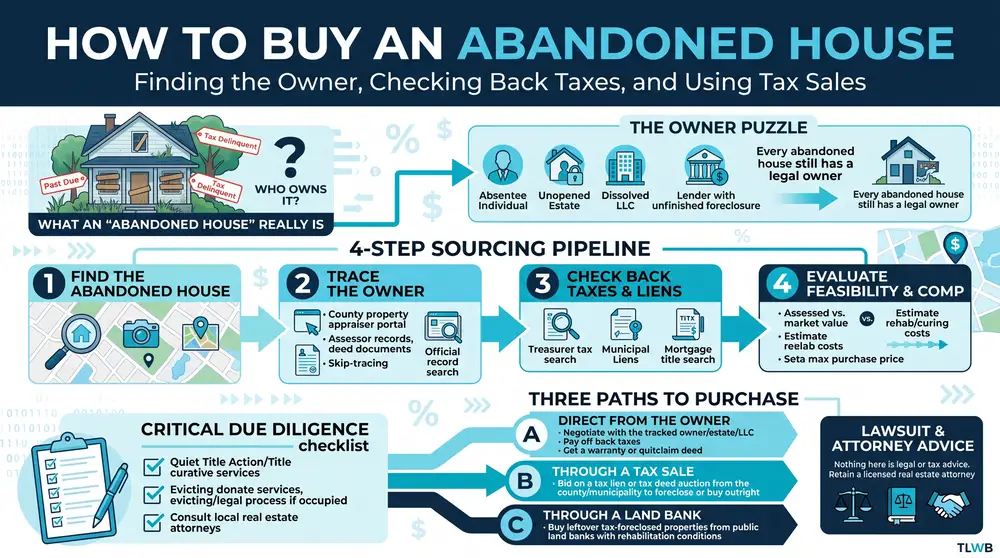
Most people who ask how to buy an abandoned house assume the hard part is finding one. It isn't. Boarded windows and a yard gone to seed are easy to spot. The hard part is that every abandoned house still has an owner, and you can only buy it from that owner, from the county through a tax sale, or from whoever the county hands it to afterward.
That owner may be a person who moved away, an estate nobody opened, a dissolved LLC, or a lender that never finished a foreclosure. Each one changes who can sign the deed.
This post covers how to find abandoned houses, how to trace the owner through county records, how to check back taxes and other liens, and the three paths to buy: direct from the owner, through the tax sale, or through a land bank. Nothing here is legal advice. Retain a licensed real estate attorney in the county where the property sits.
What an Abandoned House Actually Is
An abandoned house is a property its owner has stopped occupying, maintaining, or paying for, but still legally owns. In most states "abandoned" describes the condition of the house, not its legal status, so the owner of record keeps title until the property is sold, foreclosed, or transferred.
A few states let local governments formally certify a property as abandoned. Michigan's Certification of Abandoned Property for Accelerated Forfeiture Act lets a local unit certify abandoned, tax-delinquent property so it moves through forfeiture and foreclosureThe legal process by which a lienholder forces the sale of a property to recover the debt owed when the property owner fails to pay. faster. Certification speeds up the tax process. It does not hand the house to whoever finds it.
What about moving in and waiting? Adverse possession requires years of open, continuous, hostile possession and usually a lawsuit. It is a legal doctrine, not an acquisition strategy.
How to Find Abandoned Houses
You find abandoned houses by pairing what you see on the street with what the county records show.
Physical signs. Boarded windows, piled-up mail, overgrown yards, and violation stickers on the door.
Code enforcement and vacant property registries. Many cities require vacant buildings to be registered, and violation records are often public.
Delinquent tax lists. Several years of unpaid taxes usually means nobody is paying attention. Our guide to free and paid delinquent tax list sources covers where to get them.
Probate and foreclosure filings. A death with no probate, or a lis pendens from a lender that went quiet, often explains why a house sits empty.
Turn a Drive-By Into a Research File Spotting the house is the easy part. Our team shows investors how to turn an address into an owner, a tax history, and a lienA legal claim or right against a property that serves as security for a debt or obligation owed by the property owner. picture. |
How to Find the Owner of an Abandoned House
You find the owner of an abandoned house through the county assessor and the recorder of deeds, then the probate court or state business registry if the owner died or is a company.
Step 1: Pull the Parcel Record
Search the address on the county assessor's site. The property profile gives the parcel number, owner name, tax mailing address, assessed value, and sales history. A mailing address that differs from the property address is your first lead.
Step 2: Read the Recorded Deed
The assessor's owner field is an administrative record. The deed at the recorder's office is the legal one. Order a title search to confirm the vesting deed and any recorded mortgages.
Step 3: Identify the Type of Owner
An individual. Write to the tax mailing address.
A deceased owner. Search the probate index in the county where the owner died. No probate usually means heirs property, with several co-owners who all have to sign.
An LLC or corporation. Check the state business registry for its status and registered agent.
A lender or servicer. A foreclosure filing with no completed sale points to a stalled foreclosure, and the servicer may be the party to call.
Step 4: Make Contact
Write first. A short letter saying you want to buy, with your contact details, is enough. Never imply you represent the county. Skip-tracing services can find newer addresses when mail comes back.
How to Check Back Taxes and Other Liens on an Abandoned House
You check back taxes with the county tax collector or treasurer, and every other lien with a full title searchAn examination of public records to verify a property's legal ownership and identify any liens, encumbrances, or other claims that may affect the title.. Back taxes tell you how close the sale is. The lien search tells you what comes with the house.
At the tax office, ask about:
Years and amount delinquent. Several years of delinquent taxes can mean a sale is scheduled.
Whether a certificate was sold. In lien states, another investor may already hold a tax lien certificate on the parcel and be waiting out the redemption period.
Whether a deed sale is set. In deed states, check the next tax deed sale list.
Then look past the taxes. Mortgages, municipal liens for code enforcement or demolition, judgment liens, and federal tax liens can all attach. Which ones survive a tax sale depends on state law, so read our walkthrough on finding liens on a property and our comparison of federal tax liens vs. property tax liens. Any encumbrance the seller can't clear becomes your problem.
Learn to Read a County Record in Minutes Assessor pages, tax rolls, and deeds look different in every county. Our course shows how to read them on vacant parcels. |
Three Ways to Buy an Abandoned House
There are three practical ways to buy an abandoned house: negotiate directly with the owner, buy it through the county's tax sale process, or buy it from a land bank after the tax process has run. Each one trades price against title quality and time.
Path 1: Buy Directly From the Owner
A direct purchase gives you the cleanest title, because the owner signs a deed and a title company can insure the closing, with back taxes and liens paid from the proceeds. The obstacles are finding the owner and, if the owner died, getting the estate or every heir to sign. If you can reach the owner, this is usually the best path.
Path 2: Buy Through the Tax Sale
If the owner can't be found or won't sell, the house is headed for a tax sale. In deed states the county sells the property itself, and the winning bidder receives a tax deed. In lien states you buy a certificate, and the house becomes yours only if the owner doesn't redeem and you complete the foreclosure process. Check which system applies in our 2026 map of lien and deed states, then read the structural difference between liens and deeds and our guide to buying property with delinquent taxes.
Tax sale buyers usually buy as-is, without an interior inspection, and a tax deedA legal document that transfers property ownership to the government or an investor after the owner fails to pay property taxes for an extended period. often isn't insurable on its own, so budget for a quiet title action before you resell or finance. Parcels that don't sell may later be offered over the counter or at a scavenger sale, depending on the state.
Path 3: Buy From a Land Bank
In counties with a land bank, many abandoned houses that don't sell at the tax sale end up there. The Center for Community Progress counts more than 250 land banks and land banking programs in the United States. Land banks can often clear title, but they pick buyers on plans, not just price, and often attach rehab deadlines. Our guide to land bank properties covers how their programs and pricing work.
Factor | Direct from owner | Tax sale | Land bank |
Who you deal with | Owner, estate, or heirs | County | Land bank staff |
Title at closing | Insurable through a title company | Often needs quiet title | Often cleared before sale |
Interior inspection | Usually possible | Usually not | Usually possible |
Main obstacle | Finding and reaching every owner | Redemption, notice defects, as-is condition | Buyer conditions and approval |
What Can Go Wrong With an Abandoned House
Most problems come from the title, the building, or the people still connected to it.
Trespassing. Walking onto or into the property without permission can expose you to criminal and civil liability. An empty house is not an invitation. Stay on the street until you have written permission.
It isn't abandoned. Someone may be living there. Occupied houses add time and cost.
Missing heirs. An heir who never received notice can challenge a sale years later, which is why quiet title after a tax deed has to name every one of them.
Municipal liens and demolition orders. Code enforcement charges can be large and, in some states, survive the tax sale. The city may also have ordered the building torn down, so check with the building department before you bid.
Condition. Vacant houses deteriorate quickly. Water damage, mold, and stripped plumbing are common. Estimate fair market value after repairs, subtract a realistic repair budget, and set your maximum from there.
Read our breakdown of tax deed risks and keep every parcel inside a due diligence routine. The empty house is the cheap part. The surprises are what cost money.
Ask the Questions in Person Abandoned houses raise questions that are easier to answer face to face. Our live sessions work through real county records and sale lists. |
Frequently Asked Questions
Can you claim an abandoned house?
No. Every abandoned house still has a legal owner, and moving in or fixing it up does not transfer title. Adverse possession takes years of open possession and usually a lawsuit.
How do I find out who owns an abandoned house?
Search the address on the county assessor's website for the owner of record and tax mailing address, then confirm it against the recorded deed. Check probate if the owner died, or the business registry if it's a company.
Can I buy an abandoned house by paying the back taxes?
Not directly. Paying another person's property taxes generally gives you no ownership interest. You buy the house from the owner, at the county's tax sale, or after the county or a land bank takes it.
Is it illegal to go inside an abandoned house?
Usually, yes. Entering without the owner's permission is generally trespassing, even if the house looks empty.
What happens to abandoned houses that don't sell at the tax sale?
It depends on the state. They may stay with the county for over-the-counterTax liens or tax deeds that were not sold at public auction and are available for purchase directly from the county or taxing authority. purchase, go to a later sale, or transfer to a land bank.
The House Is Empty. The Title Isn't.
An abandoned house is a title problem in a physical disguise. Trace the owner and the liens first, and you'll know which path is open before anyone else does.
Pull the parcel record and deed for every address on your list.
Identify the owner type: individual, estate, company, or lender.
Ask the tax office for years delinquent and any certificate or sale date.
Run a full lien search before you make an offer or a bid.
Pick the path: direct purchase, tax sale, or land bank.
For the full tax sale picture, read the complete 2026 guide to tax deed investing and how to invest in tax liens. New investors can start with our beginner's roadmap and what a tax lien is. United Tax Liens offers another perspective on researching properties, and you can meet the people behind this firm and see what Tax Lien Wealth Builders does for investors.
Have an Abandoned House in Mind? Before you write to the owner or register for the sale, talk it through with our team. |
EARNINGS DISCLAIMER. Results vary. Tax lien and tax deed investing involves risk, including the potential loss of principal. Past performance is not indicative of future results. Nothing in this article constitutes financial, legal, or investment advice. See our full earnings disclaimer before making any investment decisions. |
Related reading: How to Find Delinquent Property Tax Lists · Land Bank Properties · Heirs Property and Tax Sales