
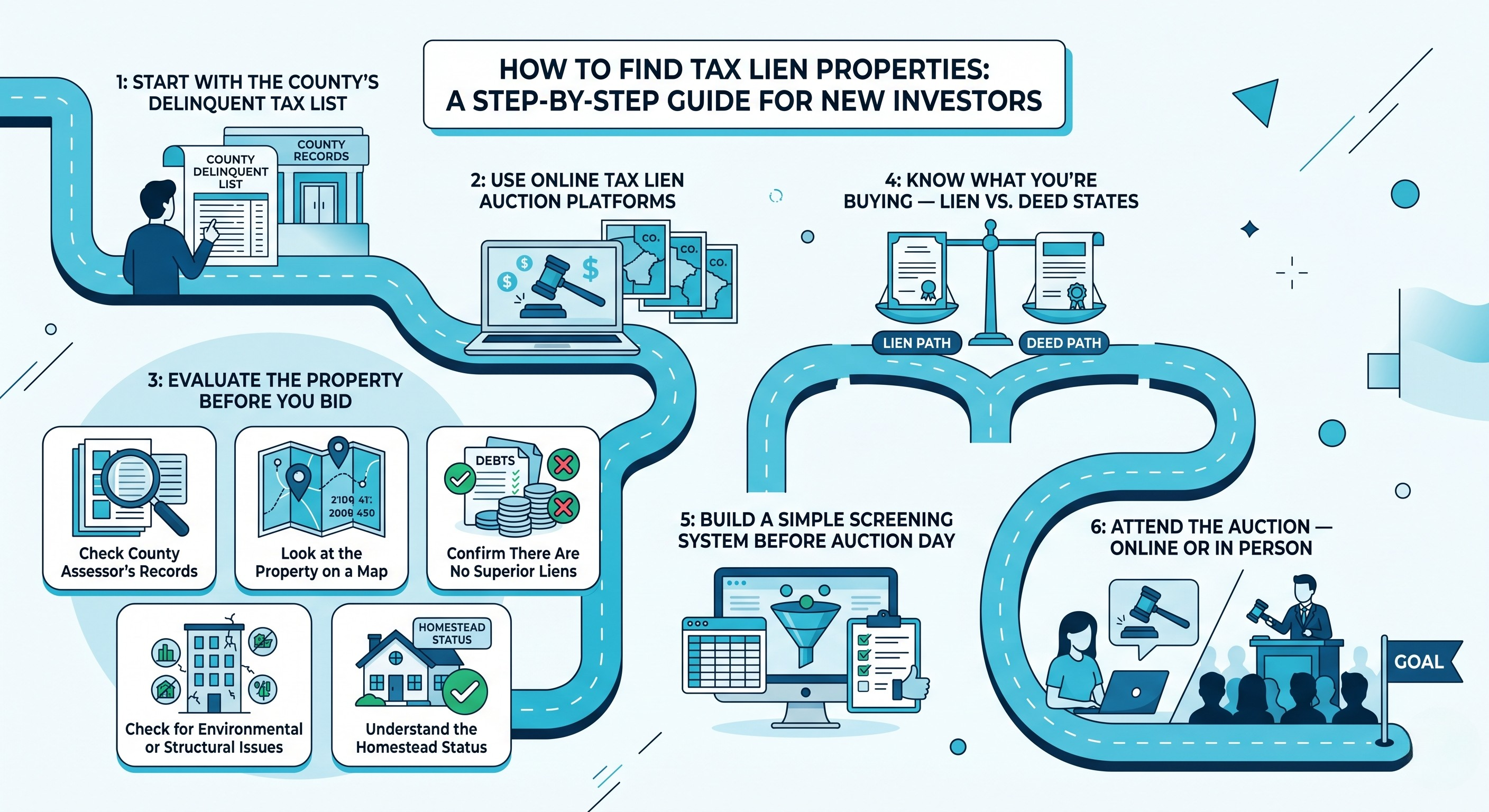
Most beginner investors spend their first weeks researching interest rates and redemption periods without ever asking the more immediate question: how do you actually find properties to bid on? The certificates don't come to you. You have to know where to look, how to read the data the county publishes, and what to check before you ever raise a paddle — or click a button — at a tax lien auction.
This guide walks through the full process — from finding the county's delinquent tax list to evaluating a specific property before auction day. By the end, you'll know exactly where tax lien opportunities are listed, how to filter them, and what to verify before you commit any capital.
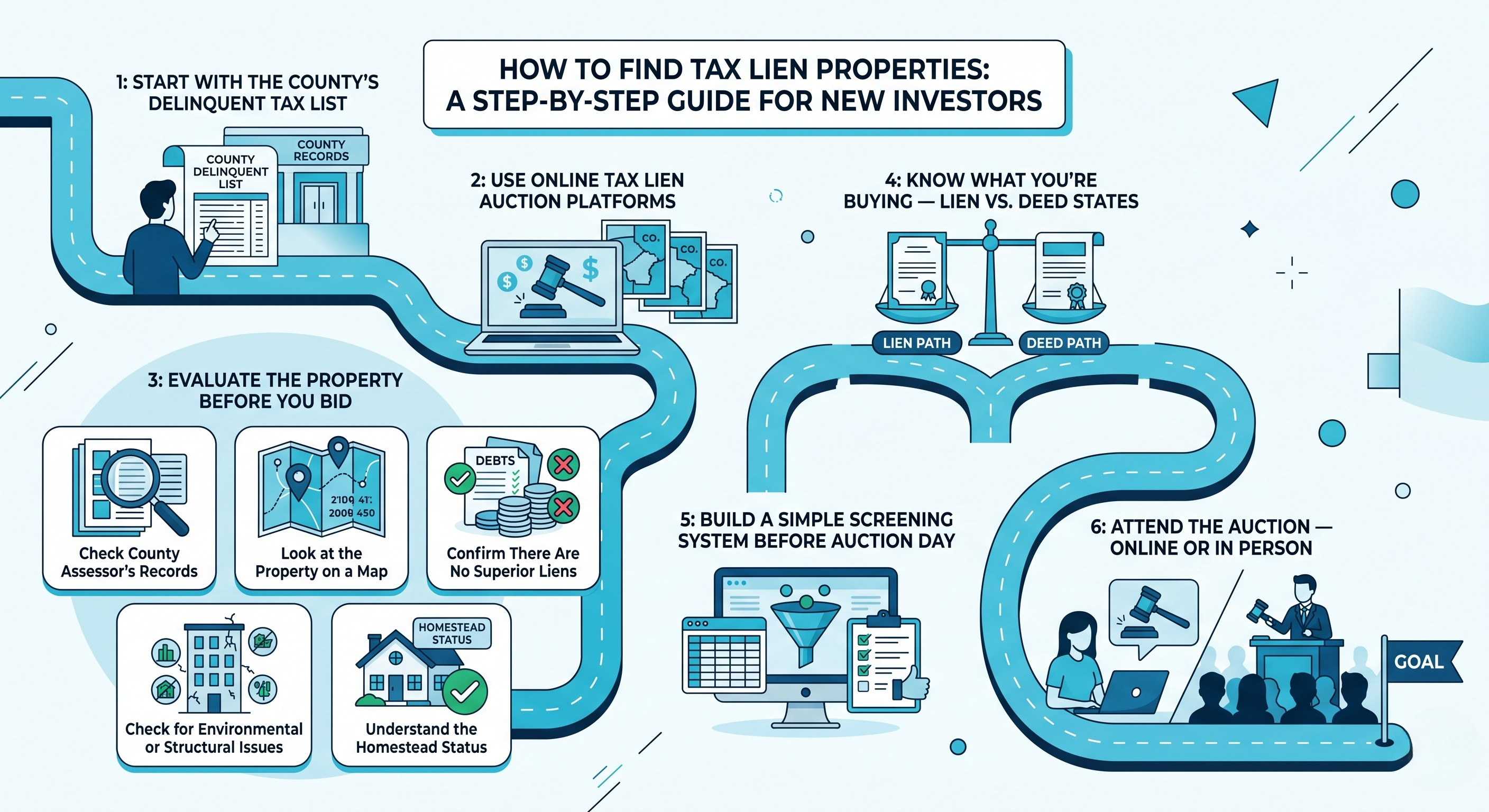
Step 1: Start with the County's Delinquent Tax List
Every county in a tax lien state publishes a list of properties with unpaid taxes. These are called delinquent tax lists — sometimes labeled as "tax sale lists" or "notice of pending tax sale" depending on the state. The list is the foundation of your research. It tells you which properties will be offered at the upcoming auction before the auction date is announced to the general public.
Where to find it:
Go to the county treasurer's or tax collector's website directly. Every county publishes this list in some form — the format and timing vary, but the list is always public.
Search for the county name plus terms like "delinquent tax list," "tax sale list," or "tax lien sale" in a search engine. Most county sites are not well organized, and a direct search often gets you there faster than navigating the site structure.
Call the county treasurer's office. This is not as efficient as the online route, but smaller counties sometimes post lists only as PDF downloads buried in obscure pages. A direct call gets you the URL or the document in under five minutes.
What the list tells you: each entry includes the property address, the parcel identification number (used to pull records from the county assessor), the owner of record, and the total delinquent taxes owed. That last figure is what the lien certificate will be sold for at auction. It does not tell you whether the property is worth bidding on — that requires the next steps.
One timing note: most states publish the delinquent list two to four weeks before the auction date, sometimes longer. Set a calendar reminder for the expected publication date in your target county so you have maximum research time before auction day.
Step 2: Use Online Tax Lien Auction Platforms
Many counties have moved their auctions to third-party online platforms. If your target county uses one of these services, the platform itself becomes your primary research tool — the delinquent list, property details, and bidding interface are all in one place.
The most widely used platforms include:
RealTaxDeed.com — used by a large number of Florida counties for both lien and deed sales. Searchable by county with property details and upcoming sale dates.
Bid4Assets — used by counties in multiple states including Maryland and several western states. Offers advance listing of available certificates with parcel-level detail.
SRI (SRI Tax Lien Services) — used across Indiana, Illinois, and several other midwestern states. One of the more comprehensive platforms for investors targeting that region.
GovEase — a growing platform used by counties across Arizona, Louisiana, Mississippi, and other states. Clean interface, good property data integration.
County-specific systems — some larger counties build and run their own auction portals. Maricopa County (Arizona) and Cook County (Illinois) both have county-operated systems. Check the county treasurer's site for the direct link.
These platforms let you filter certificates by face value, property type, and location — which makes the screening process significantly faster than working from a raw delinquent list. For new investors, starting with a platform-based county is a practical advantage: the research tools are built in, and you can practice evaluating properties without needing to pull data from multiple separate sources.
If you want to go deeper on auction strategy before your first sale, the training programs at United Tax Liens include county-specific guidance on how to navigate these platforms and build your bidding criteria — a useful resource for investors in the research phase.
Step 3: Evaluate the Property Before You Bid
Finding a property on the list is the starting point, not the finish line. A lien certificate is only as good as the property securing it. Before bidding on any certificate, run through the following checks.
Check the County Assessor's Records
The county assessor's website gives you the property's assessed valueThe dollar value assigned to a property by a local tax assessor for the purpose of calculating property taxes., land classification, building square footage (if applicable), and ownership history. Cross-reference the assessed value against the lien amount. A lien representing 2% of a property's assessed value on a solid residential lot is a very different risk profile than a lien representing 80% of a crumbling commercial property's value.
Look at the Property on a Map
Pull the parcel number into Google Maps or the county's GIS system. Confirm the property exists as described, check the surrounding neighborhood, and identify whether it's landlocked, underwater, or otherwise physically impaired. A surprising number of lien sale properties turn out to be unusable strips of land, drainage easements, or parcels entirely surrounded by a single owner's larger tract. These are not worthless — but the path to exit is narrow and requires research you want to do before auction, not after.
Confirm There Are No Superior Liens
Tax liens generally hold senior priority over most other claims — but not all. Federal IRS liens and certain other government claims can survive a tax sale in some states and attach to a property even after you've purchased the certificate. Running a basic title search on any property where you're considering a significant investment is worthwhile. At minimum, search the county recorder's records for existing encumbrances attached to the parcel before committing.
Check for Environmental or Structural Issues
Vacant land and abandoned industrial properties can carry environmental contamination that makes them legally difficult and financially costly to handle after the redemption periodThe legally defined timeframe during which a property owner can reclaim their property by paying the delinquent taxes plus interest and penalties. expires. Check EPA environmental databases and state environmental agency records for any registered contamination or remediation orders associated with the parcel. For residential properties, a drive-by inspection before auction is low-cost and often reveals condition issues that the assessor's record misses entirely.
Understand the Homestead Status
In many states, properties with an active homestead exemption carry a longer redemption period or additional procedural protections for the owner. This affects your timeline and the legal process if the owner does not redeem. Know whether a property is owner-occupied and homestead-classified before bidding — the difference can add a year or more to your investment horizon.
Step 4: Know What You're Buying — Lien vs. Deed States
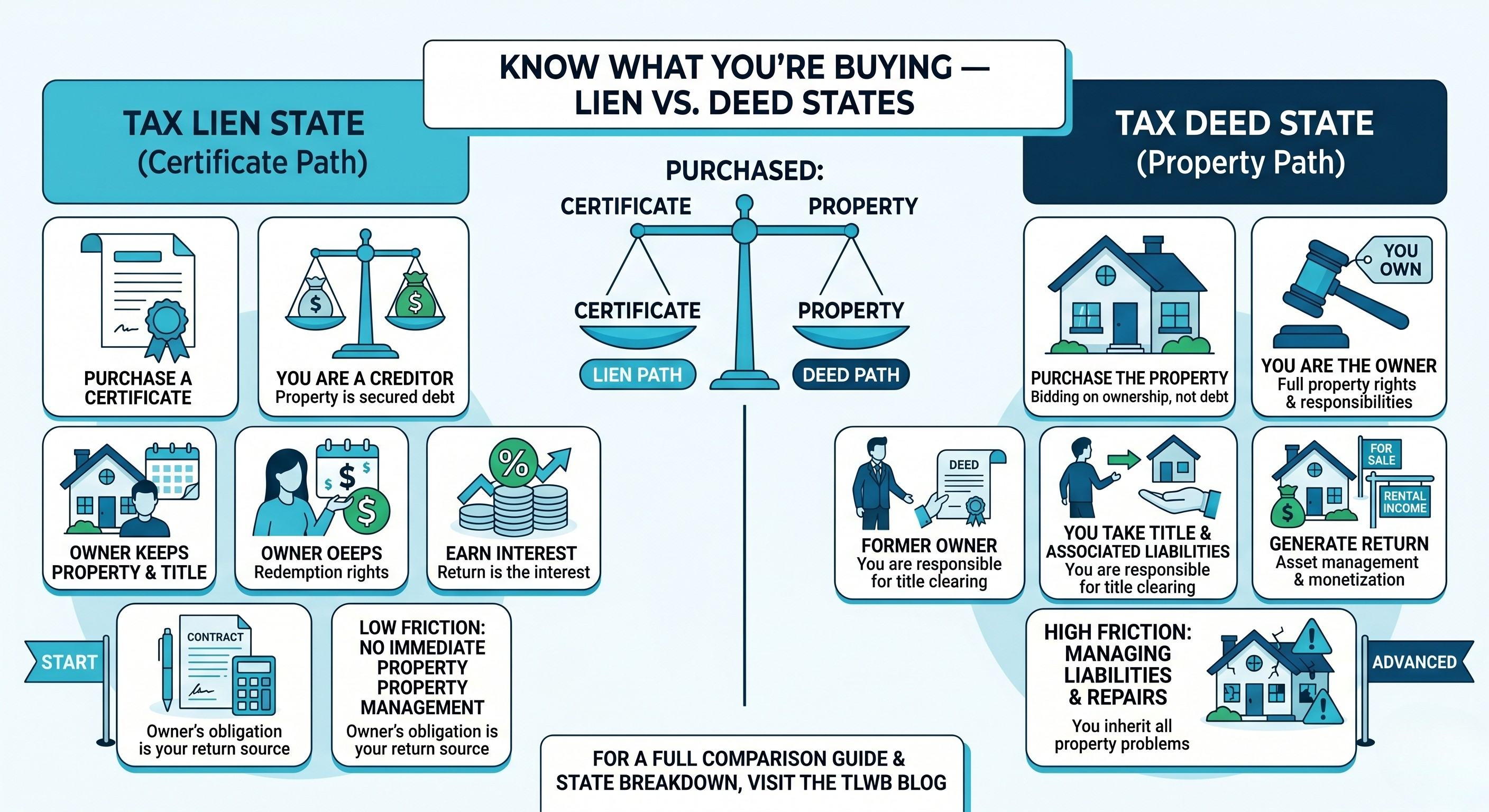
Before you commit to any county, confirm whether the state operates as a tax lien state or a tax deed state. This distinction determines what you actually purchase at the auction and what your rights are during the redemption window.
In a tax lien state, you purchase a certificate. The property owner retains title and has the right to pay you back — with interest — during the redemption period. You don't own the property. You own a secured claim against it.
In a tax deedA legal document that transfers property ownership to the government or an investor after the owner fails to pay property taxes for an extended period. state, the county sells the property itself. You are bidding on ownership, not a debt instrument. The legal and financial implications are entirely different — you take on title, any associated liabilities, and the responsibility of managing or selling the asset.
Most new investors start in tax lien states specifically because the certificate structure is lower-friction. You are a creditor, not a property owner, for the duration of the redemption period. The property's condition is not your immediate problem — the owner's obligation to repay is what generates your return. Understanding this difference is foundational before you search for properties in any specific county.
A full breakdown of how these two systems compare — and which states use each — is available in our complete guide to tax lien investing on the TLWB blog.
Step 5: Build a Simple Screening System Before Auction Day
The investors who consistently find strong tax lien opportunities are not doing anything exotic. They have a repeatable process that they run on every property before auction day. Here is a simple framework to start with:
Check | What to Look At | Pass / Flag Criteria |
1 | Lien amount vs. assessed value | Flag if lien > 15% of assessed value |
2 | Property type | Flag if vacant lot, industrial, or unclassified |
3 | Map check | Flag if landlocked, in flood zone, or no road access |
4 | Existing encumbrances | Flag if IRS lien, HOA lien, or federal claim found |
5 | Homestead status | Flag if homestead — adjust expected redemption timeline |
6 | Neighborhood stability | Flag if surrounding properties show widespread vacancy |
Properties that pass all six checks are candidates for bidding. Properties with one flag get reviewed more carefully. Properties with two or more flags get dropped from the list unless there is a compelling reason to dig deeper.
This system is not exhaustive — experienced investors add additional filters based on their specific markets. But for a new investor working through a delinquent list of 200+ properties, a six-point screen is the difference between focused research and spending a week going in circles.
For a more detailed walkthrough of how to set up your due diligenceThe research and investigation process an investor conducts before purchasing a tax lien or tax deed to evaluate the property and assess risk. process county by county, the investor resources on the TLWB blog cover specific market strategies as part of the broader content library.
Step 6: Attend the Auction — Online or In Person
Once you have a shortlist of properties that pass your screening, you're ready for auction day. The mechanics vary by state and county — online auctions run on a platform interface, in-person auctions are held at a courthouse or county building — but the preparation is the same.
Set your maximum bid before the auction opens. In bid-down states, this means the lowest interest rate you'll accept on each certificate. In premium bidding states, this is the maximum dollar amount above face value you're willing to pay. Write these numbers down and commit to them. Auction environments — even online ones — create pressure to keep bidding past rational limits. Your pre-auction numbers are your discipline mechanism.
Register in advance. Most counties and platforms require investor registration before the sale date, sometimes with a deposit. Check the specific requirements for your target county early — late registration has cost investors their entire research effort when deadlines were missed. The county treasurer's site or the auction platform will have the registration requirements listed under the upcoming sale details.
If you're preparing for your first auction and want structured guidance on what to expect and how to bid strategically, Tax Lien Wealth Builders runs live workshops that walk through the full auction process with real county examples. See the upcoming events and live training schedule for current dates and locations.
Frequently Asked Questions
Where can I find a list of tax lien properties near me?
Start with the county treasurer's website for any county you're targeting. Search for terms like "tax sale list," "delinquent tax list," or "upcoming tax lien sale." Many counties also use third-party auction platforms — RealTaxDeed, Bid4Assets, GovEase, and SRI are among the most widely used. If you can't locate the list online, a direct call to the county treasurer's office will point you to it within minutes.
How far in advance are tax lien properties listed before auction?
Most counties publish the delinquent tax list two to four weeks before the auction date. Some states — Florida, for example — require counties to publish the list a minimum of 30 days in advance. Larger counties with higher volumes may publish earlier. Smaller rural counties sometimes publish with less lead time. Subscribe to county treasurer email lists or check the platform notification system for the specific counties you follow.
Can I find tax lien properties on Zillow or other real estate sites?
Not reliably. Standard real estate platforms like Zillow or Redfin list properties for sale — they do not aggregate tax lien certificates. The delinquent tax list is a government record, not a real estate listing. The correct source is always the county treasurer's website or the designated auction platform. Some third-party data services aggregate delinquent tax data across counties, but these should be verified against the official county source before you rely on them for bidding decisions.
What happens after I find a property and win the certificate?
After winning a certificate, you receive documentation of your lien position — called a certificate of purchase in most states. The redemption period then begins. During this window, the property owner can pay the outstanding taxes plus your accrued interest to reclaim clear title. If they do, you collect your principal and return. If the redemption period expires without payment, you have the right to begin the process of obtaining a tax deed to the property. Most lien investors never reach this stage — redemption rates are high in strong real estate markets.
Start Finding Tax Lien Properties With Confidence
Finding properties is a learnable skill. The county publishes the data. The platforms make it accessible. What separates investors who build real portfolios from those who stay stuck in research mode is a process — a repeatable system for screening, evaluating, and bidding on the right certificates consistently.
If you want to build that process with experienced guidance, Tax Lien Wealth Builders offers live workshops and mentorship for investors at every stage. Whether you've never attended an auction or you're looking to expand into new states and counties, the hands-on training at TLWB puts real market knowledge behind the theory.
If you're learning at your own pace first, the United Tax Liens investor coaching program offers direct access to experienced coaches who can answer county-specific questions and help you build a screening system tailored to your target market. Both resources are worth exploring before your first auction.