
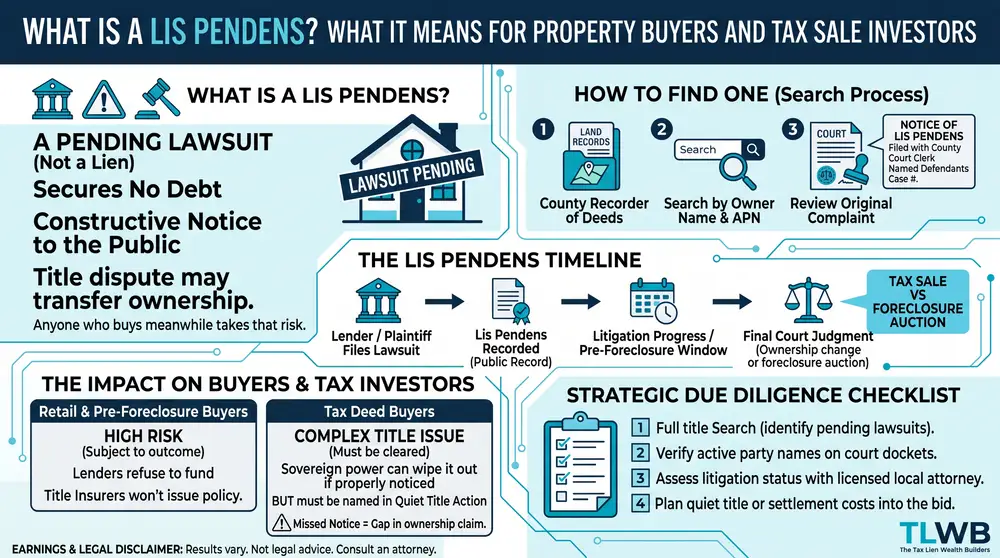
Most new investors see "lis pendensA public notice filed in court records indicating a pending lawsuit involving the title to or interest in a property. Check for lis pendens during due diligence." on a title report and assume it is just another lien to pay off at closing. It isn't. A lis pendens secures no debt. It tells the world a lawsuit could change who owns the property, and anyone who buys meanwhile takes that risk.
It is also usually the first public sign that a lender has started a mortgage foreclosure. This post covers what a lis pendens means, how to search for one, what happens after it is filed, whether the property can be sold, and how it affects a tax deedA legal document that transfers property ownership to the government or an investor after the owner fails to pay property taxes for an extended period. buyer's title. It does not cover working pre-foreclosureThe legal process by which a lienholder forces the sale of a property to recover the debt owed when the property owner fails to pay. leads.
Nothing here is legal advice. Retain a licensed real estate attorney in the county where the property sits.
What a Lis Pendens Actually Is
A lis pendens (Latin for "suit pending") is a notice recorded in the county land records stating that a lawsuit has been filed that affects title to, or an interest in, a specific piece of real estate. It gives constructive notice: anyone who later buys or lends against the property is treated as knowing about the lawsuit and is bound by its outcome.
Under Fla. Stat. § 48.23, a notice of lis pendens must list the parties, the filing date or case number, the court, a description of the property, and the relief sought. California calls it a "notice of pendency of action," and Cal. Code Civ. Proc. § 405.20 lets a party asserting a real property claim record one.
It is not a lien, which secures payment of a debt, and it is not a judgment. Nobody has won anything yet. The notice is the smoke. The lawsuit is the fire.
Why a Lis Pendens Matters
A lis pendens matters because it binds later buyers and lenders to the lawsuit's outcome. Under Cal. Code Civ. Proc. § 405.24, a purchaser or encumbrancer is deemed to have constructive notice from recording, and the claimant's rights, once decided, relate back to the recording date. "I didn't know" stops being a defense.
Florida goes further. Under § 48.23(1)(d), a recorded notice bars enforcement of interests that were unrecorded when it went on record, including federal tax liens, unless the holder intervenes within 30 days and the court allows it.
Lis Pendens Foreclosure: Usually the First Public Sign
In judicial foreclosure states, a lis pendens is usually recorded when the lender files its foreclosure complaint, so it is often the earliest record anyone outside the household can see. Missed payments are private. The lis pendens is public. Other lawsuits that carry one:
Quiet title suits. A court decides who owns the land. See our guide to quiet title actions after a tax deed.
Partition actions. Co-owners, often heirs, fight over a sale. See how heirs property shows up at tax sales.
Specific performance. A buyer wants a court to force a closing.
Fraud or deed disputes. Someone says a prior deed was forged.
In nonjudicial foreclosure states, lenders usually foreclose through a trustee without a lawsuit, so you will more often see a notice of default or notice of sale. Verify locally.
See where a lis pendens fits in the full process Reading recorded documents is one step in a repeatable pre-auction system. |
How to Search for a Lis Pendens
You search for a lis pendens in the county's official land records, then confirm the case in the court docket. The first tells you a notice exists. The second tells you whether it still matters.
Step 1: Search the County's Official Records
Search official records by every owner name, and by parcel number where allowed. Filter for "lis pendens," "LP" or "notice of pendency of action." Our guide on how to find a lien on a property covers recorder searches.
Step 2: Read the Notice
Note the case number, court, parties and relief sought. A bank foreclosing a mortgage reads very differently from a relative attacking a deed.
Step 3: Check the Court Docket
Find the status: pending, dismissed, settled, or sale scheduled. A dismissed case with no recorded release still clouds title.
Step 4: Confirm With a Title Search
For a serious bid, a professional title search catches notices under misspelled names. Build it into your due diligence, using our tax lien due diligence checklist.
What Happens After a Lis Pendens Is Filed
After a lis pendens is filed, the owner keeps title while the lawsuit proceeds, and the notice stays on record until it expires, is released, or is removed by the court. Four outcomes are common.
Settlement. The borrower pays, refinances or sells, and the plaintiff records a release.
Dismissal. The notice should be released, but it often lingers.
Early removal. California calls this expungement. Under Cal. Code Civ. Proc. §§ 405.31–405.32, the court must expunge the notice if the pleading has no real property claim or the claimant cannot show its probable validity by a preponderance of the evidence.
Judgment and sale. The property goes to a foreclosure sale. Compare sheriff sales vs. tax sales.
Some notices expire by statute. Under Fla. Stat. § 48.23(2), a notice lapses one year after the action starts unless it is founded on a recorded instrument, such as a mortgage, or a construction lien, or the court extends it. Verify your state's rule.
Learn to read a title report before you bid Lis pendens, junior liens and municipal liens all change what a parcel is worth. Learn to read them before the auction. |
Can You Sell a Property With a Lis Pendens?
Yes, a property with a lis pendens can legally be sold, but the buyer takes it subject to the lawsuit's outcome, so most buyers and lenders won't close until it is resolved. The notice doesn't freeze the owner's right to convey. It freezes the market's willingness to pay.
Sales usually close through a full payoff, a lender-approved short sale, or an investor buying at a discount and taking on the case. Most new investors assume a lis pendens means a bargain. Often it means buying a lawsuit with a house attached.
How a Lis Pendens Affects a Tax Deed Buyer's Title
Whether a lis pendens survives a tax deed saleA public auction where the actual ownership of tax-delinquent properties is sold to the highest bidder, transferring the deed to the winning investor. depends on state law and on what the underlying lawsuit is about. Property tax liens generally have priority over mortgages, and in many states a proper tax deed sale extinguishes most private interests. But a lis pendens is not a lien, so the question is whether the lawsuit behind it can still reach your title. Verify locally, every time.
When the Lawsuit Is a Mortgage Foreclosure
Florida is the clearest example. Under Fla. Stat. § 197.552, except as the tax sale chapter provides, no right, interest, restriction or covenant survives issuance of a tax deed, other than certain unsatisfied liens held by local governments, special districts and community development districts. A private mortgage being foreclosed generally does not survive (see Florida tax deed sales).
The catch: the recorded notice does not vanish on its own. An open notice can still block title insurance until it is released or discharged. A tax deed can kill the mortgage and still leave the paperwork alive.
When the Lawsuit Attacks Title Itself
A quiet title, fraud or partition suit is a different animal. If the plaintiff claims the owner never had good title, or the tax sale was defective, the case goes to the heart of what you bought. That is one of the real risks of buying tax deed properties.
What Title Companies Usually Want
Expect the insurer to except any open notice until it is released or discharged. Often the cleanest path is a quiet title action naming the foreclosure plaintiff. Budget for it before you bid.
Lien investors face less of this. If you hold a tax lien certificate and the owner redeems during the redemption period, a pending foreclosure usually doesn't touch your return. Apply for the deed and these questions become yours.
Work through title questions live Bring a parcel's recorded documents and walk through them with experienced investors. |
Frequently Asked Questions
What does lis pendens mean?
Lis pendens means "suit pending" in Latin. It is a recorded notice that a lawsuit affects title to a specific property, and later buyers are treated as knowing about it.
Is a lis pendens the same as a lien?
No. A lien secures payment of a debt, while a lis pendens only gives notice of a pending lawsuit. The notice itself secures nothing.
Does a lis pendens mean the house is in foreclosure?
Often, but not always. In judicial foreclosure states it is commonly the first public record of a foreclosure, but it can also signal a quiet title, partition or fraud case.
How long does a lis pendens last?
It depends on the state. Many last until the case ends and a release is recorded. In Florida, a notice not founded on a recorded instrument or construction lien generally expires after one year unless the court extends it.
Can you sell a property with a lis pendens?
Yes, but the buyer takes it subject to the lawsuit's outcome. Most sales close only after the case is resolved.
How do you remove a lis pendens?
The plaintiff can record a release or withdrawal, or a court can order it discharged or expunged. In California, Cal. Code Civ. Proc. § 405.38 generally awards attorney fees to whoever wins the expungement motion.
Does a tax deed sale wipe out a lis pendens?
Not automatically. A tax deed often extinguishes the mortgage behind a foreclosure notice, as in Florida, but the notice may still need a release before title is insurable. Verify locally with an attorney.
The Notice Is Not the Problem. The Lawsuit Is.
A lis pendens is a signpost, not a debt. It binds you to a lawsuit's outcome if you buy. A tax deed often extinguishes the mortgage behind a foreclosure notice, but the record still needs cleanup, and a suit that attacks title is a different risk.
Run a lis pendens search on every parcel on your list.
Check the docket status before assigning any value to the parcel.
Read your state's lis pendens statute and tax deed statute side by side.
Price a release or quiet title actionA lawsuit filed to establish clear ownership of a property and resolve any disputes or claims against the title. into your maximum bid when a notice is open.
Have a local attorney review any parcel where the lawsuit challenges title itself.
New to this? Start with what a tax lien is and the structural difference between liens and deeds. Compare tax lien states and tax deed states, review the best states for tax lien investing, and work through our beginner's guide. Then see our delinquent property tax list sources and the complete 2026 tax deed investing guide.
Found a lis pendens on a parcel you want? Talk with our team about how we evaluate title risk before a bid. |
EARNINGS DISCLAIMER. Results vary. Tax lien and tax deed investing involves risk, including the potential loss of principal. Past performance is not indicative of future results. Nothing in this article constitutes financial, legal, or investment advice. See our full earnings disclaimer before making any investment decisions. |
Related reading: How to Find a Lien on a Property · Quiet Title Action After a Tax Deed · Tax Lien Due Diligence