
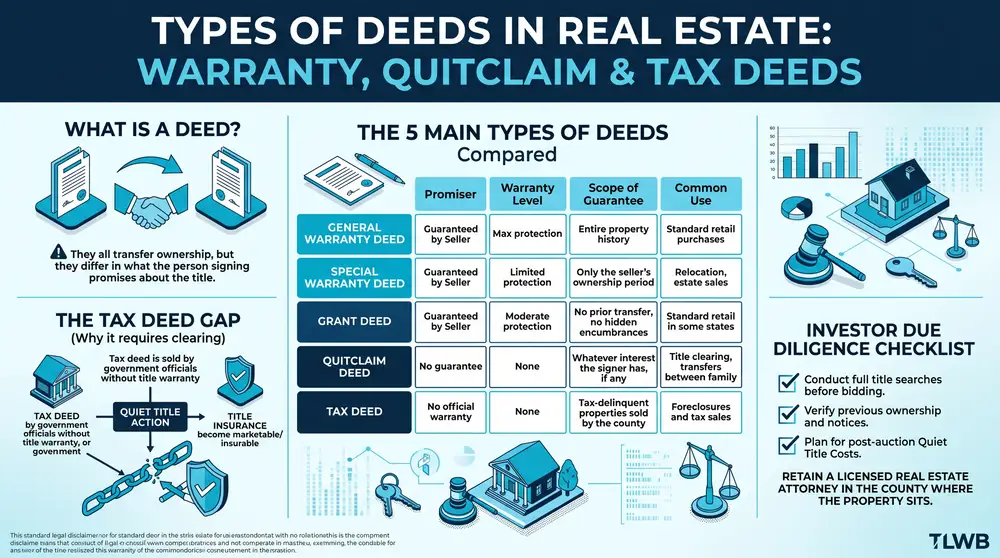
The main types of deeds in real estate are the general warranty deed, special warranty deed, grant deed, quitclaim deed and tax deed. They all transfer ownership, but they differ in what the person signing promises about the title. A general warranty deed guarantees title against defects from the property's entire history. A quitclaim deed guarantees nothing, and a tax deed generally carries no warranty from the government official who signs it.
Most new investors treat a deed as a deed. They win a county auction, record a document with their name on it, and assume they own the property the way a retail buyer does. They're wrong, and the gap shows up the day they try to sell or refinance.
The difference comes down to who stands behind the title. That is why a quiet title action and title insurance come up so often after a tax deed sale. This post covers each deed type, what it promises and when an investor receives it. It does not walk through the auction itself; for that, start with our guide to buying tax deeds.
Nothing here is legal advice. Retain a licensed real estate attorney in the county where the property sits.
What a Deed Actually Is (and What the Different Types of Deeds Promise)
A deed is the signed, delivered written document that transfers an ownership interest in real property from a grantor (the seller or transferor) to a grantee (the buyer or recipient). The type of deed tells you which promises, called covenants or warranties, the grantor makes about the title.
A deed transfers whatever interest the grantor actually holds. If that is clean fee simple title, you get it. If it is nothing, a deed without a warranty gives you nothing and no one to sue.
Deed covenants fall into three groups:
Ownership. The grantor owns the property and has the right to convey it.
No hidden burdens. The property is free of undisclosed encumbrances, such as liens or easements you weren't told about.
Defense. The grantor will defend your title if someone else claims it.
The more promises a deed carries, and the further back in time they reach, the stronger it is. A deed transfers an interest. A warranty tells you who pays if that interest turns out to be defective.
General Warranty Deed: The Strongest Promise
A general warranty deed is the strongest deed a buyer can receive, because the grantor guarantees the title against defects from any point in the property's history. If a forged signature from three owners back or an old unreleased lien surfaces, the grantor is on the hook.
Texas gives a clean example. Its Property Code sets out a statutory form that conveys fee simpleThe most complete form of property ownership, granting the owner full and unconditional rights to use, sell, or transfer the property. title "with a covenant of general warranty," in which the grantor promises to defend the property against "every person whomsoever" claiming it (Tex. Prop. Code § 5.022). The same section adds that a warranty is not required in a conveyance, which is why weaker deed types exist.
When investors receive one. Mostly in retail purchases from an individual seller through a title company. You will rarely receive one at a government sale.
Special Warranty Deed: Promises Limited to the Seller's Watch
A special warranty deed guarantees the title only against defects that arose while the grantor owned the property. The usual language warrants title against anyone claiming "by, through, or under" the grantor, "but not otherwise." Problems created before the grantor took title are not covered.
What's the difference between a general and a special warranty deed? Same kind of promise, shorter time window. A general warranty covers the property's whole history; a special warranty covers only the seller's years of ownership.
Special warranty deeds are common in commercial deals and in sales by banks, estates and companies that won't vouch for a property's earlier history. Names vary by state. Some use "limited warranty deed" or "bargain and sale deed with covenants" for similar promises, so verify locally.
When investors receive one. Buying bank-owned (REO) inventory, buying from another investor, or buying a commercial parcel. When you resell a tax deed property after clearing title, you may give one yourself.
Know What You're Buying Before You Bid The deed you receive decides how much title work follows the auction. See where title review fits in a disciplined investing process. |
Grant Deed: California's Middle Ground
A grant deed is a deed that uses the word "grant" and, by statute, carries limited implied promises without spelling them out on the page. California is the best-known example.
Under California Civil Code § 1113, using "grant" in a conveyance of fee simple implies two covenants, "and none other":
No prior conveyance. The grantor has not already conveyed the same estate to someone else.
No grantor-made encumbrances. The estate is free from encumbrances created by the grantor or anyone claiming under the grantor.
The California Department of Real Estate's reference book adds that this does not mean the grantor warrants being the owner. That gap is why California buyers rely on title insurance.
Texas implies covenants from the words "grant" or "convey" too, but its version is broader. Under Tex. Prop. Code § 5.023, the implied promise is that the estate is free from encumbrances, without California's limit to the grantor's own acts. The words on a deed carry legal weight even without a warranty clause, and the weight differs by state.
Quitclaim Deed: No Promises at All
A quitclaim deed transfers whatever interest the grantor has, if any, and makes no promise that the grantor owns anything. If the grantor owns nothing, the grantee receives nothing and has no warranty claim.
The quitclaim deed vs warranty deed question comes down to remedy. With a warranty deed, a title defect gives you a claim against the seller. With a quitclaim, it doesn't.
Quitclaims are used to move property between family members or into an LLC or trust, to settle divorces, and to clear clouds on title by getting a possible claimant to release any interest.
When investors receive one. After a tax deed saleA public auction where the actual ownership of tax-delinquent properties is sold to the highest bidder, transferring the deed to the winning investor., buying a quitclaim from a former owner or heir can clear part of the title without going to court. That matters most with heirs property sold at tax sales, where several relatives may each hold a fractional interest.
A quitclaim is not a weak deed. It is an honest one. It promises exactly what it says: nothing.
Tax Deed: Where It Fits Among the Types of Deeds for Property
A tax deed is the deed a government official issues to the winning bidder after a property is sold for unpaid property taxes. It generally carries no warranty of title, because the county, clerk or tax collector is conveying under statutory authority, not vouching for the chain of title.
That is the key distinction among the types of deeds for property. Every deed above is signed by an owner. A tax deed is signed by an official carrying out a statute. For the background, see our introduction to tax deeds and the structural difference between tax liens and tax deeds.
United Tax Liens also offers a plain-language take on what a tax deed is.
Some States Add Statutory Protections
No warranty does not mean no protection. Some states write limited protections into the tax sale statute itself:
Florida. Tax deeds are issued in the county's name and signed by the clerk. Except as Chapter 197 provides, no right, interest, restriction or other covenant survives the deed, but unsatisfied liens of record held by a municipal or county government unit, special district or community development district do. Each deed is "prima facie evidence of the regularity of all proceedings" (Fla. Stat. § 197.552). Prima facie means a challenger can still try to rebut it. More on the mechanics in how Florida tax deed sales work.
Texas. After a judicial tax foreclosureThe legal process by which a lienholder forces the sale of a property to recover the debt owed when the property owner fails to pay. sale, the deed "vests good and perfect title" to the interest the defendant owned, subject to the defendant's right of redemptionThe legal right of a property owner to reclaim their property after a tax sale by paying the full amount of delinquent taxes, interest, and penalties. and certain older recorded restrictive covenants and easements. It "may be impeached only for fraud" (Tex. Tax Code § 34.01(n)). Note the limit: you receive the interest of the defendants in the suit. Anyone not properly joined may still hold a claim.
Other states give weaker protection, set different survival rules, or attach a redemption period after the sale, as with a redeemable deed. The statute, not the deed form, controls what you own.
Learn the State Rules Before You Pick a Market Tax deed protections change at the state line. Our course teaches you to read a state's sale statute before you commit capital. |
Other Deeds Investors Run Into
Deeds from forced or fiduciary sales usually carry little or no warranty, for the same reason a tax deed doesn't: the person signing is not the owner vouching for the history.
Sheriff's deed. Issued after a court-ordered sale, usually a judicial foreclosure. The sheriff conveys the debtor's interest without vouching for it. See how a sheriff sale differs from a tax sale.
Trustee's deed. Issued after a nonjudicial foreclosure under a deed of trust, typically without warranty. Some states give its recitals presumptive effect, so verify locally.
Executor's deed. Issued by an estate's personal representative, usually with promises limited to the fiduciary's own acts.
Types of Deeds Compared: Side-by-Side Table
The table compares the five main types of deeds in real estate by what the grantor promises and when investors receive each one. Statutes vary by state, so verify locally.
Deed type | What the grantor promises | Defects covered | Who usually signs | When investors receive it |
|---|---|---|---|---|
General warranty | Good title, no undisclosed encumbrances, will defend title | Entire history of the property | Individual owner selling retail | Retail purchases through a title company |
Special warranty | Same promises, limited in time | Grantor's ownership period only | Banks, estates, companies | REO and commercial purchases |
Grant deed | Implied: no prior conveyance, no encumbrances by grantor (California) | Grantor's own acts | Sellers in grant deed states | Most standard California purchases |
Quitclaim | Nothing; transfers whatever interest exists | None | Relatives, former owners, heirs | Clearing clouds and buying out claims |
Tax deed | No warranty; some states add statutory protections | None from the grantor | County clerk, tax collector or treasurer | Winning bid at a tax deed sale |
Why a Tax Deed's Missing Warranty Leads to Quiet Title and Title Insurance
Because a tax deed carries no warranty and a tax sale can be challenged over defective notice, title insurers often won't issue a standard owner's policy on a fresh tax deed. Without a policy, many buyers and lenders won't close.
The usual answer is a quiet title action after a tax deed: a lawsuit asking a court to confirm your ownership against everyone who might claim an interest. Insurer requirements vary. Some insure after a quiet title judgment, some after a statutory challenge window passes, and some offer a limited tax deed product. Ask two or three title companies in your county before you bid.
The missing warranty is also why pre-sale work matters. A title search shows who must be notified, which junior liens are likely wiped out and which government liens may survive. See our tax lien due diligence checklist, the guide on how to find a lien on a property, and federal tax liens vs. property tax liens.
The deed conveyed ownership. It did not convey marketable title.
Plan the Title Work Into Your Numbers Quiet title costs and wait times belong in your maximum bid, not in a post-auction surprise. Tell us what you're evaluating and we'll point you to the right next step. |
Key Takeaways
A general warranty deed covers title defects from the property's entire history; a special warranty deed covers only defects arising during the seller's ownership.
A quitclaim deed transfers only whatever interest the grantor holds and makes no promise about title.
In California, the word "grant" implies two covenants under Civil Code § 1113, and the grantor does not warrant ownership.
A tax deed is signed by a government official and generally carries no warranty; Florida and Texas add limited statutory protections.
Title insurers often require a quiet title judgment or an expired challenge period before insuring a tax deed property.
Frequently Asked Questions
What are the main types of deeds in real estate?
The main types are general warranty, special warranty, grant, quitclaim and tax deeds. They differ in what the grantor promises about the title. Sheriff's, trustee's and executor's deeds come out of forced or fiduciary sales.
What is a special warranty deed?
A special warranty deed guarantees title only against defects that arose while the grantor owned the property. It does not cover problems from earlier owners. Banks, estates and commercial sellers use it often.
What is the difference between a quitclaim deed and a warranty deed?
A warranty deed promises good title and gives you a claim against the seller if it fails. A quitclaim deed makes no promise and transfers only whatever interest the grantor has, which may be none.
Is a tax deed a warranty deed?
No. A tax deed is issued by a government official under a tax sale statute and generally carries no warranty of title. Some states, such as Florida and Texas, give tax deeds limited statutory protections, so verify locally.
Does a tax deed give you clear title?
Not automatically. It transfers ownership, but title insurers often want a quiet title judgment or an expired challenge period first. Some government liens and easements can also survive, depending on the state.
Which type of deed gives the buyer the most protection?
A general warranty deed, because the grantor guarantees title against defects from the property's entire history. Buyers still purchase title insurance, since a warranty is only as good as the grantor's ability to pay.
Can I sell a tax deed property with a warranty deed?
Yes, once title is cleared and insurable, but you then take on that warranty's obligations. Many investors give a special warranty deed instead. Ask your attorney which form fits your state.
The Promise Behind the Paper
Every deed transfers an interest; the type of deed tells you who stands behind it. With a tax deed, nobody does. The statute, your research and your title work do that job. Before your first tax deed auction:
Pull the tax sale statute for each target state and note what survives the deed.
Call two or three title companies in your target county and ask what they require to insure a tax deed title.
Get a quiet title cost and timeline estimate from a local attorney and add it to your bid math.
Run a title searchAn examination of public records to verify a property's legal ownership and identify any liens, encumbrances, or other claims that may affect the title. on every parcel before the auction, not after.
Decide in advance which deed type you will give when you resell.
Next, read the complete 2026 tax deed investing guide, review the risks of buying tax deed properties, and compare markets with tax lien states vs. tax deed states.
New to the field? Start with tax lien investing for beginners, see what our students say on our success stories page, or explore everything Tax Lien Wealth Builders offers.
Learn It Live, With Investors Who Do It Deed types and title work make more sense when you can ask questions in the room. Join us at an upcoming live event. |
⚠ EARNINGS DISCLAIMER. Results vary. Tax lien and tax deed investing involves risk, including the potential loss of principal. Past performance is not indicative of future results. Nothing in this article constitutes financial, legal, or investment advice. See our full earnings disclaimer before making any investment decisions. |
Related reading: Quiet Title Action After a Tax Deed · Introduction to Tax Deeds · Sheriff Sale vs. Tax Sale