
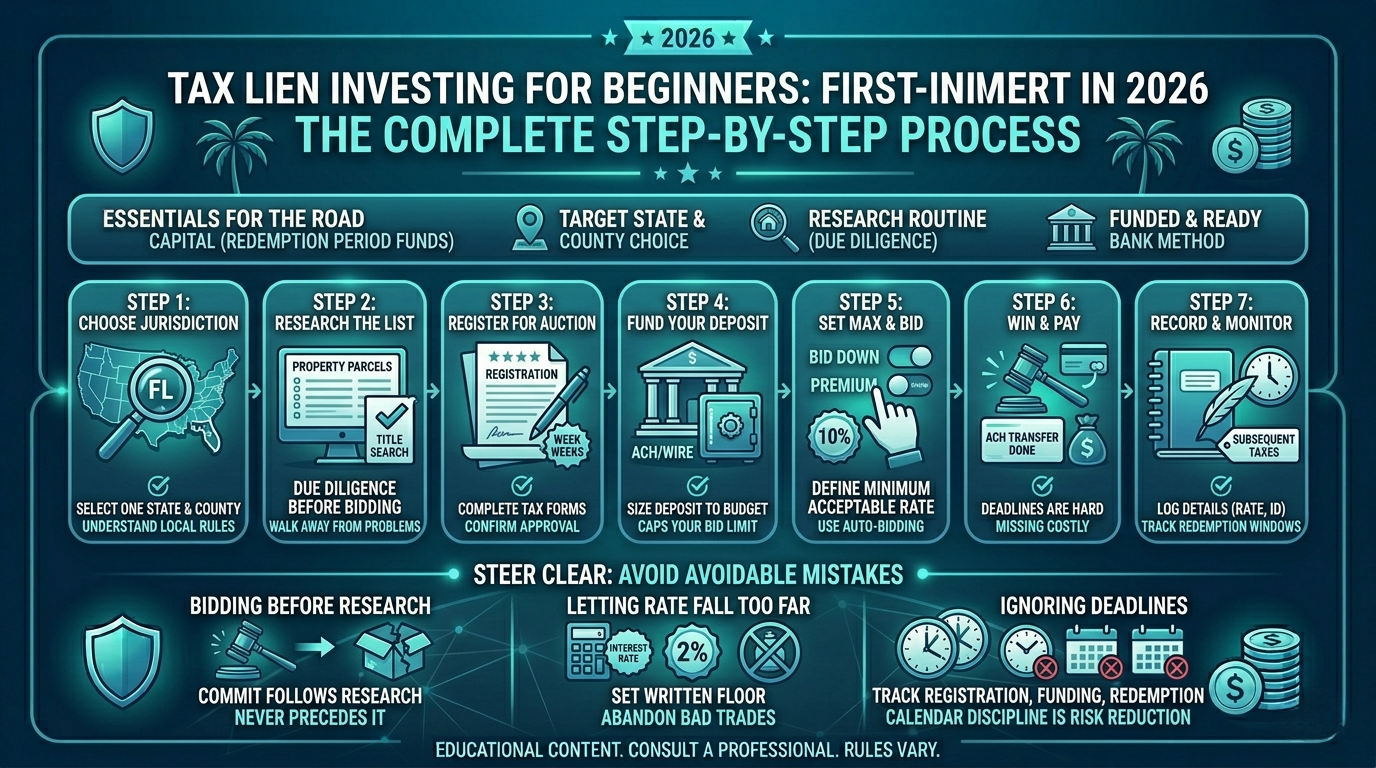
Knowing that tax lien investing exists is one thing. Actually placing your first bid and walking away with a certificate is another. The process is not complicated, but it has specific steps, and missing one — a registration deadline, a funding requirement, a piece of research — can cost you money or a good certificate.
This guide walks through exactly how to buy a tax lien certificateA legal document issued by a government authority when a property owner fails to pay property taxes, granting the certificate holder a lien on the property., from choosing where to buy to monitoring the certificate after you win. It is written for first-time investors who have a basic grasp of the concept and are ready to act. If you are still learning the fundamentals, start with our beginner’s guide to tax lien investing and come back when you are ready to transact.
As always, this is educational content, not financial or legal advice. Rules differ by state and county, so confirm the specifics with the county before you commit any money.
Before You Buy: What You’re Actually Purchasing
A quick grounding so the steps make sense. When you buy a tax lien certificate, you are not buying a property. You are buying the delinquent taxes owed on it — a lien against the property — along with the right to collect that money back with interest.
Buying the debt, not the property
This matters because it shapes how you evaluate every certificate. You are lending money secured by real estate, expecting to be repaid with interest. Acquiring the property itself is a rare, separate outcome. Keep that framing and you will research and bid the right way: on the strength of the security, not on a fantasy of cheap real estate.
What You Need Before You Buy
You can get set up quickly, but a few things should be in place before your first bid. Having them ready keeps you from scrambling once a sale opens.
Capital you can leave alone
Tax lien money gets tied up for the redemption periodThe legally defined timeframe during which a property owner can reclaim their property by paying the delinquent taxes plus interest and penalties., which can run one to three years depending on the state. Only commit funds you will not need in that window, and keep a small reserve in case you ever decide to pursue a tax deedA legal document that transfers property ownership to the government or an investor after the owner fails to pay property taxes for an extended period., which carries its own costs.
A target state and a research routine
Decide which state you are buying in and build a simple research routine before the list drops. A repeatable property profile — the same handful of checks you run on every parcel — keeps your decisions consistent and fast when the sale is live and certificates are closing.
A funded, ready bank method
Most platforms move money by ACH or wire and require a deposit before bidding. Confirm your bank can send funds quickly and set up the connection in advance, so a slow transfer never costs you the certificates you wanted.
Where to Buy Tax Lien Certificates
There are two main places to buy, and knowing the difference helps you decide where to start. Most first-time investors begin with online county auctions, then explore the second option later.
County tax sales and online auctions
The primary source is the county itself. Each county holds a tax lien auction for its delinquent parcels, and the large majority now run online through dedicated bidding platforms. This is where the term “where to buy tax lien certificates online” comes from — you register on the county’s platform, research the list, and bid remotely. You can participate in many counties from one computer.
Over-the-counter (county-held) certificates
When a certificate gets no bids at auction, it is often held by the county and made available over the counter afterward, usually at the maximum interest rate and without competition. Buying this way can sound ideal — top rate, no bidding war — but it comes with a catch worth understanding before you reach for it.
Why a certificate went unsold
A certificate that no investor wanted at auction is a signal, not a bargain. The underlying property may be worthless, contaminated, or burdened with problems that make the lien hard to collect. Over-the-counterTax liens or tax deeds that were not sold at public auction and are available for purchase directly from the county or taxing authority. buying can work for experienced investors who research carefully, but as a first-time buyer you are usually better off learning at a live auction where the competition itself helps filter out the worst parcels.
How to Buy a Tax Lien Certificate, Step by Step
Here is the full process. Follow it in order, and do not skip the research step no matter how tempting a certificate looks on paper.
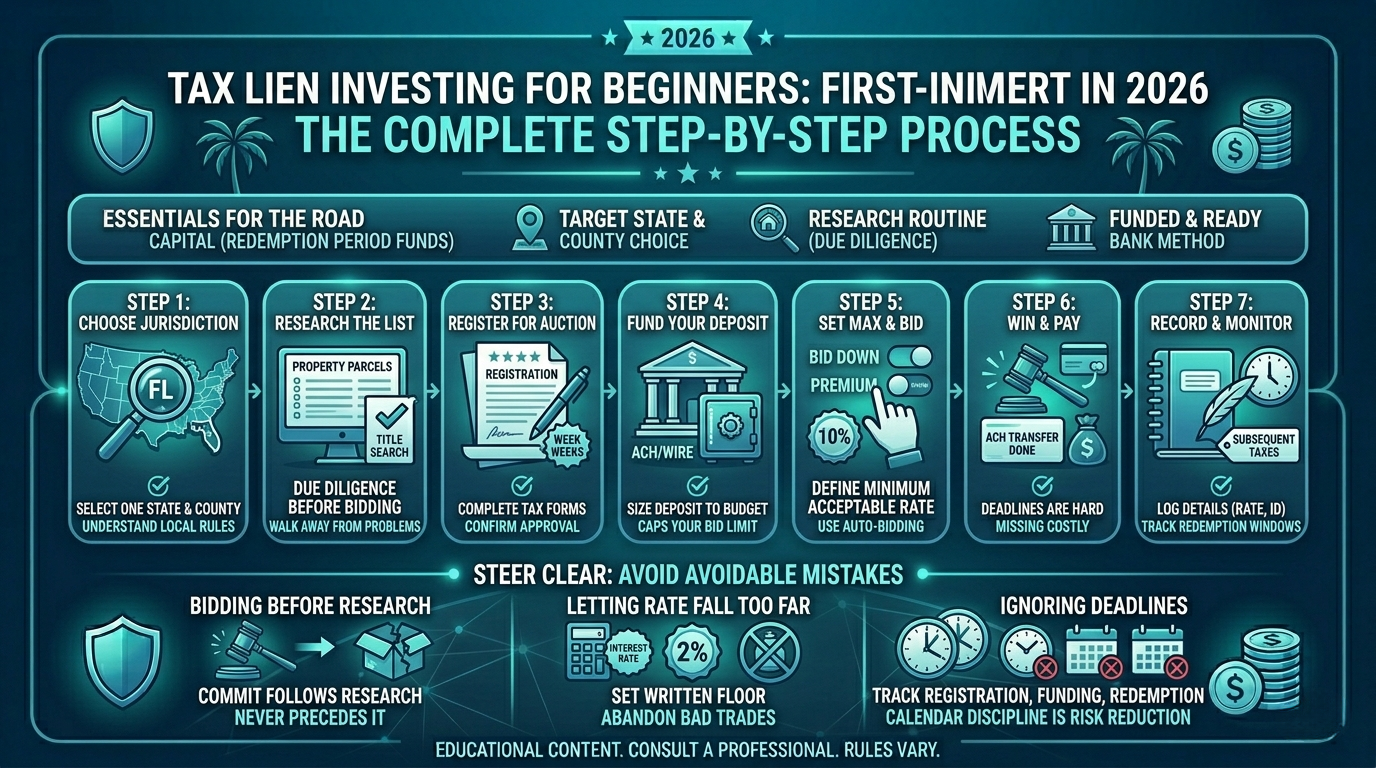
Step 1: Choose your state and county
Start with one state so you only have to learn one set of rules. Check its maximum interest rate, its redemption period, and how it runs sales. Then pick a single county within that state. Florida is a common first choice because its rules are consistent statewide and its auctions are online — our complete Florida tax lien guide breaks that market down in detail.
Step 2: Get the certificate list and research it
Counties publish the list of parcels going to sale ahead of time. Download it and do your due diligence before you bid. This is the single most important step, and the one beginners skip most. If you want a full method for locating and screening parcels, our guide to finding tax lien properties is the companion to this article — find first, then buy.
What to check on each parcel
For every parcel you are serious about, check the property type, the location, and the assessed value. A quick title search helps you spot heavy liens or claims that could complicate collection. Walk away from parcels you cannot understand, parcels on unbuildable land, and anything where the problems clearly outweigh the value of the lien.
Step 3: Register for the auction
Registration usually opens weeks before the sale and often closes a few days before it starts. Create your account on the county’s platform, complete any required tax forms, and confirm you are approved to bid. Do not leave this to the last minute — missing the registration window means missing the entire sale.
Step 4: Fund your deposit
Many counties require a deposit or pre-funded budget before you can bid, often a percentage of what you intend to spend. Fund it early through the platform’s accepted method, usually ACH or wire. Your deposit typically caps how much you can bid, so size it to the portfolio you actually want to build.
Step 5: Set your maximum and place your bids
Decide, in advance and in writing, the lowest interest rate you will accept and the most you will spend. Then place your bids. Most platforms let you pre-enter your terms and bid automatically on your behalf, but you can still be outbid until a batch closes, so check back as rounds end.
Understanding the bidding method
Know your state’s method before you start. Some states use bidding down the interest rate, where the lowest rate accepted wins; others use premium bidding, where you bid the price up and the highest bid wins. The method changes your math entirely, so make sure you know which one you are walking into.
Step 6: Win, pay, and collect your certificate
When you win, payment is usually due within a day or two — confirm the exact deadline, because missing it can carry penalties or forfeiture. Once you pay, you receive your certificate of purchase, the official record that you hold the lien. Save it and the transaction details somewhere secure.
Step 7: Record and monitor
Log the certificate number, parcel ID, purchase date, rate, and redemption deadline. Then monitor it. In many states you can pay the following year’s subsequent taxes to protect your position if the owner falls behind again. Good records also make tax season painless, since the interest you earn is reportable income.
Want to watch this whole process happen live? Reading the steps is useful; seeing a real auction is better. Our walkthrough of how tax lien auctions run in practice shows the bidding in action, start to finish. |
How to Invest in Tax Liens Without the Common Mistakes
Learning how to invest in tax liens well is mostly about avoiding a short list of predictable errors. Master the steps above, then steer clear of these.
Bidding before researching
The certificate amount tells you what the taxes were, not whether the property is worth anything. Every dollar you commit should follow research, never precede it. If you find yourself bidding on a parcel you have not looked at, stop.
Letting the rate fall too far
In competitive counties the interest rate can be bid down to a level that no longer rewards you for the risk and the wait. A low rate on a questionable parcel is a bad trade. Your written floor exists precisely to stop you in that moment.
Ignoring the deadlines
Registration, funding, and payment all have hard deadlines, and so does the right of redemption window that governs when you can pursue a tax deed. Investing in tax lien certificates is partly a calendar discipline. Track every date and you remove most of the avoidable risk.
Frequently Asked Questions
Where can I buy tax lien certificates online?
Directly from county tax collectors, most of which run their sales through online auction platforms. You register on the specific county’s site, fund a deposit, and bid remotely. Some counties also sell unsold, county-held certificates over the counter after the auction closes.
How much money do I need to buy a tax lien certificate?
Often just a few hundred to a few thousand dollars per certificate, plus whatever deposit the county requires upfront. There is usually no requirement to buy in bulk, so you can start with a single small certificate while you learn the platform and the process.
Do I need to attend the auction in person?
In most states, no. The majority of county tax sales are now online, so you can register, research, and bid from anywhere. A minority of counties still hold in-person sales, so check the format for the specific county before you plan around it.
What happens right after I win a certificate?
You pay the amount due within the county’s deadline, usually a day or two, and receive your certificate of purchaseA document issued to an investor at a tax sale confirming their purchase of a tax lien or tax deed and detailing the terms of the investment.. After that you wait through the redemption period, collecting interest if the owner pays, or moving toward a tax deed application if they do not.
Can I buy tax lien certificates in any state?
Not every state sells tax liens — some sell tax deeds instead, and the rules vary widely. Choose a state that sells certificates and learn its system before you commit. You can also build skills through structured training, including the online courses on our sister platform for self-paced tax lien education.
Buy your first certificate with confidence. Knowing how to buy tax lien certificates on paper is the start; doing it alongside experienced investors is what builds real confidence. Tax Lien Wealth Builders runs live training that walks you through real sales step by step. Browse upcoming sessions on the blog and resource library too. |
Disclaimer: This article is for educational purposes only and is not legal, tax, or investment advice. Tax lien rules vary by state and county. Confirm current procedures with the relevant county before investing and consult a qualified professional.