
Florida is one of the most active markets in the country for new investors, and for good reason. Every year the state’s 67 counties auction off hundreds of thousands of tax lien certificates on properties with unpaid taxes — most of it online, open to bidders anywhere in the United States. If you have looked into tax lien certificates Florida sells and felt buried in statutes and county jargon, this guide is built to fix that.
We are going to walk through the entire process in plain language: what you are actually buying, how the 18% interest rate works, how the auction runs, how to research a property before you bid, and what happens in the small number of cases where you end up owning real estate instead of collecting interest. This is written for beginners and intermediate investors who want the real mechanics, not a sales pitch.
One note before we start. This is educational content, not legal or financial advice. Florida’s rules are set by Chapter 197 of the Florida Statutes, and individual counties add their own procedures on top. Always confirm the current rules with the county tax collector before you commit money.
What Tax Lien Certificates Florida Investors Are Actually Buying
The single biggest mistake beginners make is assuming a tax lien certificateA legal document issued by a government authority when a property owner fails to pay property taxes, granting the certificate holder a lien on the property. is a way to buy a house cheaply. It is not, at least not directly. When you buy a certificate, you are buying a lien — a legal claim against a property for money owed. You are stepping into the county’s shoes and paying someone else’s overdue property taxes. In return, the property owner owes that money back to you, with interest.
That distinction shapes everything else. Most of the time, the owner pays. You collect your principal plus interest, and you never touch the property. Owning the real estate is the exception, not the rule, and it only happens through a separate process we will cover later.
How a tax lien becomes available
In Florida, property taxes are ad valorem taxes, meaning they are based on the assessed value of the property. When an owner fails to pay by the deadline, those become delinquent taxes. The county still needs that revenue to fund schools, roads, and services, so rather than wait, it sells the debt to investors. The certificate sale is how the county gets paid immediately and shifts the job of collecting to you.
What the certificate gives you (and what it doesn’t)
A Florida tax lien certificate gives you the right to collect the delinquent taxesProperty taxes that remain unpaid past the due date, which may result in penalties, interest, and eventually a tax lien being placed on the property. plus interest, and — if the owner never pays — the right to start the process that can lead to a sale of the property. It does not give you the right to enter the property, contact the owner aggressively, collect rent, or take possession. You hold a financial instrument, not a deed. The county, not you, manages the relationship with the owner until the lien is resolved, and your job in the meantime is simply to hold the certificate and wait for one of two outcomes: redemption, or the point where you can apply for a deed.
The lien vs. the property
Think of it this way: the lien rides on top of the property like a passenger, not the driver. The owner still owns and controls the home. Your claim sits on the title until it is paid off or resolved. Confusing the lien with ownership is what leads beginners to overbid on certificates attached to properties they would never actually want to own.
Why Florida Is a Top Market for Tax Lien Investing
Florida consistently ranks among the most popular states for new tax lien investors, and the reasons are structural rather than marketing. The state pairs heavy investor demand with a system that is unusually transparent, predictable, and open to outsiders. Before you commit capital, it helps to understand why so many people choose this market — and what that competition means for your returns.
Volume and statewide consistency
With 67 counties putting hundreds of thousands of parcels up each year, Florida offers enormous selection. Just as importantly, every county operates under the same Chapter 197 framework, so once you understand how one Florida tax lien auction works, you understand them all. That consistency is rare — in many states the rules shift from county to county — and it dramatically shortens the learning curve for someone new to the market.
Online access from anywhere
Because nearly every county runs its sale through an online platform, you can research and bid from anywhere in the country. An investor in California can hold certificates in a dozen Florida counties without ever leaving home. That accessibility is a double-edged sword: it widens your opportunities, but it also means you are competing against a national pool of bidders, which is part of why rates on the most desirable parcels get bid down so aggressively.
A built-in floor on returns
Many states let the winning rate fall to zero with nothing to catch it. Florida’s mandatory 5% minimum on redemption gives income investors a backstop that simply does not exist everywhere. Combined with the high statutory ceiling, that floor is why Florida is so often recommended as a first market for people who want predictable interest income rather than a lottery ticket on real estate.
How Florida’s Tax Certificate System Works
Florida runs one of the most structured and beginner-friendly tax lien systems in the country. The timeline is predictable, the rate is capped by law, and the bidding format is the same statewide. Once you understand the four pieces below, the rest of tax lien investing Florida offers starts to make sense.
The delinquency timeline
Florida property taxes become delinquent on April 1 each year. The county tax collector then advertises the unpaid parcels in a local newspaper and, on or before June 1, is required by law to hold a tax certificate sale. This is why most Florida auctions cluster in late May and early June — the timing is set by statute, not by the county’s preference.
The 18% rate and bidding down the interest
Florida certificates carry a maximum interest rate of 18% per year, but you rarely earn the full 18%. The auction uses a system called bidding down the interest rate. Bidding opens at 18% and investors compete by accepting a lower rate. The lowest rate wins the certificate. So if you and another investor both want the same lien, you undercut each other on yield until one of you stops.
Whole and quarter-percent increments
Bids are placed in whole or quarter-percent increments — 18%, 17.75%, 17.5%, and so on down. On desirable certificates in populated counties, competition can push winning rates into the low single digits. On overlooked rural parcels, you might win at or near the full 18%. Knowing where the competition concentrates is part of building a strategy.
The 5% minimum rule
Here is the rule that protects your downside. Under Florida law, when a certificate is redeemed you are guaranteed a minimum return of 5% of the certificate amount — even if you bid the rate down to 2% or 3%. The one exception: if you bid all the way down to 0%, you earn no interest at all. That 5% floor is a major reason Florida appeals to income-focused investors who want a predictable result.
The two-year redemption period
After you buy a certificate, the property owner has a redemption period during which they can pay off the debt and stop you from going further. In Florida, you must wait two years from April 1 of the year the certificate was issued before you can take the next step toward the property. During those two years the owner’s right of redemption is fully protected, and most owners do redeem. When they do, you receive your money plus the interest you locked in.
County-held (over-the-counter) certificates
Not every certificate sells at auction. When no investor bids on a parcel, the certificate is “struck to the county” and held at the full 18%. These over the counter certificates can sometimes be purchased directly from the county after the sale, at the maximum rate and without competition. They require extra caution — a certificate nobody wanted at auction often signals a problem property — but for experienced investors they can be a quiet source of high-yield liens.
Want to learn this in a room with people who do it for a living? Florida’s system rewards investors who practice before they bid. TLWB runs live, hands-on training that walks you through real auctions step by step. See upcoming sessions and what each one covers. |
The Florida Tax Certificate Auction, Step by Step
Almost every Florida county now runs its certificate sale online through a bidding platform. That means you can participate in dozens of county auctions from a laptop. The interface differs slightly by county, but the sequence below holds everywhere.
Before the auction — registration and funding
You register on the county’s auction platform, agree to the terms, and — in many counties — fund a deposit or budget account in advance. Registration usually opens several weeks before the sale. Treat this window as your research period: download the certificate list, filter for the parcels you care about, and set a budget you will not exceed.
During the auction — placing and managing bids
Florida auctions typically use a batch system. You pre-enter the lowest interest rate you are willing to accept on each certificate, and the platform bids on your behalf, automatically using the lowest competitive rate it can while still beating other bidders. Batches close in scheduled rounds, often hourly or daily. You can usually be undercut right up until a batch closes, so the list is not final until the round ends.
Setting your floor rate
Decide your minimum acceptable rate before the auction starts and write it down. The most common beginner error is getting caught in the moment and accepting a yield so low it is not worth the risk. If a certificate keeps getting bid below your floor, let it go. There are always more certificates than there is capital, and discipline beats enthusiasm in this market every single time.
After you win — payment and record-keeping
When you win, payment is usually due within 24 to 48 hours, typically by ACH or wire through the platform — confirm the exact deadline with each county, because missing it can carry penalties. Once paid, you receive your certificate of purchase, the official document proving you hold the lien. Keep meticulous records: certificate numbers, parcel IDs, purchase dates, and rates. You will also receive a 1099-INT each year because the interest you earn is taxable income.
Doing Due Diligence on Florida Properties
The certificate is only as good as the property behind it. Due diligence is what separates investors who earn steady returns from those who get stuck holding a lien on a worthless parcel. You do this research before you bid, never after.
Property research basics
Start with the county property appraiser’s website. Look at the assessed valueThe dollar value assigned to a property by a local tax assessor for the purpose of calculating property taxes., the property type, the location, and any photos available. A residential home in a stable neighborhood is a very different bet than a sliver of unbuildable swamp or a landlocked strip with no road access. The certificate amount tells you what the taxes were; it tells you nothing about whether the property has real value.
Red flags that should stop a bid
Walk away from parcels that are environmentally contaminated, on land that cannot be built on, or burdened with code-enforcement liens that can exceed the property’s value. Be cautious with mobile homes without land, timeshare interests, and properties tangled in active litigation. If you cannot quickly understand what the parcel is and why the taxes went unpaid, that uncertainty is itself a reason to pass.
Title and encumbrance checks
A basic title search helps you understand what else is attached to the property. Tax liens in Florida generally take priority over most other claims, but you still want to know whether the parcel carries a heavy encumbrance such as a federal lien or a municipal lien that could complicate things if the case ever reaches a sale. For most certificates you are simply collecting interest, but the rare case where you pursue the property is exactly where unexpected encumbrances hurt.
Understanding why the taxes went unpaid
It is worth asking why an owner stopped paying taxes in the first place. Sometimes it is harmless — an estate in probate, an out-of-state owner who lost track, a temporary cash crunch — and those certificates often redeem cleanly. Other times the unpaid taxes are a symptom: the property is contaminated, uninsurable, tied up in a dispute, or genuinely not worth the taxes owed. You will not always find a definitive answer, but the act of asking the question forces you to look closely enough to spot the obvious problem parcels before you bid on them.
From Certificate to Tax Deed: What Happens If the Owner Doesn’t Pay
This is the part beginners find most confusing, so let us be precise. Holding a certificate does not make you the owner. To pursue ownership, you go through a second, separate process that converts the lien into a potential sale of the property.
Applying for a tax deed
Once two years have passed from April 1 of the issuance year, and the certificate has not been redeemed, you can file a tax deed application with the county. To apply you must pay off any other outstanding certificates and bring the taxes current. This is a real cost, so investors only apply when they genuinely want to force a resolution — either to get paid or to acquire the property.
The tax deed sale
Your application triggers a tax deed sale, a public auction held by the clerk of the circuit court. The property is sold to the highest bidder. The opening bid includes the back taxes, your certificate amount and interest, and the costs of the sale, so you are reimbursed first out of the proceeds. In most cases someone bids, the property sells, you get paid, and you move on.
When you actually end up owning the property
If nobody bids at the tax deed sale, the property can end up with you, the applicant. This is how certificate investors occasionally acquire real estate, sometimes for a fraction of market value. But the deed you receive may have title issues, which is why investors often follow up with a quiet title action — a court process that clears the title so the property can be sold or insured normally. Once a tax deed is issued and paid for, the previous owner generally cannot reclaim the property, so the path to foreclosure of the owner’s interest is effectively complete.
Returns, Risks, and Realistic Expectations
Tax lien certificates Florida investors hold can produce solid, predictable income — but only if you understand how the math actually works and where the risks hide. Let us set realistic expectations.
How your return is calculated
Your interest accrues on the certificate amount from the month of the sale to the month of redemption, subject to that 5% minimum unless you bid 0%. The return is simple interest, not compound, and it stops the moment the owner redeems. That means a certificate redeemed quickly at a low bid rate can still hit the 5% floor, while one held closer to two years at a higher rate earns more in absolute dollars.
A worked example
Say you win a $2,000 certificate at a 7% rate. If the owner redeems after roughly ten months, you would earn interest in the ballpark of $115 to $120, but the 5% minimum guarantees you at least $100 regardless. If the same certificate runs the full two years at 7%, you would earn closer to $280. Now multiply that across a portfolio of dozens of certificates and you can see how income-focused investors build steady, diversified cash flow rather than chasing one big property.
The 5% floor matters most on fast redemptions and low winning rates. Imagine you win a small $500 certificate at just 5% and the owner redeems after only four months. Simple interest for that period would be a few dollars, but the mandatory minimum steps in and you collect roughly $25 instead. That floor is precisely what makes Florida attractive to conservative investors: even your worst-timed certificates have a guaranteed reward, as long as you did not bid all the way to 0%.
How Florida returns compare to other fixed income
Put these numbers in context. A high-yield savings account or a short-term government bond might pay a low single-digit percentage with almost no effort. A Florida certificate can pay more, with the security of the underlying property and that 5% floor — but it also ties up your capital for up to two years, requires real research, and is not federally insured the way a bank deposit is. The right comparison is not “Florida tax liens versus a savings account” in the abstract; it is whether the extra return justifies the extra work and the lock-up for your specific situation.
The real risks beginners underestimate
The romantic risk — “what if I get a great house for pennies” — is rare. The practical risks are more mundane: bidding the rate so low the return is not worth your time, buying a certificate on a property with no real value, missing a payment deadline, or tying up capital for two years on a parcel you never researched properly. Bankruptcy filings by the owner can also delay or complicate redemption. None of these are reasons to avoid Florida; they are reasons to do the homework this guide keeps pointing you toward.
Building and Managing a Florida Tax Lien Portfolio
One certificate is a transaction. A portfolio is a strategy. The investors who treat Florida as a long-term income stream think in terms of dozens of certificates spread across counties, price points, and redemption timelines. Here is how to approach that without overextending yourself.
Choosing your counties
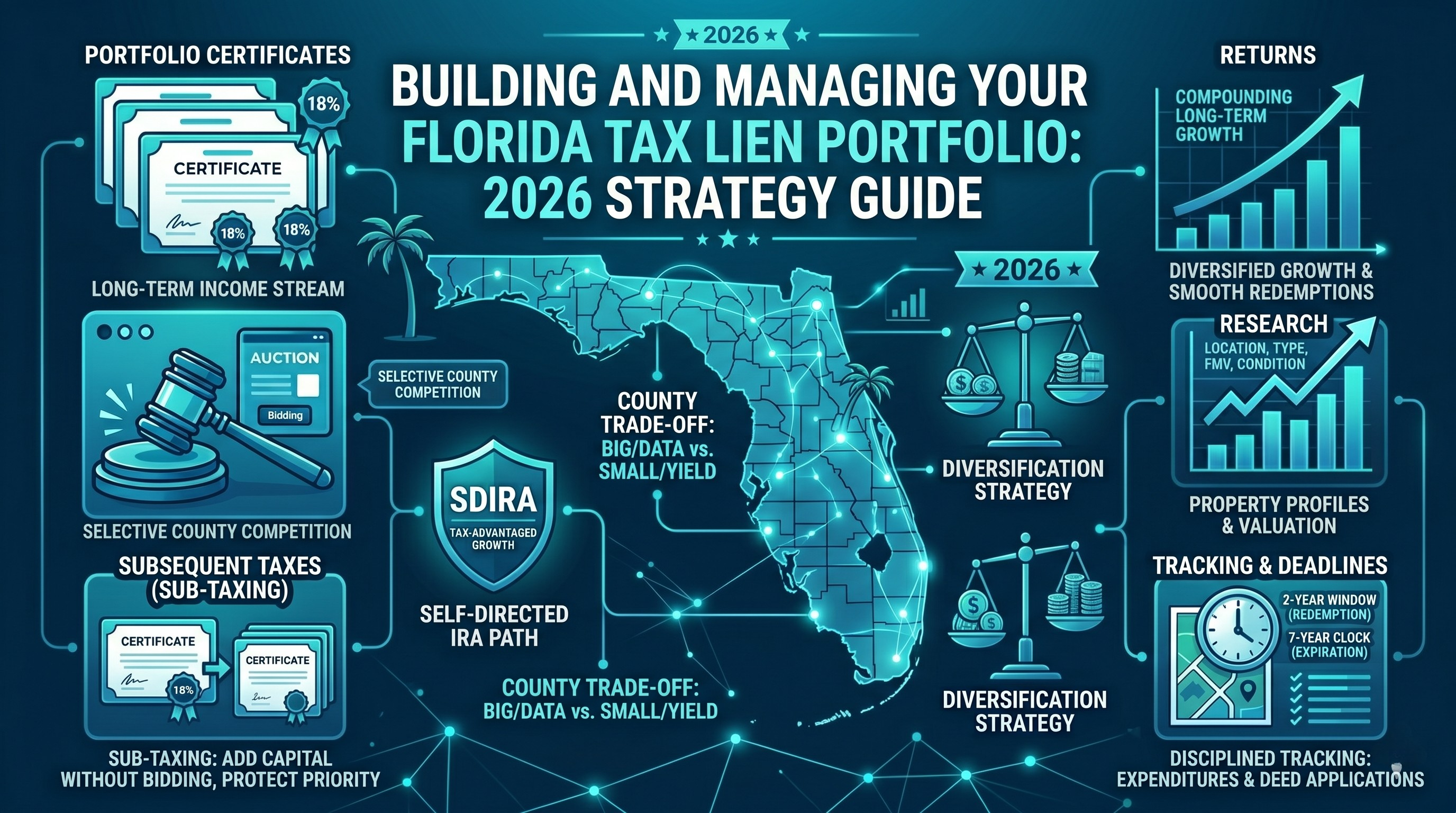
County selection is a trade-off between competition and information. Large, populous counties have deep certificate lists and strong property data, but they also draw the most bidders, which pushes winning rates down. Smaller counties may let you win closer to the full 18%, but property information can be thinner and parcels harder to evaluate. Build a property profile for each parcel you are serious about — location, type, assessed value, and condition — so you are comparing certificates on substance, not just on yield.
Allocating capital and diversifying
Resist the urge to put a large share of your capital into one attractive certificate. Spreading the same money across several smaller liens reduces the impact of any single problem property and smooths out your redemption timing. Compare each opportunity against the property’s fair market value, not just the size of the tax bill, so you understand the real security behind the lien. A diversified book of certificates behaves much more like a steady income portfolio than a series of one-off bets.
Using a self-directed IRA
Some investors hold Florida certificates inside a self-directed IRA, which can allow the interest to grow in a tax-advantaged account rather than being taxed as ordinary income each year. The rules are strict and the setup involves a specialized custodian, so this is a path to explore with a qualified professional rather than something to improvise on your own.
Paying subsequent taxes
When you hold a certificate and the owner falls behind again the following year, Florida lets the existing certificate holder pay those subsequent taxes and fold them into the position. This practice, sometimes called sub-taxing, lets you protect your lien’s priority and put more capital to work at a known rate without bidding again at auction. It is a quiet advantage that experienced Florida investors use to compound their positions over time.
Tracking redemptions and deadlines
Every certificate is a small clock. The owner can redeem at any point during the two-year window, and your certificate ultimately expires seven years from issuance if you never apply for a tax deed. Letting a certificate lapse means losing your investment entirely, so disciplined tracking of dates, redemptions, and deed-application windows becomes essential once your portfolio grows beyond a handful of liens. A simple spreadsheet works at first; dedicated software helps as you scale.
Common Mistakes Florida Beginners Make
Most losses in this market are self-inflicted and avoidable. If you internalize the four mistakes below, you will already be ahead of the majority of first-year investors.
Bidding without researching the property
The certificate amount tells you nothing about whether the property is worth anything. Bidding on a parcel you have not looked at is how investors end up holding liens on land they could never sell or a structure that has been condemned. Research first, bid second, with no exceptions — the few minutes it takes to pull up the parcel can save you the full amount of your investment.
Chasing the lowest rate
In competitive counties it is easy to get pulled into bidding the rate down to a level that no longer compensates you for the risk and the two-year wait. A 2% return on a questionable parcel is worse than passing and deploying that capital somewhere better. Set your floor before the auction and hold it, even when the screen is telling you to keep going.
Treating redemption as failure
New investors are sometimes disappointed when an owner redeems, as if they missed out on the property. They have it backwards. For an income strategy, a clean redemption with interest is exactly the outcome you want. Pursuing an owner-occupied homestead exemption property all the way to a deed is far more complicated and far less common than beginners expect, because those owner-occupied homes are the ones most likely to be redeemed quickly.
Forgetting the certificate can expire
A Florida certificate is not good forever. If you never collect a redemption and never apply for a tax deed, it expires seven years after issuance and your investment is simply gone. Track every certificate’s age and have a clear plan for each one well before that deadline arrives, especially on liens that are sitting unredeemed past the two-year mark.
Florida vs. Other Tax Lien States
Florida is a strong starting point, but it helps to see how it compares to other popular markets. The table below contrasts Florida with Arizona, another well-known certificate state, and Texas, which uses a redeemable deed model focused on acquiring property rather than earning interest. Some states also use premium bidding, where investors bid the price up instead of the rate down. Rules change, so verify current details with each state before investing.
Feature | Florida | Arizona | Texas |
|---|---|---|---|
System type | Tax lien certificate | Tax lien certificate | Redeemable tax deed |
Maximum return at sale | 18% per year (bid down) | 16% per year (bid down) | 25% penalty in year one |
How you bid | Bid the interest rate down | Bid the interest rate down | Bid the price up |
2 years before deed application | 3 years before foreclosure | 6 months to 2 years | |
Typical auction format | Online, county-run | Online, county-run | Mostly in person, county-run |
Primary investor goal | Interest income | Interest income | Acquiring the property |
The takeaway: if your goal is steady interest income with a built-in floor and a fully online process, Florida is hard to beat for a first market. If your goal is acquiring property, a deed-based state may fit better. We break the national picture down further in our state-by-state breakdown of the best places to invest, which pairs well with this Florida deep dive.
How to Get Started the Right Way
If you are ready to move from reading to doing, here is a sane sequence. First, build your foundation with our complete introduction to how tax lien investing works. Then learn the mechanics of a live sale in our walkthrough of how tax lien auctions run and how to win one, and sharpen your property research with our guide to locating and vetting tax lien properties.
From there, pick one or two Florida counties, register on their platforms, and paper-trade a sale — follow the auction without bidding to see how rates move. Read more case studies and tutorials on the TLWB blog, and when you want structured help, the team behind Tax Lien Wealth Builders runs live events designed to take you from spectator to confident bidder. Whichever route you choose, the goal is the same: enough preparation that your first real bid feels routine rather than nerve-wracking.
Prefer to learn online at your own pace first? Our sister training platform offers video-based tax lien investing courses that complement the in-person events well, so you can choose the format that fits your schedule.
Stop watching from the sidelines. Florida’s next certificate season is the best time to put this knowledge to work. Join a TLWB live training, get walked through a real auction, and build your first portfolio with experienced investors in the room. |
Frequently Asked Questions
Is tax lien investing in Florida good for beginners?
Yes, for a specific reason: the rules are statewide and predictable, the auctions are online, and the 5% minimum return gives income-focused beginners a floor. The learning curve is in research and discipline, not in the mechanics, which is why most people start with small certificates while they get comfortable.
How much money do I need to start buying tax lien certificates in Florida?
Less than most people assume. Many certificates sell for a few hundred to a few thousand dollars, and counties do not require you to buy in bulk. Your real constraint is having enough capital to diversify across several certificates rather than betting everything on one, plus a reserve in case you ever pursue a tax deed application.
What interest rate will I actually earn?
Florida certificates start at an 18% maximum and are bid down, so your real yield depends on competition. Popular urban parcels can be bid into the low single digits, while overlooked certificates can win near 18%. Whatever rate you win, the 5% minimum applies on redemption unless you bid 0%, which earns no interest.
What happens if the property owner never pays?
After two years from April 1 of the issuance year, you can apply for a tax deed, which sends the property to a public auction. Usually it sells and you are reimbursed first, including your interest. In the uncommon case where no one bids, the property can pass to you, though you will likely need to clear the title before reselling.
Do I have to live in Florida to invest in Florida tax liens?
No. Florida’s county auctions are conducted online and are open to bidders from anywhere in the United States. You register on each county’s platform, fund your account, and bid remotely. This is one of the main reasons the Florida market attracts so many out-of-state investors.
Can I lose money with Florida tax lien certificates?
It is possible, mainly if you buy a certificate on a property with no real value, fail to do due diligence, or miss a payment deadline. The certificate itself is backed by the property, but a worthless property backs a weak certificate. Careful research and a firm bidding floor are how you keep the risk low.
How are Florida tax lien certificate earnings taxed?
The interest you earn is taxable income. Counties issue a 1099-INT each year reporting your earnings, and you report that interest like other investment income. Holding certificates inside a self-directed IRAAn individual retirement account that allows investment in alternative assets like tax liens and tax deeds for potential tax-advantaged returns. is one way some investors defer or shelter that tax, but the rules are specific and worth reviewing with a tax professional before you set anything up.
How long does it take to get my money back?
There is no fixed answer, which is part of the trade-off. Some owners redeem within months of the sale; others wait until close to the end of the two-year window. You cannot force redemption — you can only wait, then apply for a tax deed once the two years pass. This is why you should only invest money you can comfortably leave untouched for up to two years, and why diversifying across many certificates helps keep some cash flowing in as different liens redeem at different times.
Disclaimer: This article is for educational purposes only and is not legal, tax, or investment advice. Florida tax lien rules are governed by Chapter 197 of the Florida Statutes and vary by county. Confirm current procedures with the relevant county tax collector and consult a qualified professional before investing.