

The auction is where tax lien investing becomes real. Everything before it — the research, the screening, the property checks — leads to a single moment when you either win a certificate at a rate that makes financial sense or you walk away and wait for the next sale. Knowing how to navigate that moment is what separates investors who build consistent portfolios from those who either overpay in the excitement of the auction or sit on the sidelines indefinitely.
This guide explains exactly how tax lien auctions work — the mechanics, the bidding formats, the online platforms, and the preparation steps that determine your results before auction day even starts. It also covers the most common mistakes new investors make, and what winning your first auction actually looks like in practice.

What Is a Tax Lien Auction?
A tax lien auctionA public sale conducted by a government entity where investors can bid on tax lien certificates for properties with unpaid taxes. is a public sale held by a county or municipality to recover unpaid property taxes. When a property owner fails to pay taxes by the deadline, the county places a lien on the property. Rather than waiting to collect the debt itself, the county sells the right to collect that debt — plus interest — to investors at a public auction. The investor pays the outstanding tax balance and receives a tax lien certificate documenting their legal claim against the property.
The property owner then has a defined window — called the redemption period — to repay the investor the original lien amount plus accrued interest. If the owner pays, the investor earns their return and the lien is released. If the owner does not pay within the redemption window, the investor gains the right to pursue a tax deed to the property through the legal process.
Counties hold these sales on an annual schedule — usually once per year, though the timing varies widely. Florida counties run May through June. Indiana runs September through October. Arizona runs February through March. Knowing the auction calendar for your target counties is a basic but essential part of planning your investment year.
Online Auctions vs. In-Person Auctions
The format of a tax lien auction determines how you participate, how fast things move, and what preparation is required. Most states now offer at least partial online access — some have moved their auctions entirely to digital platforms, while others still require physical attendance for all or part of the process.
Online Tax Lien Auctions
Online auctions run through third-party platforms or county-operated portals. Investors register in advance, browse available certificates before the sale date, and submit bids through the platform interface during the auction window. The major platforms include RealTaxDeed (Florida), GovEase (Arizona, Louisiana, Mississippi), SRI Tax Lien Services (Indiana, Illinois), and Bid4Assets (Maryland and others).
The advantages are significant: no travel, access to multiple counties simultaneously, and the ability to set bids and monitor results from anywhere. The main discipline challenge with online auctions is that the convenience can create a false sense of low stakes. Investors who would not overbid in a room full of competitors sometimes overbid repeatedly on a screen because the feedback is slower and the pressure is less visible. The same pre-auction preparation discipline applies regardless of format.
In-Person Tax Lien Auctions
In-person auctions are held at county courthouses, civic buildings, or designated auction venues. Investors register on-site or in advance, receive a bidder number, and participate in a live auction conducted by a county official or auctioneer. Iowa's rotational system, for example, requires in-person registration in most counties. Some smaller counties in competitive states still run live-room auctions despite having online options elsewhere in the same state.
In-person attendance has a real advantage: you can observe other investors' bidding behavior, get a direct read on competition levels in that specific county, and build relationships with county staff and other investors over time. Many experienced investors treat their first year in a new county as a learning trip — attending in person to understand the market before committing significant capital.
How the Bidding Works: Two Methods to Understand
The bidding format determines how competition plays out and what your actual return will be. There are two primary methods used across lien states.
Bid Down the Interest Rate
In bid-down states, the auction opens at the statutory maximum interest rate and investors compete by accepting progressively lower returns. The investor willing to accept the lowest rate wins the certificate. Florida, for example, opens at 18% — if five investors compete for the same certificate, one might win at 4%, another might stop at 7%, and the 4% bidder takes the lien.
The practical implication: in heavily contested urban counties, rates can be driven to fractions of a percent by institutional investors with large capital bases. In rural counties with fewer participants, winning rates closer to the statutory maximum are common. Your research on competition levels at the county level directly affects what return you should expect before you ever place a bid.
Premium Bidding
In premium bidding states — New Jersey, Indiana, and Colorado among them — the interest rate is fixed. Investors compete by bidding above the face value of the lien. The highest premium wins. The critical rule: if the property owner redeems, you collect the original lien face value plus accrued interest — not your premium. Whatever you paid above face value is not recoverable from the owner.
This means premium bidding requires a hard cap calculation before the auction opens. Determine the maximum premium you can pay on each certificate while still producing an acceptable return — factoring in the interest rate, the expected redemption timeline, and the property's underlying value as a fallback. Bidding past that number because of auction momentum is the single most expensive mistake in premium bidding states.
Bid Down Rate | Premium Bidding | |
How you compete | Accept lower interest rate | Pay above face value |
Rate at close | Variable — driven by competition | Fixed by statute |
Risk of overbid | Rate compressed to near zero | Unrecoverable premium |
Example states | Florida, Arizona, Illinois | New Jersey, Indiana, Colorado |
Best strategy | Know county competition levels first | Hard cap before bidding |
How to Prepare for a Tax Lien Auction
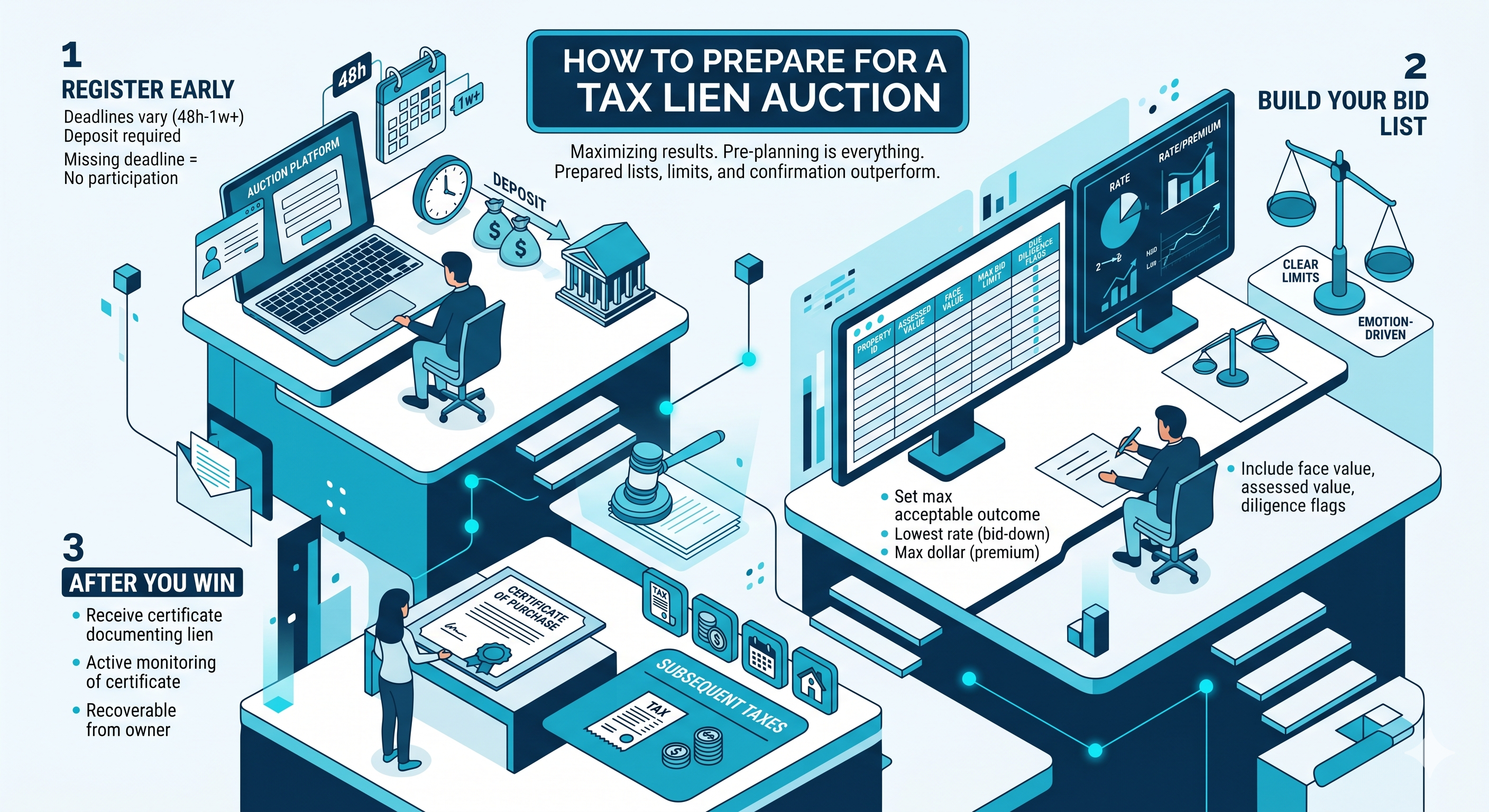
Your results at auction are determined largely before the auction begins. Investors who arrive with a prepared list, clear bid limits, and a registration confirmation consistently outperform investors who show up with a general idea of what they want to buy.
Register Early
Most counties and auction platforms require advance registration — sometimes with a deposit that will be applied to your winning bids. Deadlines vary: some platforms close registration 48 hours before the auction. Others require registration a week or more in advance. Missing the registration window means watching an auction you spent days researching without being able to participate. Check the specific requirements for each county and build the deadline into your calendar before you start screening properties.
Build Your Bid List
From your screened property list, identify the certificates you intend to bid on and set your maximum acceptable outcome for each one. In bid-down states: the lowest interest rate you'll accept. In premium states: the maximum dollar amount above face value. Write these down in a simple document or spreadsheet and open it before the auction starts. Having your limits in front of you during bidding is a mechanical way to prevent emotion-driven overpayment.
For each certificate on your list, also note the delinquent taxes face value, the assessed value of the underlying property, and any flags from your due diligence screening. This gives you the full picture at a glance without needing to re-research anything mid-auction.
Understand What Happens After You Win
Winning a certificate is not the end of the process — it is the beginning of the redemption periodThe legally defined timeframe during which a property owner can reclaim their property by paying the delinquent taxes plus interest and penalties.. After the auction, you receive a certificate of purchase documenting your lien position. In many states, you are also responsible for paying any subsequent taxes that come due on the property during the redemption window. These amounts are recoverable from the owner at redemption — they are added to the total the owner must repay — but they do require active monitoring of each certificate you hold.
Common Mistakes at Your First Tax Lien Auction
Bidding Without a Hard Limit
The most frequent and most costly mistake. Whether you're in a bid-down state being driven toward a near-zero rate or in a premium state watching the price climb above what the math supports, crossing your pre-set limit is how investors turn a research win into a financial loss. Set the limit before the auction. Hold it during the auction. There will always be another sale.
Skipping the Property Evaluation
Buying a certificate on a property you haven't evaluated is speculation, not investing. Even a basic check — assessed valueThe dollar value assigned to a property by a local tax assessor for the purpose of calculating property taxes. vs. lien amount, map review, search for existing encumbrances — takes less than 30 minutes per property and eliminates the certificates most likely to create problems. Investors who skip this step often end up holding liens on worthless or legally complicated properties with no clear path to a return.
Ignoring the Redemption Timeline
A lien certificate that runs for three years ties up your capital for three years. If your investment timeline or cash flow needs require access to that money sooner, a long-redemption state or county is the wrong target regardless of the interest rate. Match the redemption period to your actual financial situation before selecting a market, not after.
Treating All Certificates as Equal
A $400 lien on a vacant lot with no road access is not the same investment as a $400 lien on a residential property with a $60,000 assessed value. Face value tells you the cost of entry — it says nothing about the quality of the underlying collateral. Every certificate on your list deserves individual evaluation. The fair market value of the property is your real security. Never lose sight of it.
Frequently Asked Questions
How do I find upcoming tax lien auctions in my target state?
Start with the county treasurer's website for each county you're targeting. Most counties publish their upcoming sale dates, registration deadlines, and available property lists directly on the site. For states using centralized platforms — GovEase, SRI, Bid4Assets, RealTaxDeed — the platform itself lists all upcoming sales across participating counties. Signing up for county email notifications or platform alerts is the most reliable way to stay current on sale dates.
Can I attend a tax lien auction without buying anything?
Yes, and for a first-time investor, attending an auction as an observer before you bid is one of the most valuable things you can do. In-person auctions allow you to watch how competition unfolds in that specific county, observe how experienced investors respond when rates get driven low, and get a direct read on the pace and format of the sale. Many online platforms also allow you to monitor auctions in real time without placing bids. Treat your first attendance as paid research.
What happens if nobody bids on a tax lien certificate?
Certificates that receive no bids at auction are typically held by the county or made available for post-auction purchase — often called over-the-counter sales. In states like Iowa, over-the-counterTax liens or tax deeds that were not sold at public auction and are available for purchase directly from the county or taxing authority. certificates are available from the county treasurer at any time, at the full statutory interest rate, until purchased. These can represent genuine opportunities for investors who want to deploy capital outside of formal auction windows — though the reason a certificate went unbid at auction is always worth investigating before purchasing it post-sale.
How long does a tax lien auction take?
Online auctions vary widely — some run for a few hours on a single day, others are structured over multiple days with different property batches closing at different times. In-person auctions in smaller counties can be completed in a few hours. Larger counties with thousands of certificates may run multi-day sales. Check the specific auction schedule published by the county or platform well in advance — particularly for online auctions where multiple closing windows can overlap if you're bidding across several counties simultaneously.
Ready to Attend Your First Tax Lien Auction?
The mechanics of tax lien auctions are learnable. What makes the difference at your first sale is not inside knowledge — it's preparation. Knowing your bid limits before the auction opens, understanding the format of the specific county you're targeting, and having a screened property list ready before registration closes puts you ahead of the majority of first-time investors who arrive underprepared.
For investors who want to walk through a real auction environment with experienced guidance before going live, Tax Lien Wealth Builders runs live workshops that simulate the full auction process — covering county selection, property screening, bid strategy, and what to do after you win. See the upcoming training events at TLWB for current dates and formats.
If you're in the research phase and not ready for a live event yet, the United Tax Liens blog publishes ongoing content on auction strategy, county-specific breakdowns, and investor case studies — useful material for building your knowledge base before your first sale.