
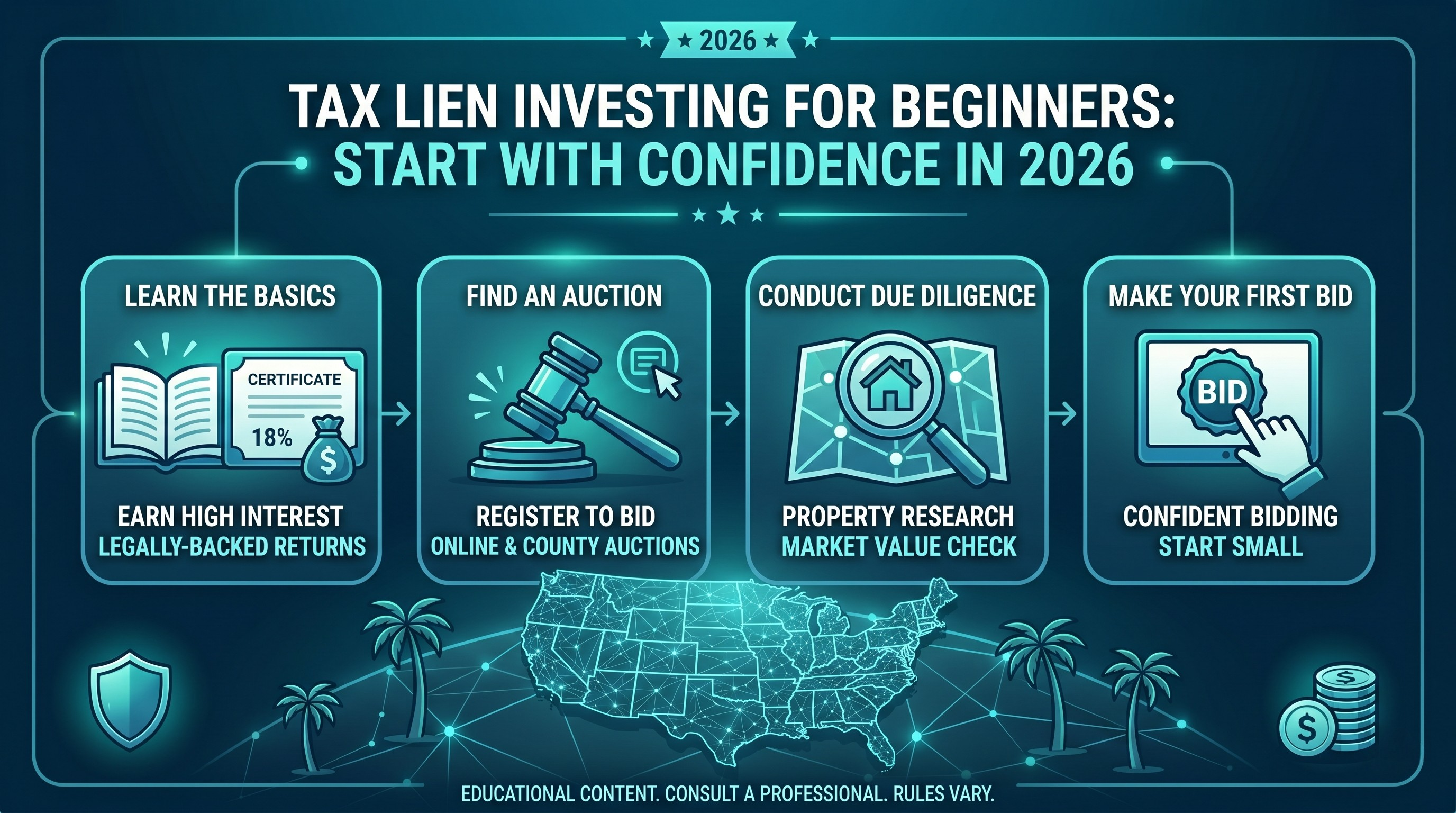
If you have heard that you can earn high, legally backed returns by paying other people’s overdue property taxes, you have heard about tax lienA legal claim or right against a property that serves as security for a debt or obligation owed by the property owner. investing. It is one of the few investments where the interest rate is set by state law and your money is secured by real estate. But the jargon scares a lot of people off before they ever start.
This guide fixes that. We will explain what tax lien investing actually is, how the process works from start to finish, whether it is a good idea for someone in your position, and the exact steps to make your first move. No hype, no “get rich quick” promises — just the real mechanics, written for a complete beginner.
A quick note: this is educational content, not financial or legal advice. Rules vary by state and county, so always confirm the specifics before you invest. With that out of the way, let us start at the beginning.
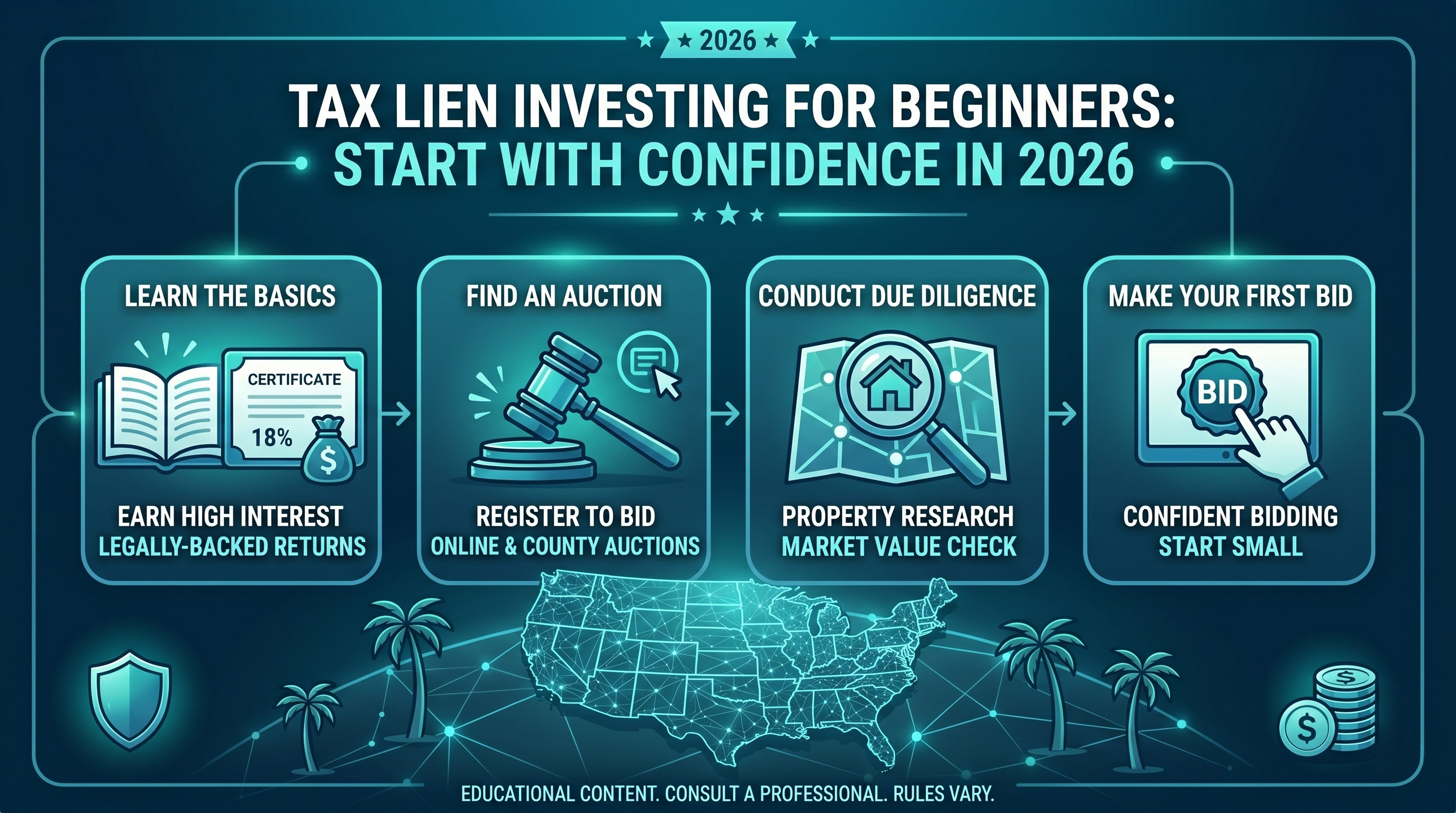
What Is Tax Lien Investing?
When a property owner does not pay their property taxes, the local government still needs that money. Rather than wait, the county sells the debt to investors. You pay the overdue taxes on the owner’s behalf, and in exchange you get a legal claim — a lien — against the property, plus the right to collect what you paid back with interest.
The simple version
Think of yourself as stepping into the county’s shoes. The unpaid taxes become delinquent taxes, the county sells that debt, and you become the one the owner now owes. Most of the time the owner pays you back with interest, and you never go anywhere near the property. That is the entire model in one sentence: you are lending money that is secured by real estate, at a rate the state sets.
What is a tax lien certificate?
When you win at a tax sale, the document you receive is a tax lien certificate. So what is a tax lien certificateA legal document issued by a government authority when a property owner fails to pay property taxes, granting the certificate holder a lien on the property., exactly? It is the official proof that you paid the delinquent taxesProperty taxes that remain unpaid past the due date, which may result in penalties, interest, and eventually a tax lien being placed on the property. and now hold the lien. It states how much you are owed and the interest rate you will earn. In some states this paperwork is called a certificate of purchase, but it means the same thing.
What you’re really buying
This is the point beginners most often get wrong, so let us be clear: a tax lien certificate is not a deed. You are not buying the house. You are buying the right to collect a debt, backed by the property as security. Owning the real estate is a separate, much rarer outcome that only happens if the owner never pays. Keep that distinction front and center and you will avoid most early mistakes.
Why Tax Lien Investing Appeals to Beginners
Plenty of investments are open to newcomers. Here is why tax liens specifically tend to attract people who are just getting started, and why the appeal is mostly justified.
A relatively low cost to enter
You do not need tens of thousands of dollars. Many certificates sell for a few hundred to a few thousand dollars, and counties do not force you to buy in bulk. That low barrier lets a beginner start small, learn the process with limited risk, and scale up only once they are comfortable.
Returns backed by law and by property
Unlike a stock, the interest rate on a tax lien is set by statute, not by the market’s mood. Depending on the state, the maximum rate can be well into the double digits. And because the debt is secured by the property, you are not relying on a company’s performance — you are relying on the value of real estate and the owner’s strong incentive to keep it by paying you back through their right of redemption.
No tenants, no toilets, no landlord headaches
Tax lien investing gives you exposure to real estate without the operational grind of being a landlord. There are no tenants to screen, no repairs to manage, no late-night maintenance calls. For people drawn to real estate but repelled by the work of owning rentals, that hands-off quality is a big part of the appeal.
How the Process Actually Works, Start to Finish
Here is the full lifecycle of a tax lien, from the moment you bid to the moment you get paid. Once you see the whole arc, the individual pieces stop feeling intimidating.
The auction
Counties sell certificates at a tax lien auction, most of which now run online. Depending on the state, you either bid the interest rate down — a process called bidding down the interest rate — or you bid the price up, known as premium bidding. Either way, the county collects its money and you walk away holding the lien on the parcels you won.
The waiting period
After the sale, the owner gets a redemption period — a window of time, often one to three years depending on the state, during which they can pay off what they owe plus your interest. During this period you simply hold the certificate and wait. You cannot occupy or sell the property; you are earning interest while the clock runs.
The two possible outcomes
Every certificate ends in one of two ways. Understanding both is how you set realistic expectations.
Outcome 1: the owner pays
This is what happens the large majority of the time, and it is the outcome an income investor actually wants. The owner redeems the certificate, you receive your original investment plus the interest you earned, and you move on to the next one. Clean, predictable, and exactly the point of the strategy.
Outcome 2: the owner doesn’t pay
If the redemption periodThe legally defined timeframe during which a property owner can reclaim their property by paying the delinquent taxes plus interest and penalties. passes with no payment, you can begin the process that may lead to ownership. That involves applying for a tax deed, which typically sends the property to a tax deed sale. Usually it sells and you are repaid first; occasionally no one bids and you can end up with the property itself, sometimes after a step to clear the title through foreclosure of the owner’s remaining interest.
Want to see how the whole system fits together? Our complete walkthrough of how tax lien investing works from the ground up is the natural next read after this one — it goes deeper on every stage you just learned. |
Is Tax Lien Investing a Good Idea? An Honest Look
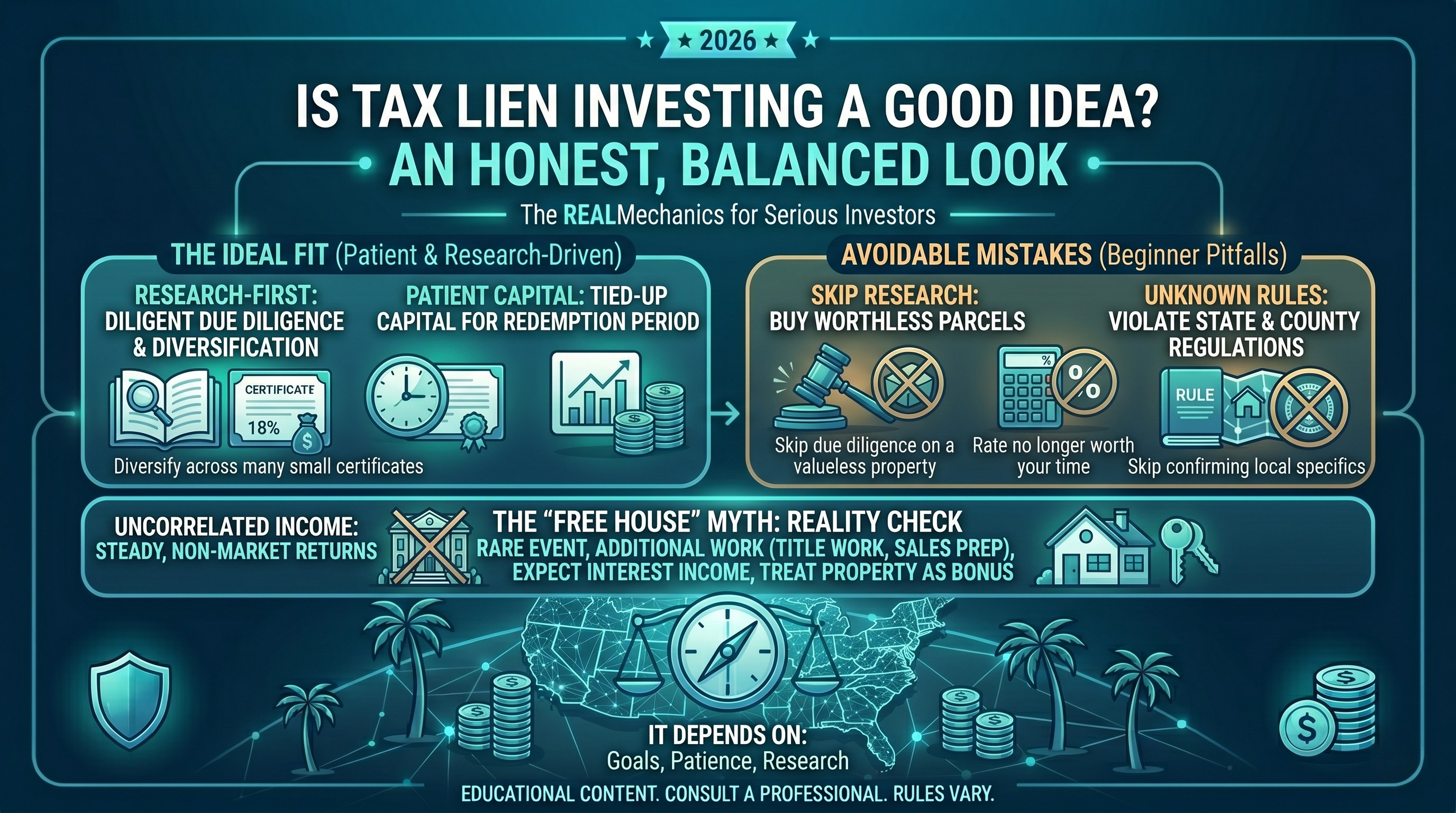
Is tax lien investing a good idea for you? The honest answer is: it depends on your goals, your patience, and your willingness to do homework. It is not a scam, and it is not free money either. Here is the balanced view.
Where beginners get it right
Tax liens reward patient, research-driven investors who treat it as a steady income strategy rather than a jackpot. If you are comfortable doing due diligence on properties, can leave your capital tied up for the redemption period, and want returns uncorrelated with the stock market, the strategy fits well. People who diversify across many small certificates tend to have the smoothest experience.
Where beginners get burned
The losses almost always come from skipping research. Buying a certificate on a worthless parcel, bidding the rate down so low it is not worth your time, or not understanding the rules in a particular state — these are the avoidable mistakes that give the strategy a bad name. The tool is sound; the discipline is what varies.
The “free house” myth
You have probably seen ads promising you will buy mansions for a few hundred dollars in back taxes. Ignore them. Ending up with a property is rare, and when it happens the property is usually modest and may need title work before you can sell it. Go in expecting interest income, treat any property you acquire as a bonus, and you will never be disappointed.
How to Start Tax Lien Investing in Five Steps
Ready to move from reading to doing? Here is a sane, low-risk path for your first certificate.
Step 1: Learn one state’s rules
Do not try to learn every state at once. Pick one state and learn how it runs sales, what its maximum rate and redemption period are, and whether certificates are sold at auction or available over the counter. Florida is a popular starting point because its rules are consistent statewide and its auctions are online — our complete Florida tax lien guide is a good place to begin.
Step 2: Pick a county and study its list
Choose a county within your state and download its upcoming certificate list. Look at the property types, the assessed value of each parcel, and where they are located. This is also where you decide which parcels are worth bidding on and which to skip. If you want help locating viable properties, our guide to finding and vetting tax lien properties walks through the process.
Step 3: Set a budget and a floor
Decide how much total capital you will commit and the lowest interest rate you will accept on any certificate. Write both numbers down before the auction starts. The single most useful habit a beginner can build is the discipline to stop bidding when the rate drops below your floor.
Step 4: Register and bid
Register on the county’s auction platform ahead of time, fund any required deposit, and place your bids. For your very first sale, consider following along without bidding, or bidding on just one small certificate, so you can learn the platform with minimal money at stake.
Step 5: Track everything and wait
Once you win, record the certificate number, parcel ID, purchase date, and rate. Then you wait for redemption. Keeping organized records becomes essential as you add more certificates, and it makes tax time far easier since the interest you earn is reportable income.
Frequently Asked Questions
How much money do I need to start tax lien investing?
Less than most people think. Many certificates sell for a few hundred to a few thousand dollars, and there is no requirement to buy several at once. A common beginner approach is to start with one or two small certificates, learn the full cycle, and reinvest as they redeem.
Is tax lien investing safe for beginners?
It is relatively safe in the sense that your investment is secured by real estate and the interest rate is set by law. The main risks are buying a certificate on a low-value property or misunderstanding a state’s rules. Both are avoidable with research, which is why starting small in one state is the smartest way in.
How long until I get my money back?
It varies. Some owners redeem within months; others wait until near the end of the redemption period, which can be one to three years depending on the state. Because you cannot force an early payment, only invest money you can comfortably leave alone for the full period.
What is the difference between a tax lien and a tax deed?
A tax lien is a claim for unpaid taxes that earns you interest; a tax deedA legal document that transfers property ownership to the government or an investor after the owner fails to pay property taxes for an extended period. transfers ownership of the property. Some states sell liens, some sell deeds, and some do both. We cover this in detail in our breakdown of tax lien versus tax deed investing, which is worth reading once you understand the basics here.
Where can I learn tax lien investing properly?
Start with free resources like the articles on the TLWB blog, then consider structured training when you are ready to commit real capital. You can learn online at your own pace through our video-based tax lien courses, or in person at a live event for hands-on practice.
Your first certificate is closer than you think. Tax lien investing for beginners is mostly about confidence, and confidence comes from preparation. When you are ready to learn the process hands-on with experienced investors, Tax Lien Wealth Builders offers live training built for newcomers. |
Disclaimer: This article is for educational purposes only and is not legal, tax, or investment advice. Tax lien rules vary by state and county. Confirm current procedures with the relevant county before investing and consult a qualified professional.