
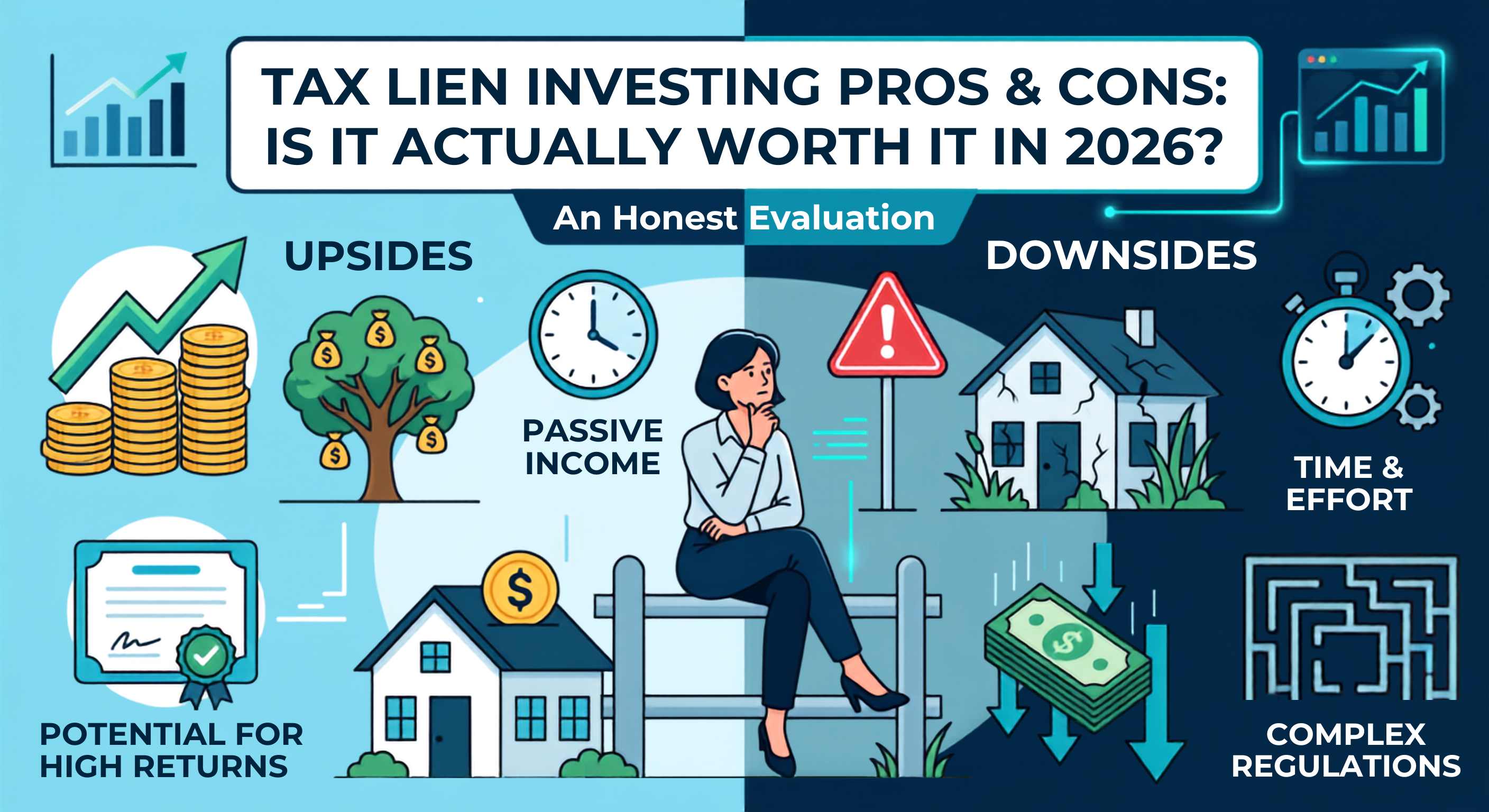
Every investment gets sold to you with the upside loud and the downside in fine print. Tax lienA legal claim or right against a property that serves as security for a debt or obligation owed by the property owner. investing is no different — you have probably seen the ads promising effortless double-digit returns and cheap houses. This article does the opposite. We are going to lay out the real pros and cons of tax lien investing, side by side, so you can decide for yourself whether it is worth your time and money.
No hype and no fear-mongering — just an honest evaluation for someone sitting on the fence. By the end you will know what the strategy genuinely offers, where it can bite you, and the kind of investor it actually suits.
One note first: this is educational content, not financial or legal advice. Rules vary by state and county, and your situation is your own, so treat this as a framework for your decision rather than a recommendation.
Is Tax Lien Investing Legit?
Before weighing pros and cons, it is worth clearing up the question many people quietly have: is tax lien investing legit, or is it a scheme? The short answer is that the mechanism is completely real and legal — but the marketing around it is often where the trouble starts.
Yes — it’s a real, government-run process
Tax lien sales are run by county governments, not by private promoters. When taxes go unpaid, the county sells the delinquent taxes as a lien to investors so it can fund services without waiting. You receive an official tax lien certificate, and your return is set by state law. This is a long-established public process, not a loophole.
Where the bad reputation comes from
The skepticism is earned, just misdirected. It comes from the guru-style marketing layered on top of a legitimate process — the seminars promising guaranteed riches and mansions for pocket change. The process is sound; the overblown promises are not. Separate the two and the picture gets much clearer.
The Pros of Tax Lien Investing
Here is what genuinely makes the strategy attractive when it is done well.
Interest rates are set by law, not the market
Depending on the state, the maximum rate can reach well into the double digits, and it is fixed by statute rather than market sentiment. Even after competitive bidding down the interest rate, the yields can compare favorably to many conventional fixed-income options. Your return does not depend on a company’s earnings or a market rally.
Your money is secured by real estate
A tax lien is backed by the property it is attached to, and tax liens generally hold priority over most other claims. The owner has a powerful incentive — their right of redemption and the threat of losing the property — to pay you back. That security is the core of the appeal: you are not an unsecured lender hoping to be repaid.
A low cost to get started
You do not need a large bankroll. Many certificates sell for a few hundred to a few thousand dollars, and there is no requirement to buy in bulk. That makes it one of the more accessible ways to get real-estate-backed exposure without a down payment on a property.
Passive and uncorrelated with stocks
Once you hold a certificate, there is nothing to manage — no tenants, no repairs, no day-to-day work. And because returns come from tax law and property, they do not move in lockstep with the stock market, which appeals to investors looking to diversify away from equities.
The Cons and Real Risks of Tax Lien Investing
Now the other side of the ledger — the parts the ads tend to skip. None of these are reasons to avoid the strategy outright, but ignoring them is how people lose money.
Your capital gets locked up
When you buy a certificate, your money is tied up for the redemption period, which can run one to three years depending on the state. You cannot force the owner to pay early, and there is no easy secondary market to sell out. If you might need that cash soon, this is a real drawback.
You probably won’t get the property
The “cheap house” pitch is mostly fiction. The large majority of certificates are redeemed, meaning you collect interest and never touch the property. Actually acquiring real estate requires the owner to default, you to apply for a tax deed, and the property to go through a tax deed sale where it usually still sells to someone. Treat property acquisition as a rare bonus, not the plan.
The research burden is on you
Every certificate demands due diligence. You have to evaluate the assessed value and the real fair market value of the property, and often run a basic title search to spot complications. This takes time and judgment, and there is no one to outsource the consequences to if you get it wrong.
Risks beginners underestimate
Beyond the obvious, watch for the quieter risks: buying a certificate on a worthless or contaminated parcel, bidding the rate so low the return is not worth the wait, missing a payment or filing deadline, or an owner bankruptcy that delays redemption. In rare cases where you do pursue the property, you may face the cost and effort of foreclosure of the owner’s interest and clearing the title before you can sell.
Rules vary, and the mistakes are yours
Every state runs its system differently — different rates, redemption periods, and procedures — and even the paperwork name changes, with some states issuing a certificate of purchase instead. There is a genuine learning curve, and the responsibility for understanding the rules in your chosen state sits entirely with you.
Pros and Cons at a Glance
If you want the quick version to weigh before reading on, here is the summary side by side.
Pros | Cons |
|---|---|
High interest rates set by law | Capital is locked up for the redemption periodThe legally defined timeframe during which a property owner can reclaim their property by paying the delinquent taxes plus interest and penalties. |
Secured by real estate | Acquiring property is rare, not the norm |
Low cost to start | Heavy research burden on every parcel |
Passive, no tenants or repairs | Rules vary by state; mistakes are your own |
Returns uncorrelated with the stock market | No guaranteed early payout or liquidity |
Want to see what real results look like? The honest way to judge any strategy is by outcomes, not promises. See real student results and reviews from investors who learned the process and put it to work. |
Is Tax Lien Investing a Good Idea for You?
Whether tax lien investing is a good idea depends less on the strategy and more on the investor. Here is a simple way to place yourself.
It’s a strong fit if…
You want steady, real-estate-backed income, you can comfortably lock up capital for a year or more, and you are willing to do research before you bid. It also suits people who want to diversify outside the stock market, and those who like the idea of investing through a self-directed IRA for tax-advantaged growth. If that sounds like you, the pros likely outweigh the cons.
It’s probably not for you if…
You need liquidity and might want your money back on short notice, you are hoping to flip cheap houses quickly, or you do not have the time or interest to research parcels properly. Going in with those expectations is how the cons end up dominating your experience. There is no shame in deciding it is not your strategy.
So, Is It Worth It in 2026?
For the right investor, yes. Tax lien investing offers legally backed returns secured by real estate, at a low cost of entry, with little ongoing work — a genuinely useful tool for patient, research-driven people. For the wrong investor, the locked-up capital and research burden make it more frustrating than it is worth. The deciding factor is honesty about your own goals and patience. If you are still building the basics, our beginner’s guide to tax lien investing and our complete tax lien investing overview are the right next steps.
If you have decided it is worth a closer look, get concrete. Study a real market like Florida through our Florida tax lien guide, learn the transaction with our walkthrough of how to buy your first certificate, and browse more on the TLWB blog.
Frequently Asked Questions
Is tax lien investing legit or a scam?
It is legitimate. Tax lien sales are run by county governments under state law, and your return is set by statute. The scam reputation comes from the hyped marketing around it, not the process itself. Approach it as a real, research-based investment rather than a get-rich-quick scheme and the reputation question answers itself.
What are the biggest risks of tax lien investing?
The main risks are buying a certificate on a low-value property, having your capital tied up longer than expected, missing a deadline, and misunderstanding a state’s rules. Most are avoidable with diligent research and a disciplined approach to which certificates you bid on.
Can you lose money with tax liens?
Yes, mainly if the property securing your lien turns out to be worthless or you make a procedural error. The lien is only as strong as the property behind it, which is why due diligenceThe research and investigation process an investor conducts before purchasing a tax lien or tax deed to evaluate the property and assess risk. is non-negotiable. Done carefully, losses are uncommon, but they are possible.
Is tax lien investing better than the stock market?
It is not better or worse — it is different. Tax liens offer fixed, real-estate-backed returns with low liquidity, while stocks offer growth potential with daily liquidity and market risk. Many investors use tax liens to diversify alongside stocks rather than to replace them.
How do I decide if it’s right for me?
Weigh the pros and cons against your own goals: your need for liquidity, your tolerance for research, and your time horizon. If you want backed income and can be patient, it fits well. The clearest way to decide is to learn the process properly before committing real money.
Decide with knowledge, not guesswork. The investors who do well with tax liens are the ones who learned the process before they bid. Tax Lien Wealth Builders runs live training that walks you through real auctions, real due diligence, and real decisions — so you can judge for yourself whether it is worth it, with your eyes open. |
Disclaimer: This article is for educational purposes only and is not legal, tax, or investment advice. Tax lien rules vary by state and county, and all investing carries risk. Confirm current procedures with the relevant county and consult a qualified professional before investing.