
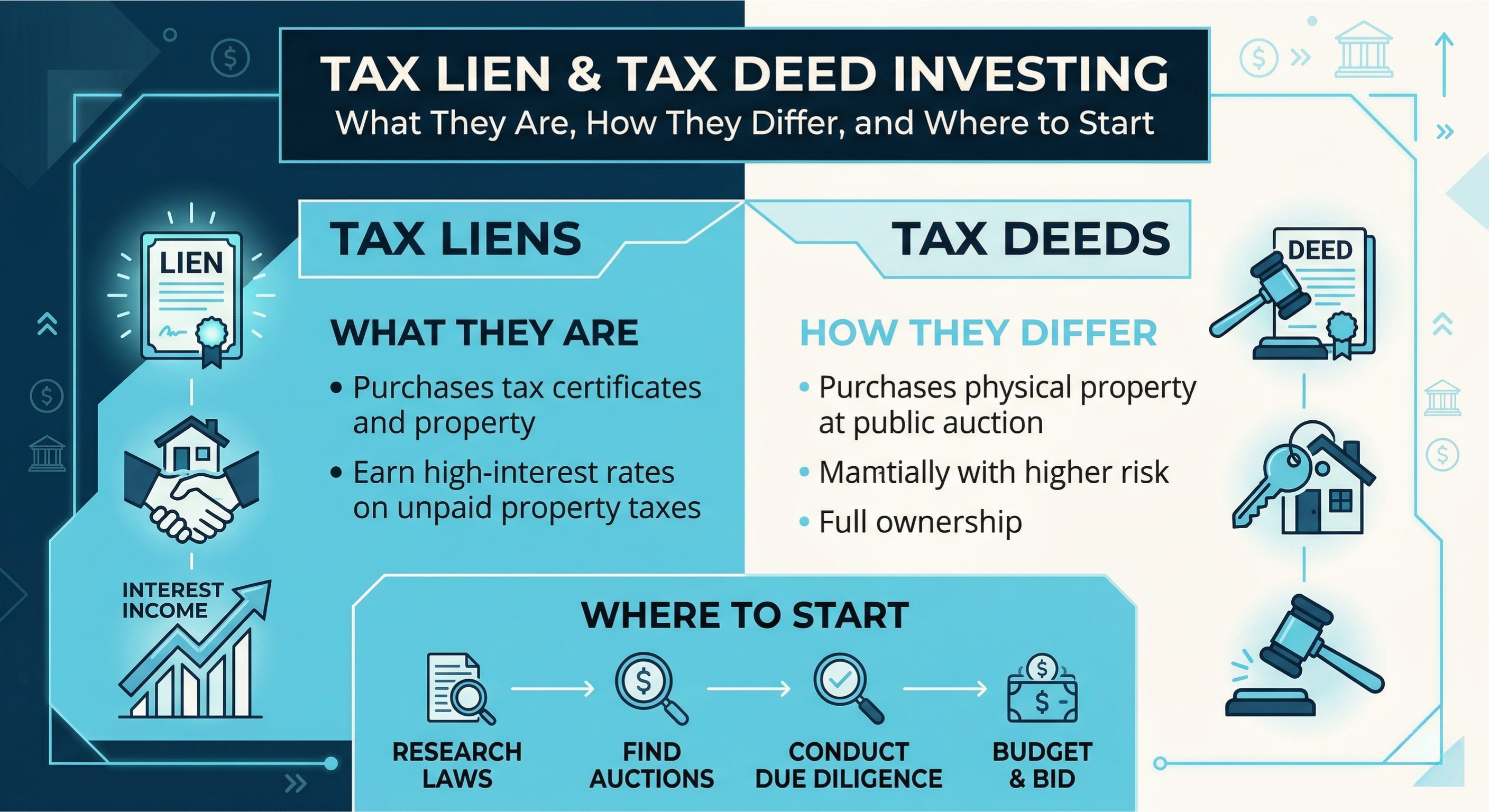
Two terms come up constantly in real estate investing circles: tax lien and tax deedA legal document that transfers property ownership to the government or an investor after the owner fails to pay property taxes for an extended period.. Most beginners use them interchangeably. That's a mistake — they are fundamentally different investment vehicles, with different mechanics, different risk profiles, and different end goals.
This guide breaks both down clearly. By the end, you'll know exactly how each works, which states offer which, and how to decide where to start. No jargon left unexplained. No fluff.
If you want the full investor education context before diving in, the Tax Lien Wealth Builders blog is a solid starting point. But this article gives you the foundation.
New to this space? Tax Lien Wealth Builders offers structured education for investors who want to learn tax lien and tax deed investing the right way — with real guidance, not just YouTube clips. See what's available. |
The Core Difference: Debt vs. Ownership
Here's the clearest way to understand the difference between a tax lien and a tax deed:
When you invest in a tax lien, you are buying the debt — specifically, a lien certificate that represents the government's claim against a property for unpaid taxes.
When you invest in a tax deed, you are buying the property itself — ownership transfers to you after the government sells it at auction.
Both exist because property owners fail to pay their property taxes. The difference is how the local government responds — and that depends entirely on the state.
In a tax lien state, the government sells the right to collect the delinquent tax debt to investors. The owner still has a chance to redeem their property by repaying the investor with interest. In a tax deed state, the government skips that step — it seizes the property and sells it outright.
How Tax Lien Investing Works
When a homeowner falls behind on property taxes, the local government needs that revenue. Rather than wait, many states allow the municipality to issue a lien certificate — a legal document representing the unpaid tax debt — and sell it to investors at auction.
What You're Actually Buying
You're not buying the property. You're buying the government's right to collect. That lien certificate entitles you to:
The original tax debt amount
Statutory interest — set by state law, typically between 8% and 36% annually
Penalty fees in some states
The property owner then enters a redemption periodThe legally defined timeframe during which a property owner can reclaim their property by paying the delinquent taxes plus interest and penalties. — usually one to three years — during which they can pay off the lien (your certificate value plus interest). If they do, you get paid. If they don't, you may be able to foreclose and take ownership of the property.
This is what makes tax lien investing attractive: the return is defined by statute, not by market sentiment. United Tax Liens explains this model in depth — including how auctions work and what the redemption process looks like from an investor's perspective.
Tax Lien Investing: Risk and Reward
Advantages:
Government-backed returns — interest rates are set by law
Lower capital requirements — you can start with a single certificate
First-lien position in most states — you're ahead of mortgage lenders in priority
Defined process — rules are public and consistent within each state
Risks:
Property condition — if you end up foreclosing, you inherit whatever the property looks like
Redemption risk — the owner pays you off and you lose the long-term position
Due diligenceThe research and investigation process an investor conducts before purchasing a tax lien or tax deed to evaluate the property and assess risk. required — not every certificate is worth buying
State law complexity — rules vary significantly across tax lien states
Want to see what real investors say about this model? Read firsthand accounts from people who've gone through the process at United Tax Liens investor testimonials. |
How Tax Deed Investing Works
Tax deed investing cuts straight to ownership. When a property owner fails to pay taxes in a tax deed state, the government eventually sells the property at a public auction — called a tax deed saleA public auction where the actual ownership of tax-delinquent properties is sold to the highest bidder, transferring the deed to the winning investor.. The winning bidder receives a tax deed, which is a document transferring ownership.
What You're Actually Buying
You're buying the property outright. There's no redemption period waiting for you — in most cases, once the deed is transferred, the former owner has lost their claim. What you get:
Legal ownership of the real estate
Potential equity if the property is worth more than your bid
A physical asset you can rent, renovate, flip, or hold
Tax deed investing strategies vary widely. Some investors target vacant land — lower purchase prices, no tenants to manage. Others look for distressed residential properties with strong underlying value. The common thread: you're buying below market (sometimes significantly) because you're absorbing the risk and complexity that others avoid.
Tax Deed Investing: Risk and Reward
Advantages:
Direct ownership — skip the middleman, own the asset
Potential for large equity gains if the property is undervalued
No waiting for a redemption period to collect your return
Diverse strategies — land, residential, commercial all available
Risks:
Title issues — tax deeds can come with clouded title that requires legal clearing
Property condition — you're often buying sight unseen or with limited inspection access
Higher capital requirements — bidding on real property takes more money
Competitive auctions — popular markets attract experienced buyers
Tax Lien vs Tax Deed: Side-by-Side Comparison
Here's the clearest way to see the difference between tax deed and tax lien investing in one view:
Tax Lien | Tax Deed | |
What you buy | The debt (lien certificate) | The property itself |
What you own after | A claim on the property | Title to the property |
Redemption period | Yes — owner can pay you off | No — sale is final |
Return type | Interest (8–36% by state) | Equity / resale profit |
Capital needed | Low to moderate | Moderate to high |
Complexity | Lower — process is defined | Higher — title research required |
Risk level | Lower | Higher |
End goal | Get paid with interest | Own and sell/rent property |
Neither model is universally better. Tax lien investing suits investors who want defined, passive returns with lower complexity. Tax deed investing suits those who want direct ownership and are comfortable with higher due diligence and capital requirements.
The United Tax Liens investing services page walks through both approaches in the context of real investment decisions — worth reading before you commit to either path.
Tax Lien State vs Tax Deed State: Which One Are You In?
Your state determines what type of investing is available to you locally. Understanding tax lien vs tax deed states is the first practical step before you do anything else.
Tax Lien States vs Tax Deed States: The Map
Roughly 30 states are tax lien states. The rest are primarily tax deed states — though some states use a hybrid model where the process starts as a lien but quickly converts to a deed if unpaid. Here's a quick reference:
Tax Lien States (examples) | Tax Deed States (examples) |
Florida | California |
Illinois | Texas |
New Jersey | Georgia |
Arizona | Michigan |
Colorado | Oregon |
Iowa | Washington |
Indiana | Nevada |
Note: Several states — including Maryland, New York, and Connecticut — operate hybrid systems. Always verify current law in your target state before bidding. The National Tax Lien Association maintains updated state-by-state information for investors.
Does It Matter Where You Live?
Not necessarily. You can invest in tax liens or tax deeds in any state that allows out-of-state investors — which most do. If you live in California (a tax deed state) but want the fixed-interest returns of a lien certificate, you can invest in Florida or Illinois remotely.
This is increasingly common. Online auctions have opened access to markets across the country. The question isn't where you live — it's where the best opportunity is and whether you understand the local rules.
Not sure which state or strategy fits your goals? The team at United Tax Liens works with investors at every level. Reach out directly to talk through your situation — or explore the United Tax Liens about page to understand who you'd be working with. |
Where to Buy Tax Yield Investments Online
The landscape for buying tax lien certificates and attending tax deed auctions has shifted dramatically online. You no longer need to show up in person at a county courthouse — though some counties still run live auctions.
Online Auction Platforms
Several platforms host county-authorized auctions for both liens and deeds:
Bid4Assets — one of the largest platforms for tax deed and lien auctions across multiple states
RealAuction — used by counties in Florida, New Jersey, and other lien states
SRI Inc. — specializes in tax lien auctions, primarily in the Midwest
GovEase — growing platform connecting investors with county-run online auctions
Each platform operates differently. Some require pre-registration and a deposit. Some states use simultaneous bid auctions; others use round-robin or premium bidding. You need to understand the auction format before bidding — submitting the wrong type of bid can cost you the certificate or leave money on the table.
What to Do Before You Bid
Regardless of whether you're targeting a lien certificate or a tax deed, the pre-auction process is similar:
Research the property — look up the parcel on the county assessor's site and pull any available records
Check for senior liens — some properties carry IRS liens or environmental liens that survive the tax sale
Assess the property's condition using satellite imagery, street view, and permit records
Verify the redemption period and interest rate (for liens) or title clearance process (for deeds)
Set a maximum bid and stick to it — auction psychology is real
The Tax Lien Wealth Builders resources cover the due diligence process in detail — including what experienced investors look for before submitting a bid.
Which Path Is Right for You?
This is the question most beginners eventually land on. Here's a direct framework:
Choose Tax Lien Investing If You:
Want defined returns without depending on property markets
Are starting with limited capital (some certificates sell for under $500)
Prefer a passive model — buy the certificate, wait for redemption or interest
Want lower complexity while you learn the system
Are in or near a strong lien state like Florida, Illinois, or New Jersey
Choose Tax Deed Investing If You:
Are comfortable with real estate ownership and the work it involves
Have more capital to deploy and want direct equity exposure
Have experience with due diligence, title research, or property rehab
Are targeting large equity spreads rather than fixed interest
Want to build a portfolio of owned properties, not just certificates
Many experienced investors do both. They start with liens to learn the landscape, build capital from interest returns, and eventually move into deeds when they have the knowledge and resources to manage it. The United Tax Liens blog has case studies of investors who made exactly that transition.
How to Get Started With Tax Lien and Tax Deed Investing
The barrier to entry is lower than most people think — but the learning curve is real. Here's the honest path forward:
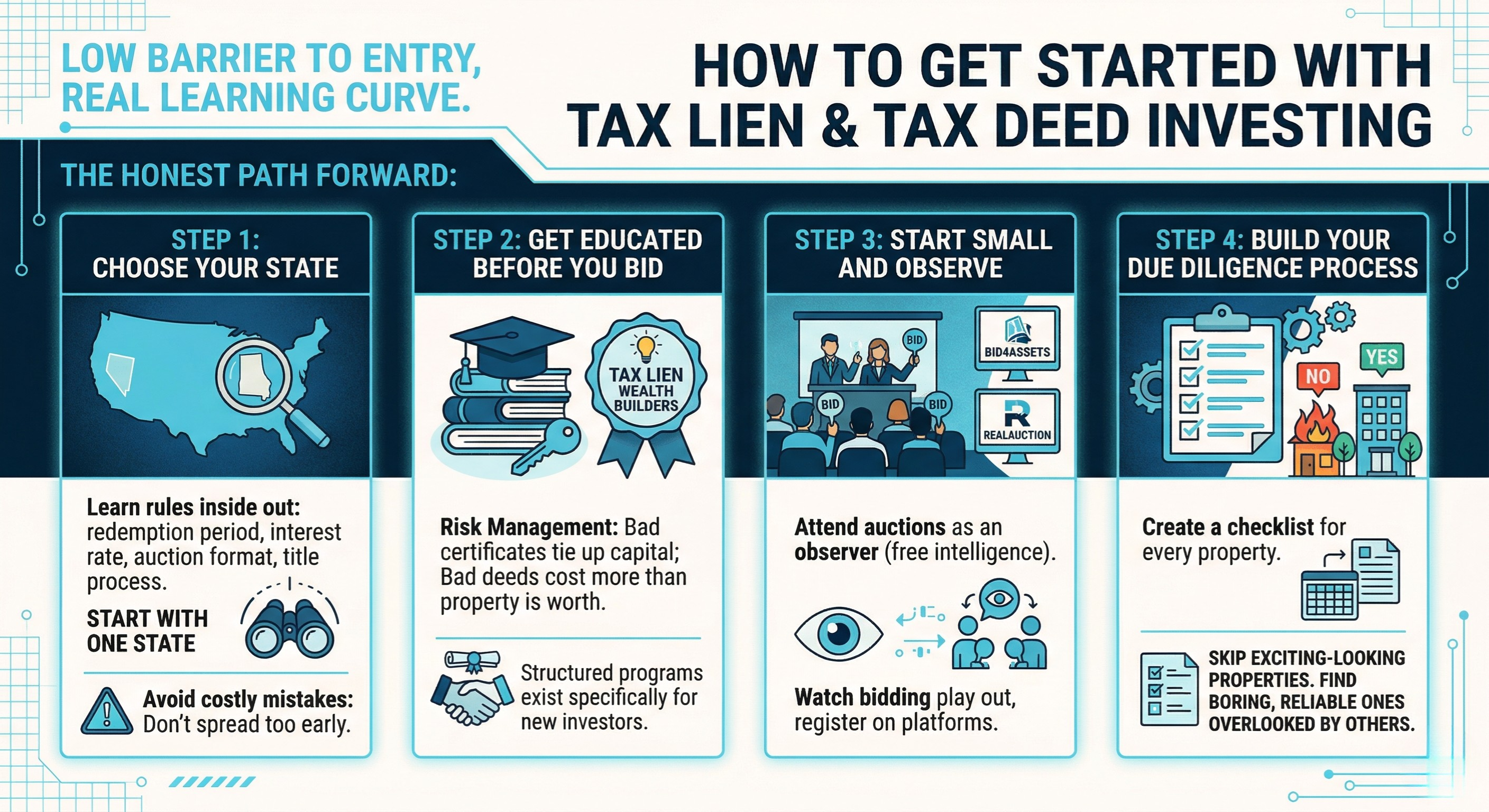
Step 1: Choose Your State
Start with one state. Learn its rules inside out — redemption period, interest rate, auction format, title process. Spreading across multiple states too early dilutes your focus and increases the chance of costly mistakes.
Step 2: Get Educated Before You Bid
Tax lien and tax deed auctions are not forgiving environments for uninformed bidders. A bad certificate can tie up capital for years. A bad deed purchase can cost more to resolve than the property is worth. Education isn't optional — it's risk management.
The structured programs at Tax Lien Wealth Builders exist specifically for this: investors who want to learn the system properly before deploying real capital.
Step 3: Start Small and Observe
Before bidding competitively, attend a few auctions as an observer. Register on platforms like Bid4Assets or RealAuction. Watch how bidding plays out. Note which certificates get competitive and which don't. This is free intelligence.
Step 4: Build Your Due Diligence Process
Create a checklist for every property you consider. The investors who consistently profit from this model aren't smarter — they're more systematic. They skip the exciting-looking properties that everyone is bidding on and find the boring, reliable ones that others overlooked.
Ready to stop researching and start investing? Tax Lien Wealth Builders offers the education and support to move from curious to confident. Explore the full program — or visit United Tax Liens to see how professional investors approach the process. |
Final Thoughts
Tax lien and tax deed investing are not the same thing — and the difference matters more than most beginners realize. One gives you a defined, interest-bearing claim on a property. The other gives you the property itself. Both can generate strong returns. Both require real knowledge to execute well.
The investors who do best in this space treat it like a business, not a lottery. They understand the rules of their target state, they run disciplined due diligence, and they don't let auction excitement override their numbers.
If you're serious about building wealth through tax yield investments, start with education. The Tax Lien Wealth Builders team has built a program around exactly that — and the United Tax Liens coaching team is available to help you apply it.