
Not every state treats tax lien investing the same way. Interest rates range from 8% to 36% depending on where you invest. Redemption periods run from one year to three or more. Some states hold their auctions entirely online — others require you to show up in person at a county courthouse.
The state you choose shapes everything: your potential return, your capital requirements, the time it takes to close out a certificate, and how much competition you face at auction. Getting this right is one of the most important decisions you'll make as a tax lien investor.
This guide breaks down the best states for tax lien investing in 2026 — covering interest rates, redemption timelines, auction formats, and what makes each market worth your attention. We also explain how to evaluate any state before you commit capital, and include a full reference table covering lien states, deed states, and hybrid states across the country.
Whether you're just getting started or looking to expand into a new market, this guide gives you what you need to invest with clarity.
How to Evaluate a State Before You Invest
Before diving into the top markets, it's worth understanding the criteria that actually separate a strong state from a weak one. A high statutory rate means nothing if competition drives your actual return to near zero. A long redemption periodThe legally defined timeframe during which a property owner can reclaim their property by paying the delinquent taxes plus interest and penalties. is a problem if you need to access your capital quickly. Evaluate each of the following before deciding where to invest.
1. Statutory Interest Rate or Penalty
The statutory rate is the maximum annual return the state allows on a tax lien certificate. Rates range from around 8% to 36%. Higher rates attract more competition, which often drives actual returns well below the legal maximum. Research what investors are realistically earning in a given county — not just what the statute permits.
2. Redemption Period
The redemption period is the window the property owner has to repay the delinquent taxes, accrued interest, and any applicable penalties. Most states offer between one and three years. Longer redemption periods mean more interest accumulates — but your capital stays illiquid for longer. Align this with your investment timeline before committing.
3. Bidding Method
States use two primary auction formats:
Bid down the interest rate: Investors compete by accepting progressively lower returns, starting from the statutory maximum. The lowest bid wins the certificate.
Premium bidding: Investors bid above the face value of the lien. The highest premium wins. Important caveat — if the owner redeems, you receive only the original lien amount plus interest, not your premium. Overbidding is the most common and most costly mistake in premium bidding states.
4. Online vs. In-Person Auctions
Many states have moved to fully online tax lien auctions, which opens the market to investors anywhere in the country. Others still require physical attendance. Online access is a significant advantage — it allows you to diversify across counties and states without travel costs.
5. Competition and Market Depth
Institutional investors dominate large urban counties in competitive states. Rural counties within those same states can offer dramatically better rates simply because fewer investors are paying attention. When evaluating a state, research at the county level — not just the state level. A state with a 36% statutory rate and a cutthroat Cook County market can sit next to a small county where you reliably earn 12%.
6. Property Value as a Safety Net
Tax liens are secured by real property. The property acts as collateral — if the owner never redeems and you move toward foreclosure, the property's value determines how whole you come out. Investing in markets with strong or stable property values reduces your downside. Always assess the underlying real estate, not just the lien.
The Best States for Tax Lien Investing in 2026
The seven states below are consistently the strongest markets for individual tax lien investors. Each is a true lien state — investors purchase the certificate, earn interest while the owner retains the right to redeem, and can pursue a tax deed only after the redemption period has expired without payment.
1. Florida
Interest Rate: | Up to 18% per year |
Redemption Period: | 2 years |
Auction Method: | Bid down the interest rate |
Online Auctions: | Yes — available across most counties |
Florida is the most recommended starting point for new tax lien investors, and it earns that reputation for concrete reasons. The statutory interest rate is 18% per year — one of the highest in the country — and the state has built out a robust online auction infrastructure that makes it fully accessible without travel. You can build a Florida portfolio from anywhere.
The bidding method is bidding down the interest rate. County auctions typically run May through June, with each of Florida's 67 counties holding its own sale on a separate schedule. Investors compete downward from 18% — the lowest bid wins the certificate. In high-competition counties like Miami-Dade, Broward, and Orange, rates are routinely driven to 0.25% or below. In smaller counties, winning rates of 5%–10% are common.
One important rule to know: Florida guarantees a minimum return of 5% on redemptions that happen within the first three months, regardless of the winning bid. If you won a certificate at 0.25% and the owner redeems in month two, you still earn 5% on that certificate. This protection makes ultra-low winning bids less catastrophic than they might seem.
After two years, if the owner has not redeemed, the certificate holder can apply for a tax deed sale — initiating the process that can ultimately transfer the property. This two-step structure (lien certificate first, deed sale later) is how most lien states operate.
Florida's size is a meaningful advantage. With 67 counties, hundreds of thousands of certificates issued annually, and a strong mix of urban and rural markets, you have enough inventory to build a diversified portfolio across risk levels and property types. For a beginner looking to learn the system without committing to a high-competition or high-capital market, Florida is the natural starting point.
2. Arizona
Interest Rate: | Up to 16% per year |
Redemption Period: | 3 years |
Auction Method: | Bid down the interest rate |
Online Auctions: | Yes — available in major counties |
Arizona offers a slightly lower statutory rate than Florida but compensates with a strong real estate market, solid online auction infrastructure, and significantly lower competition outside of Maricopa County (Phoenix). For investors willing to look beyond the largest market in the state, Arizona can deliver real returns at or near the statutory maximum.
Auction season runs February through March. Most major counties use online platforms, making it straightforward to participate as an out-of-state investor. The state uses the bid-down method — auctions open at 16% and investors compete downward from there.
The three-year redemption period is longer than Florida's two years, which means more interest accumulates if the owner holds the certificate for the full term. For investors focused on compound growth rather than quick turnover, this is an asset — a certificate running at 8% for three years without redemption generates a total return that a two-year period at the same rate cannot match.
Arizona's sun belt real estate market has historically maintained strong property values, which provides meaningful downside protection. If a certificate expires without redemption and you pursue a deed, you're more likely to be dealing with a property that holds real value.
For investors starting with smaller capital, several rural Arizona counties offer certificates at low face values — sometimes under a thousand dollars. This allows for broader diversification across multiple certificates without needing significant capital upfront.
3. New Jersey
Interest Rate: | Up to 18% per year + up to 6% redemption penalty |
Redemption Period: | 2 years minimum |
Auction Method: | Premium bidding |
Online Auctions: | Available in many counties |
New Jersey stands apart from most other tax lien states because of its two-layer return structure. In addition to the 18% annual interest rate, the state allows a redemption penalty of up to 6% of the lien face value, paid by the property owner when they redeem. This penalty is separate from and stacked on top of the accrued interest, which effectively increases total returns beyond what the interest rate alone suggests.
The auction format is premium bidding, which introduces a real due diligence challenge. Investors compete by bidding above the face value of the lien — the highest premium wins. If the owner redeems, you collect the original lien amount plus interest and penalty, but not your premium. You lose whatever you bid above face value. Discipline in premium calculation is essential. Overpaying on premium is the most common mistake in New Jersey — and it erases the advantage the penalty structure creates.
Entry costs are higher here than in most other states. New Jersey has some of the highest property values in the country, which means lien face values are often larger. This state tends to attract investors with more capital who are comfortable working through the mechanics of premium bidding and conducting thorough property analysis before bidding.
The upside is substantial when the numbers are right. New Jersey's real estate market is consistently strong, redemption rates are high, and when you combine the interest return with the penalty structure, the total yield on a fully redeemed certificate can outperform most other lien states on an absolute basis.
4. Iowa
Interest Rate: | 24% per year (2% per month) |
Redemption Period: | Approximately 2 years |
Auction Method: | Rotational system — no competitive bidding in most counties |
Online Auctions: | Limited — many counties still in-person |
Iowa has one of the highest statutory interest rates in the country at 24% annually — and it uses a system that eliminates the rate compression that makes competitive markets frustrating. Rather than a live auction where investors bid each other down, Iowa uses a rotational assignment method in many counties. Registered investors are assigned available liens in rotation at the full statutory rate. No bidding war. No rate compression. The 24% is the rate you actually earn.
When liens are not purchased through the rotation, they often become available over the counter — meaning you can buy them directly from the county treasurer's office at any time, again at the full 24% rate. This creates an ongoing opportunity to deploy capital outside of formal auction windows.
Iowa also holds scavenger sales for older, unpurchased liens — auctions where these accumulated certificates are sold at deeply discounted entry prices. The risk is higher, since liens that have gone unsold often reflect underlying property problems. But for investors with the research capability to screen these properties carefully, scavenger sales offer some of the lowest entry points in the state.
The primary downside is accessibility. Many Iowa counties still rely on in-person participation for the rotation system, which limits this market to investors willing to travel or build a local network. That in-person requirement is, paradoxically, one reason the market remains less crowded than Florida or New Jersey — the barrier filters out remote-only investors.
5. Indiana
Interest Rate: | 10–15% per 6-month redemption period |
Redemption Period: | 1 year |
Auction Method: | Premium bidding via centralized online system |
Online Auctions: | Yes — most counties use a centralized state platform |
Indiana is worth close attention because its one-year redemption period is one of the shortest of any lien state in the country. Capital turns over faster here than in states with two- to three-year windows, which can be a meaningful advantage for investors looking to redeploy earnings quickly.
Indiana's penalty structure works differently from a standard annual interest rate. Investors earn a 10% penalty on the lien amount for the first six months of the redemption period, and an additional penalty for the second six months if the owner redeems later. A quick redemption in the early months still yields solid annualized returns — the penalty structure front-loads the investor's return.
Most Indiana counties use a centralized online platform, which makes the state highly accessible to out-of-state investors. Tax sales run primarily in September and October, giving investors a defined annual window to deploy capital. The certificate of purchase issued at sale documents your lien position for the duration of the redemption period.
One nuance to understand in Indiana: investors who win a lien may need to pay subsequent taxes — taxes that come due on the property during the redemption period. Paying these is common practice. It protects your lien position by preventing new tax debts from becoming superior liens. All amounts paid as subsequent taxesAdditional property taxes that become due after the initial tax lien certificate is purchased. Lien holders may need to pay these to protect their investment. are recoverable from the property owner at redemption, so the cost is not lost — but it does require active monitoring of your certificates throughout the redemption window.
6. Colorado
Interest Rate: | Approximately 9–15% per year (set annually by formula) |
Redemption Period: | 3 years |
Auction Method: | Premium bidding |
Online Auctions: | Available in larger counties; smaller counties may be in-person |
Colorado's statutory rate is the lowest on this list, set annually using a formula tied to federal rates. In recent years it has ranged between 9% and 15%. For investors chasing 18%+ returns, this may appear underwhelming — but Colorado's real competitive advantage is the absence of competition in rural markets.
In smaller Colorado counties — populations under 50,000, outside the Front Range metro corridor — institutional investors are largely absent. Individual investors routinely win certificates at or very near the statutory maximum simply because fewer bidders are participating. The lower headline rate, combined with near-maximum real returns, can make rural Colorado more attractive than a higher-rate state where competition drives actual returns to 1%–2%.
The three-year redemption period means more total interest accumulates over the life of a certificate. Patient investors building a long-term passive income position benefit from this structure — certificates held to full term compound over a longer window than in one- or two-year states.
Colorado uses premium bidding, so the same discipline applies here as in New Jersey: calculate your maximum acceptable premium before bidding, and hold that line. In rural counties with lower competition, this is less of a concern — you often win without needing to pay any premium at all.
7. Illinois
Interest Rate: | Up to 18% per 6-month period (up to 36% annually) |
Redemption Period: | 2–3 years depending on property type and county |
Auction Method: | Bid down the penalty |
Online Auctions: | Available in Cook County and many downstate counties |
Illinois has the highest statutory return of any state on this list — up to 36% annually before bidding. In practice, the picture is more complex, and this market is not right for beginners. But for experienced investors who understand the system, downstate Illinois is one of the most compelling under-the-radar markets in the country.
Here is how Illinois works: the state auctions penalty rates rather than annual interest rates. The maximum penalty is 18% per six-month redemption period. Investors bid down this penalty at auction. Win at the maximum 18% for both six-month periods of a full redemption year, and your total return is 36%. Win at a competitively driven 1%, and your return collapses.
In Cook County (Chicago), institutional competition is intense. Rates at Cook County auctions are regularly driven down to fractions of a percent, wiping out the apparent advantage. The story is entirely different downstate. Counties like Sangamon, Winnebago, Peoria, and McLean see far less competition. Double-digit penalty rates on winning certificates are realistic in these markets.
Illinois also holds scavenger sales for liens that have remained unsold for two or more years. These are distinct from regular annual auctions — certificates at scavenger sales can be purchased for as little as a few hundred dollars, regardless of the original lien face value. The risk is elevated because chronically unsold liens often reflect distressed or problematic properties. Thorough property research and a solid understanding of the foreclosure process in Illinois are prerequisites before participating in scavenger sales.
States to Approach with Caution: Detailed Breakdown
Most investors start their state research by looking for the highest statutory interest rate. That's the wrong filter. Rate means nothing if the structure locks you out, competition erases your return, or the legal process turns a simple lien into a years-long legal headache. The states below deserve a closer look before you commit any capital — not because they're useless, but because each one has a specific characteristic that trips up investors who don't research deeply enough before bidding.
California
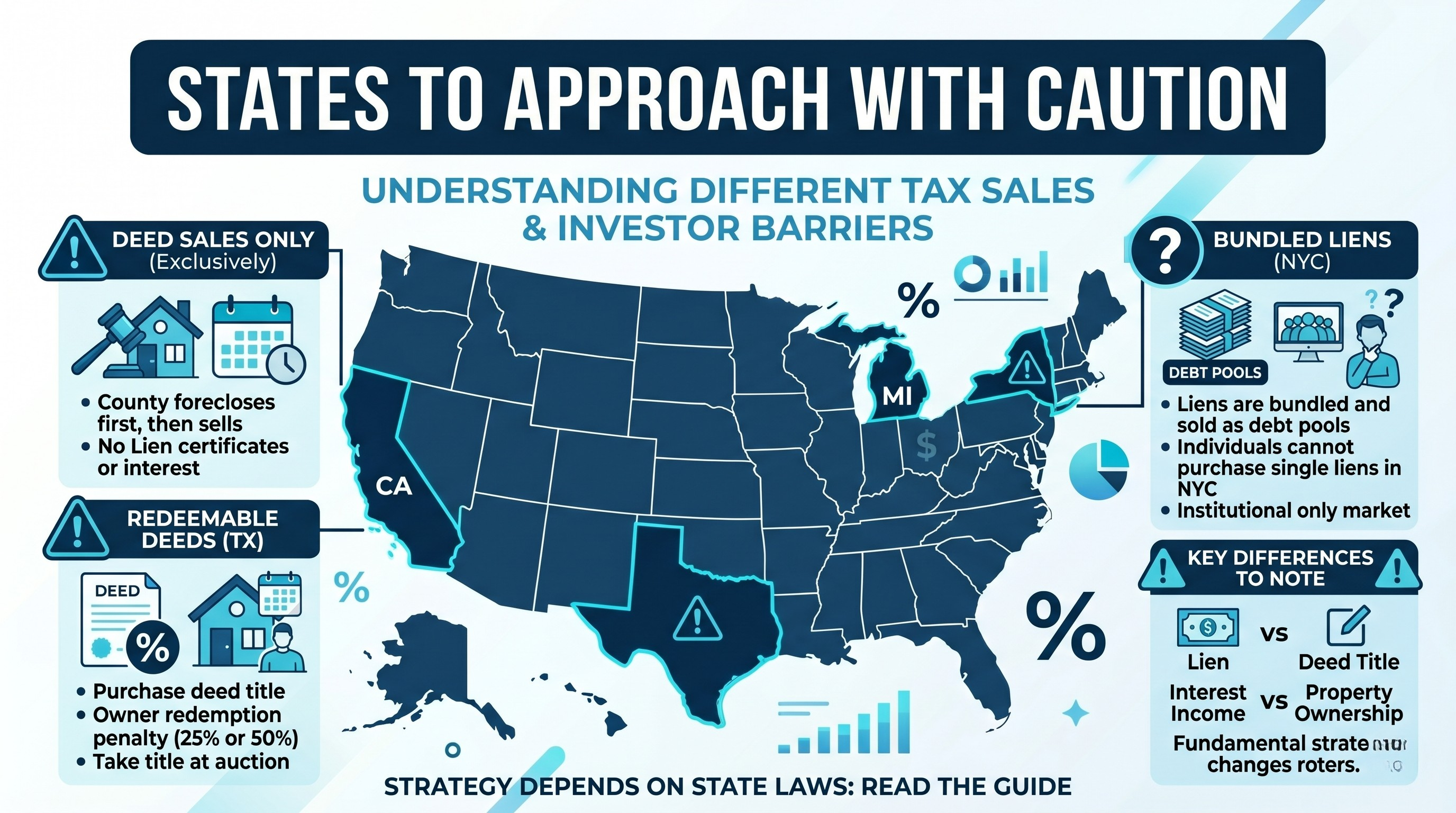
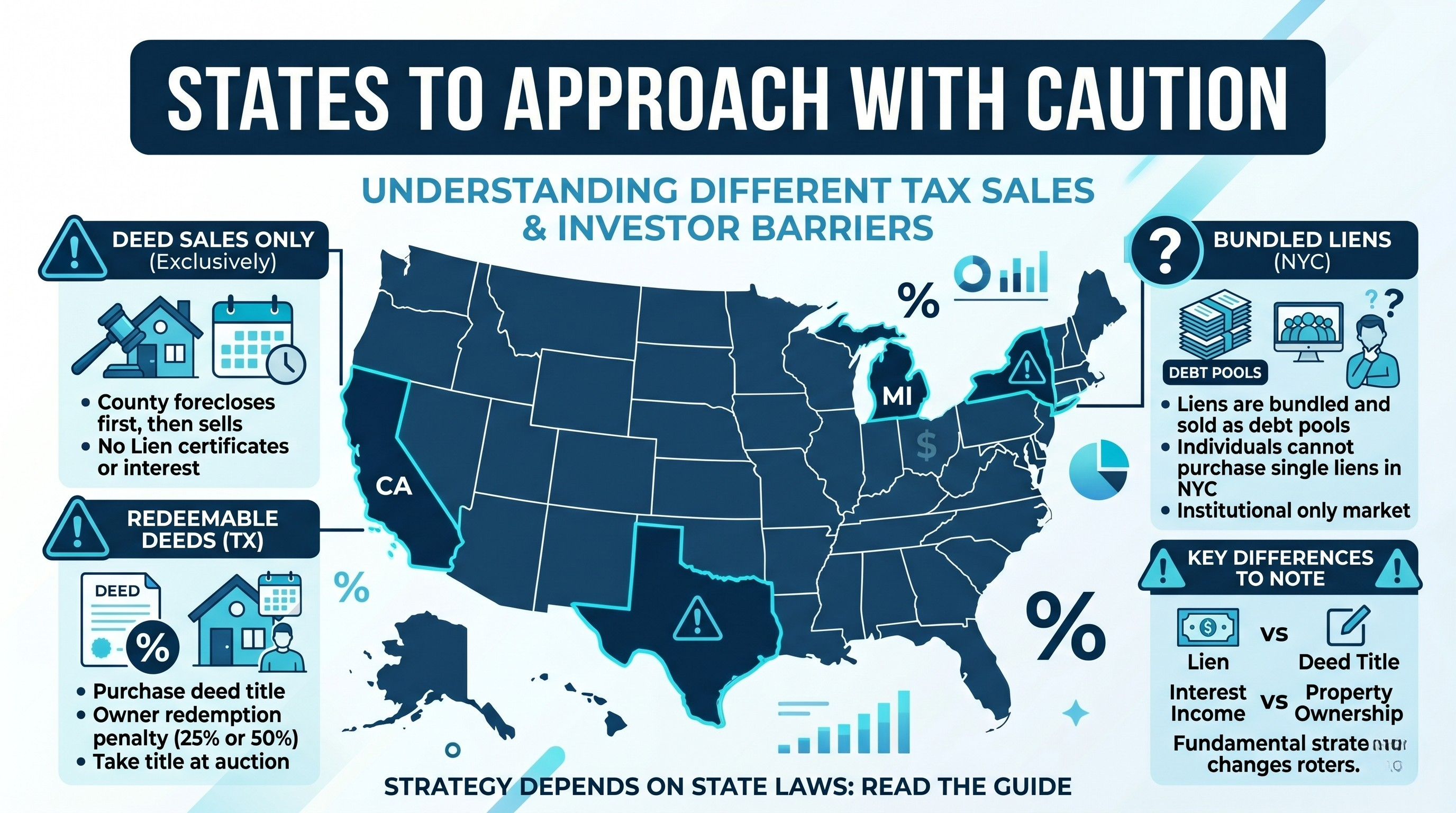
California does not sell tax lien certificates. It is a pure tax deed state, meaning the county holds delinquent properties through a five-year default period and then sells the physical property at a public auction — not the right to collect the debt. There is no certificate to purchase, no statutory interest rate to earn during a waiting period, and no passive income structure of any kind.
This matters because California has enormous name recognition and a real estate market that investors naturally gravitate toward. The assumption that California must have a tax lien program is common — and wrong. Investors who show up to California deed auctions expecting to earn interest income while an owner redeems will be disappointed. California deed sales can produce value for real estate investors willing to take on physical property, but the approach is entirely different from lien investing. You are bidding on a property, not a debt instrument. You need to understand the condition of the property, any existing encumbrances that may survive the tax deed, and the costs of managing or selling the asset after acquisition. If you are drawn to passive income through certificates rather than active property management, California is not your market.
Michigan
Michigan is also a tax deed state, operating under one of the more aggressive timelines in the country. Properties with three or more years of unpaid taxes are foreclosed by the county and offered at a public deed auction. Individual lien certificates do not exist in the Michigan system. The county absorbs the delinquency, processes the foreclosure internally, and then sells the resulting deed to the public.
Michigan deed auctions — particularly in Wayne County (Detroit) and surrounding areas — have attracted significant investor attention because properties can be purchased at very low prices. That low entry cost reflects real risk. Many properties in high-foreclosure Michigan counties have significant deferred maintenance, environmental concerns, code violations, or occupancy complications that create costs well beyond the auction price. Investors who have purchased Michigan deed auction properties without conducting thorough on-site due diligence have found themselves holding properties worth less than the remediation costs. If you pursue Michigan as a deed auction market, in-person property inspection before bidding is not optional. It is the minimum necessary standard.
Texas
Texas operates what is called a redeemable deed system. At a Texas tax sale, you are not purchasing a lien certificate — you are purchasing an actual deed to the property. The moment you win the auction, you are the legal deed holder. The original owner retains a right to redeem the property for a defined window: six months for non-homestead properties and up to two years for properties with a homestead exemptionA legal provision that reduces the assessed value of a primary residence for property tax purposes, lowering the tax bill and affecting lien amounts..
If the owner exercises that right of redemptionThe legal right of a property owner to reclaim their property after a tax sale by paying the full amount of delinquent taxes, interest, and penalties., they must pay you your full purchase price plus a 25% penalty within the first year. If they redeem in the second year on a homestead property, that penalty increases to 50%. On paper, this looks extraordinary — a 25% to 50% guaranteed return. In practice, the structure introduces complications that lien certificates don't carry.
First, you hold title to the property during the redemption window. That means you carry legal responsibilities as the deed holder — property taxes that come due during that period, potential liability questions, and the administrative burden of monitoring a property you do not actually control or occupy. Second, Texas real estate transactions involve closing costs, title work, and legal fees that reduce your net return from the stated penalty. Third, Texas deed auctions in competitive urban counties — Dallas, Houston, Austin, San Antonio — regularly see institutional bidding that drives prices above assessed value. When you overpay at auction and the owner redeems at a 25% penalty, your real return on the actual capital deployed can be much lower than the headline number suggests. Texas can work well for experienced deed investors who understand real estate valuation and are comfortable holding title during the redemption period. It is not a passive income system in the way lien certificates are.
New York
New York City's tax lien program is one of the most discussed and least accessible systems for individual investors in the country. Rather than selling individual certificates property by property, New York City bundles thousands of delinquent liens into large debt pools and sells those pools to institutional buyers — typically large financial entities that securitize the debt. An individual investor cannot walk into a New York City tax lien sale and purchase a single certificate the way they would in Florida or Arizona. The minimum investment to participate in the bundled pool sales is far beyond the reach of most individual investors, and the pools themselves are structured as debt instruments requiring institutional-level legal and financial infrastructure to manage.
Upstate New York counties operate differently and some do hold individual lien sales where private investors can participate. The statutory interest rate in New York is up to 20%, which is competitive. However, the upstate market is fragmented — each county runs its own process on its own schedule, with varying levels of transparency and online accessibility. For investors willing to research county-by-county and work through the administrative variation across the state, upstate New York has real opportunity. It requires significantly more groundwork than a state with a standardized, centralized auction system.
Ohio
Ohio is a tax deed state that has drawn investor interest because of low entry prices in markets like Cleveland, Akron, and Columbus. The county forecloses on delinquent properties and conducts a sheriff's sale, transferring the deed directly to the winning bidder. There are no lien certificates in the Ohio system.
The challenge in Ohio is what comes after you win. Ohio deed auction properties — especially in legacy industrial cities — frequently carry title complications, outstanding municipal liens for code violations or demolition orders, and condition issues that are invisible from the auction listing. Ohio also has specific rules around the quiet title actionA lawsuit filed to establish clear ownership of a property and resolve any disputes or claims against the title. process that deed auction buyers may eventually need to pursue to clear title sufficiently for resale or financing. A quiet title action in Ohio requires legal representation, court filings, and months of process time before the title is considered marketable. Budget for legal costs as a real line item, not an afterthought.
Georgia
Georgia operates a redeemable deed system similar in concept to Texas but with notable differences. Investors at Georgia tax sales purchase a deed to the property. The original owner has one year to redeem by paying the investor's purchase price plus a 20% penalty — regardless of whether the redemption happens on day one or day 364. The 20% penalty is not annualized — it is a flat penalty for any redemption within the year.
In theory, this means a very early redemption produces an extraordinary annualized return. A 20% flat penalty on a redemption in month two is the equivalent of over 100% annualized. In practice, the Georgia market has significant competition in suburban Atlanta counties, and the deed holding complications — legal title, property tax obligations during the redemption year, potential for occupied properties — add friction that pure lien certificate investing avoids. Georgia works well for investors who have real estate experience and are comfortable with deed holding mechanics. For investors seeking a passive, low-maintenance certificate income stream, the added complexity of deed title is a real operational consideration.
Washington and Oregon
Both Washington and Oregon are tax deed states with no lien certificate programs. Oregon uses a county-managed foreclosure system where properties are sold at public auction after the redemption period expires without any intermediate certificate stage. Washington operates similarly, with county treasurers conducting deed auctions for tax-delinquent properties. Neither state offers the certificate structure that generates passive interest income during the redemption window. Investors interested in these markets are making direct property purchases, not debt investments.
A note on hybrid and redeemable deed states generally: The line between "lien state" and "deed state" is not always clean. Several states operate hybrid systems — Indiana is a good example — where elements of both structures exist depending on the property type, county, or stage of the delinquency process. Before investing in any state, read the actual state statutes governing tax sales (most are publicly available through the state legislature's website) or consult a local tax lien attorney. Seminar materials and online summaries are useful starting points, but the statute is the controlling document. Rules change, statutory rates are periodically adjusted by the legislature, and counties within the same state can have meaningfully different procedures within the framework the state law allows.
Tax Lien States vs. Tax Deed States: Quick Reference Table
Understanding whether a state is a lien state, deed state, or hybrid is the foundation of any research process. The table below covers a broad range of states with key data points for reference. Always verify current statutory rates and rules with your county treasurer before investing — rates and procedures can change.
State | Type | Max Rate | Redemption Period |
Alabama | Redeemable Deed | 12% + 1%/mo | 3 years |
Arizona | Tax Lien | 16% | 3 years |
Arkansas | Redeemable Deed | 10%/6 months | 30 days–2 years |
California | Tax Deed | N/A | N/A |
Colorado | Tax Lien | 9–15% (varies) | 3 years |
Connecticut | Tax Lien | 18% | 6 months–1 year |
Florida | Tax Lien | 18% | 2 years |
Georgia | Redeemable Deed | 20% penalty | 1 year |
Illinois | Tax Lien | 36% (18%/6mo) | 2–3 years |
Indiana | Tax Lien (hybrid) | 10–15%/period | 1 year |
Iowa | Tax Lien | 24% | 2 years |
Kentucky | Tax Lien | 12% | 1 year |
Louisiana | Tax Lien | 5% + 1%/mo | 3 years |
Maryland | Tax Lien | 6–24% (varies by county) | 6 months–2 years |
Massachusetts | Tax Lien | 16% | 6 months–3 years |
Michigan | Tax Deed | N/A | N/A |
Mississippi | Tax Lien | 18% annual | 2 years |
Missouri | Redeemable Deed | 10%/year | 1 year |
Nebraska | Tax Lien | 14% | 3 years |
New Jersey | Tax Lien | 18% + 6% penalty | 2 years min |
New York | Varies by county | 20% | Varies |
Ohio | Tax Deed | N/A | N/A |
Oklahoma | Tax Lien | 8% | 2 years |
Oregon | Tax Deed | N/A | N/A |
South Carolina | Tax Lien | 8–12% | 1 year |
Texas | Redeemable Deed | 25–50% penalty | 6 months–2 years |
Vermont | Tax Lien | 12% | 1 year |
West Virginia | Tax Lien | 12% | 18 months |
Wyoming | Tax Lien | 15% | 4 years |
Note: Rates and redemption periods are subject to legislative change. Verify current rules with your county treasurer or a local tax lien attorney before investing.
Frequently Asked Questions
Which state is best for tax lien investing beginners?
Florida is the most commonly recommended starting point for new investors. The combination of a high statutory rate (18%), an online auction system accessible from anywhere in the country, a large volume of available certificates across 67 counties, and a well-documented process makes it easier to learn the fundamentals without needing significant travel or capital. Start with a small number of certificates in rural Florida counties where competition is lower, and build from there.
Can I invest in tax liens from out of state?
Yes. Many states now offer fully online auctions that allow investors to participate regardless of where they live. Florida, Arizona, Indiana, and Illinois (Cook County) are all accessible online. Some states and counties still require in-person attendance — Iowa is a notable example where in-person participation is common for the rotational system. Before committing to a market, confirm the auction format and any residency requirements with the county treasurer's office.
What happens if the property owner never redeems?
If the property owner fails to pay within the redemption window, the certificate holder gains the right to initiate a foreclosure process. The exact mechanics vary by state — in most lien states, this means applying for a tax deed, which triggers either a property transfer or a public deed auction. If the property sells at that auction, you are paid from the proceeds up to the value of your lien and accrued interest. The property itself typically covers your original investment if it has maintained any real market value.
How much money do I need to start investing in tax liens?
Entry costs vary widely by state and county. Some Florida and Iowa counties have certificates available for a few hundred dollars. A realistic portfolio that provides meaningful diversification across multiple certificates generally requires $5,000–$10,000 to start. Building a larger income stream requires more capital, but there is no mandated minimum. Starting small while you learn the process is a well-established approach — the goal is to understand how the system works in a real county before scaling up.
Are tax liens a safe investment?
Tax liens are secured by real property, which provides protection that unsecured investments lack. However, risk exists in this asset class like any other. Key risks include: environmental contamination on the underlying property, title issues that complicate the foreclosure process, a redemption period that ties up capital longer than planned, and competitive auctions that compress returns to near zero. A thorough title search before bidding on any certificate is one of the most important risk management steps available to investors. Tax liens are generally considered lower-risk than direct property speculation — but they are not risk-free, and no investment is.
What is the difference between a tax lien state and a tax deed state?
In a tax lien state, the county sells the right to collect the unpaid debt. You purchase a certificate, the owner retains title to the property, and you earn interest during the redemption window. If the owner doesn't pay, you can ultimately pursue a deed through the legal process. In a tax deed state, the county skips the lien step and sells the property itself after the redemption period expires. Lien investing is more passive and requires less capital per position. Deed investing puts you directly into property ownership from the moment you win the auction.
Ready to Start Investing in Tax Liens?
Knowing which states to target is the first step. The next is learning the mechanics — how to evaluate properties before bidding, how to protect your lien position during the redemption period, what to do when an owner doesn't redeem, and how to build a portfolio that generates consistent passive income.
Tax Lien Wealth Builders offers live workshops and hands-on training for investors at every stage — from complete beginners who have never attended an auction to experienced investors looking to expand into new state markets. The courses and live events at TLWB give you the tools, the mentorship, and the community to make this a real income stream, not just a concept.
If you prefer to start with online video training, the comprehensive courses at United Tax Liens walk through the full investing process in a self-paced format — covering due diligence, auction strategy, and redemption period management in detail. United Tax Liens is the online training counterpart to TLWB's live event program, and together they cover every learning style.
The market is open. Auctions are running. If you want to understand how to move from reading about tax lien investing to actually building a portfolio, exploring the United Tax Liens training library is a strong place to start your research before attending your first live event.